


Taking on a contractor sounds simple until you factor in IR35. Get the status determination wrong and HMRC can come back years later demanding unpaid tax, National Insurance, and penalties — not from the contractor, but from your business. This guide walks through exactly how to bring on a contractor the right way, from checking whether the rules even apply to you, through to paying them compliantly.
What Is IR35? The Off-Payroll Working Rules Explained
IR35, formally the off-payroll working rules, is tax legislation that stops workers from avoiding employment taxes by supplying their services through a limited company — usually a Personal Service Company (PSC) — when the actual working relationship looks like employment. If the relationship between you and the contractor mirrors employment in substance, HMRC expects PAYE tax and National Insurance Contributions (NICs) to be paid, even though the individual is technically self-employed on paper.
Why Does IR35 Exist?
The rules exist because a contractor working through a limited company pays less tax overall than an employee doing the same job. HMRC introduced IR35 to close that gap for “disguised employees” — people who work exactly like staff but are engaged as contractors purely for the tax advantage.
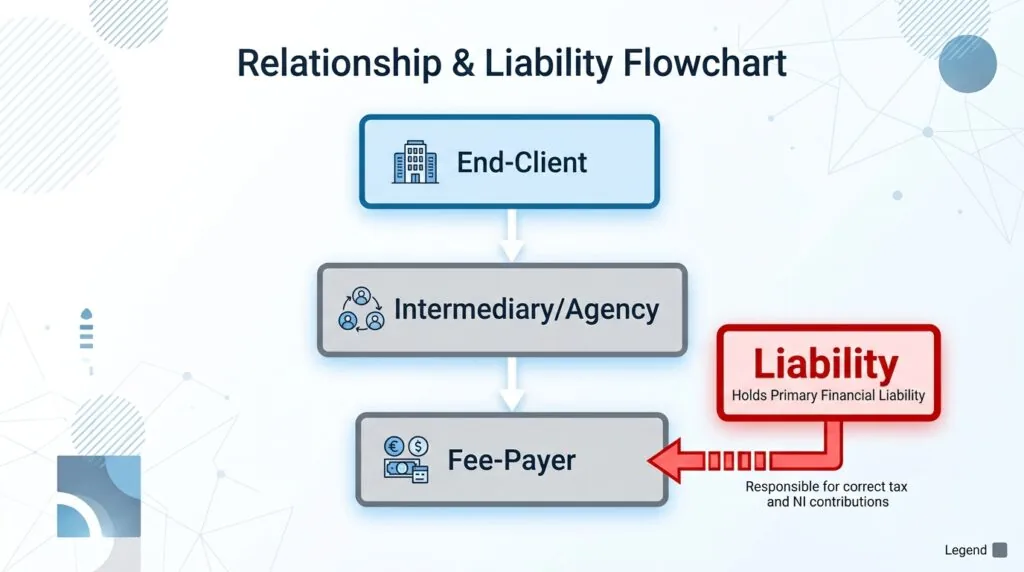
Who Holds the Liability? (The Client vs. The Intermediary)
Since the Finance Act 2020 reforms, liability for getting the determination right sits with the end-client in most cases — not the contractor. If you’re a medium or large business engaging a contractor through their PSC, you (or the fee-payer in the supply chain) carry the risk of an incorrect status decision. Small companies are the exception, covered below.
Does IR35 Apply to Your Business? The Small Company Exemption
Not every business has to make an IR35 determination. Under the Companies Act 2006, if your company qualifies as “small,” the responsibility for deciding IR35 status stays with the contractor’s own limited company, not with you.
The Companies Act 2006 Qualifying Criteria
A business qualifies as small if it meets at least two of the following three thresholds:
| Criteria | Threshold |
|---|---|
| Annual Turnover | £10.2 million or less |
| Balance Sheet Total | £5.1 million or less |
| Number of Employees | 50 or fewer |
What Happens if Your Business Is Exempt?
If you meet the small company exemption, you don’t need to issue a Status Determination Statement, and the contractor’s PSC is responsible for assessing IR35 status and paying any tax due. That said, many small businesses choose to assess status anyway, because getting it wrong still creates commercial and reputational risk, and because growth can push you over the threshold without warning.
Inside vs. Outside IR35: Key Differences at a Glance
| Factor | Inside IR35 | Outside IR35 |
|---|---|---|
| Tax treatment | Deemed employee — PAYE tax and NICs deducted | Contractor pays own tax via their limited company |
| Control | Client directs how, when, and where work is done | Contractor controls their own methods and schedule |
| Substitution | Contractor must do the work personally | Genuine right to send a substitute |
| Financial risk | None — paid regardless of outcome | Contractor bears risk (fixes errors unpaid, invests in own equipment) |
| Payment method | Deemed salary via payroll or umbrella company | Gross invoice payment to their PSC |
Inside IR35: The Deemed Employee
An “inside IR35” contractor is treated as an employee for tax purposes only. They still invoice through their limited company, but tax and NICs are deducted before they’re paid, as if they were on payroll.
Outside IR35: The Genuine Business-to-Business Engagement
An “outside IR35” engagement is a genuine business relationship. The contractor controls how the work gets done, carries real financial risk, and is free to send someone else to do the job. They invoice you gross, and their company handles its own tax.
The Three Pillars of IR35 Status Determination
Every credible IR35 assessment comes down to three legal tests, shaped by decades of employment tribunal case law, including the landmark Ready Mixed Concrete (South East) Ltd v Minister of Pensions and National Insurance [1968] ruling that still underpins how status is judged today.
1. Personal Service and the Right of Substitution
If a genuine, unfettered right of substitution exists — meaning the contractor could send a suitably skilled replacement and you’d have to accept them — that points firmly outside IR35. The key word is “genuine.” A substitution clause that’s never actually usable in practice (for example, because you retain the right to approve or reject any substitute for any reason) won’t hold up. To make this real, document at least one instance where a substitute was offered or used, and avoid contract wording that lets you refuse a substitute without cause.
2. Control (Supervision, Direction, and SDC)
This looks at how much say you have over how, when, and where the work is done. If you supervise the contractor’s day-to-day work, set their hours, or direct their methods the way you would an employee, that’s a strong indicator of Supervision, Direction, or Control (SDC), pushing the engagement inside IR35. Genuine contractors are told what outcome is needed, not how to achieve it.
3. Mutuality of Obligation (MOO)
MOO exists when you’re obliged to offer ongoing work and the contractor is obliged to accept it. A one-off, defined project with no expectation of further work afterward weakens MOO and supports an outside determination. This is the pillar competitors most often skip — and it matters, because HMRC’s own CEST tool doesn’t assess MOO at all, despite tribunals repeatedly treating it as a foundational test. Relying on CEST alone, without separately considering MOO, is one of the most common reasons a status determination unravels under HMRC scrutiny.
How to Take on a Contractor Under IR35: Step-by-Step Onboarding Workflow
To take on an independent contractor in the UK under IR35 rules, follow these steps:
- Determine your company size — check whether you qualify for the small company exemption.
- Assess employment status using the three pillars: substitution, control, and mutuality of obligation.
- Issue a Status Determination Statement (SDS) setting out the decision and the reasoning behind it.
- Align the written contract with reality — the Statement of Work must match actual working practices.
- Set up compliant payments — gross invoicing for outside IR35, payroll or umbrella company for inside IR35.
Step 1: Pre-Engagement Assessment & Status Determination
Do this before the contractor starts, not after. Use HMRC’s CEST tool as a starting point, but supplement it with a manual review of MOO, since CEST won’t catch it. Keep a written record of your reasoning — this demonstrates “reasonable care,” which matters if HMRC later challenges the decision.
Step 2: Issue a Status Determination Statement (SDS)
An SDS is a formal document stating the contractor’s status and the reasons for it. You’re legally required to share it with both the contractor and the fee-payer (usually the recruitment agency, if one is involved) before payments begin. If you don’t issue a valid SDS, you become the fee-payer by default and inherit full liability for any tax shortfall.
Step 3: Implement a Status Disagreements Process
If a contractor disputes your determination, you’re legally obliged to have a process for them to challenge it, and you must respond within 45 days. Ignoring a disagreement, or failing to have a process at all, is itself a compliance failure that HMRC can flag during an audit.
Step 4: Structuring the Contract (The Statement of Work / SOW)
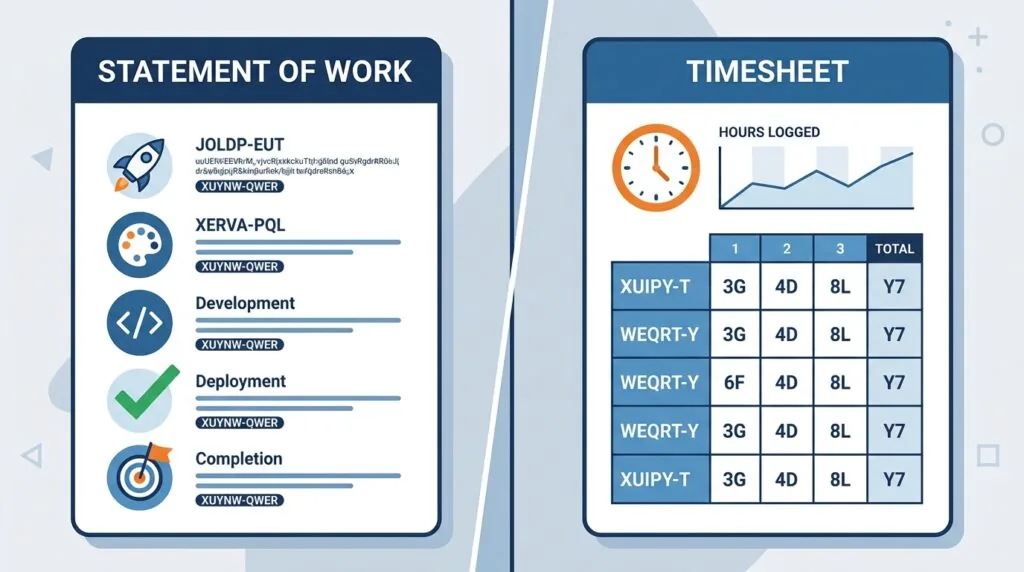
Don’t just reuse an employment contract template with the names swapped. For genuine outside IR35 work, use a Statement of Work built around deliverables and milestones, not hours worked. A time-and-materials contract that pays for hours logged looks far more like employment than a SOW that pays on completion of defined outputs. Specify what’s delivered, by when, and to what standard — not how the contractor’s day should be structured.
Step 5: Managing the Ongoing Working Practices
This is where most businesses fail. A perfectly drafted contract is worthless if daily practice contradicts it. If the paperwork says “no supervision” but a manager assigns daily tasks and reviews timesheets like an employee’s, HMRC will side with what actually happened. Review working practices every few months, especially on long-running engagements, since informal drift toward employee-style management is common and easy to miss.
How to Pay Your Contractors Legally Under IR35
Paying Outside IR35 Contractors (Gross Invoiced Payments)
Outside IR35 contractors invoice you directly through their PSC and are paid in full, without tax deducted. Their company then handles its own Corporation Tax, VAT (if registered), and any dividends they draw.
Paying Inside IR35 Contractors (Fee-Payer Deemed PAYE Payroll)
Inside IR35 contractors are paid through a deemed employment arrangement. The fee-payer deducts income tax and employee NICs before payment, and the fee-payer is also responsible for employer NICs and, where applicable, the Apprenticeship Levy — an added cost many businesses forget to budget for.
The Role of Compliant Umbrella Companies
Many businesses route inside IR35 contractors through an umbrella company, which acts as the legal employer and runs PAYE on their behalf. Only use umbrella companies checked against HMRC’s guidance on compliant providers — non-compliant “mini umbrella” schemes have been a major source of HMRC investigations, and using one doesn’t protect your business from liability if it turns out to be avoiding tax improperly.
Common Compliance Pitfalls and HMRC Audit Red Flags
- Copy-pasted employment contracts relabelled as consultancy agreements, with no real changes to substance.
- Substitution clauses that are never usable in practice, undermining an outside IR35 claim.
- Contractors on rolling engagements for years with no defined end point, weakening the MOO argument.
- Relying solely on CEST without documenting a manual review of Mutuality of Obligation.
- No SDS issued, or an SDS issued without genuine reasoning behind it.
- Contractors attending staff meetings, appraisals, or using an internal email signature and job title — all signs of integration that push toward “inside.”
- Providing equipment and requiring exclusivity, both of which resemble employment more than genuine self-employment.
Frequently Asked Questions (FAQs)
Does IR35 apply if I only take on one contractor?
Yes. IR35 applies per engagement, not based on how many contractors you use. A single contractor engagement still requires a status determination unless your business meets the small company exemption.
What happens if I get the IR35 determination wrong?
HMRC can pursue the end-client (or fee-payer) for unpaid PAYE tax, employer and employee NICs, interest, and penalties, sometimes going back several tax years.
Can a contractor be inside IR35 for one client and outside for another?
Yes. Status is assessed per engagement based on the specific working practices and contract terms of that particular relationship, not the contractor’s general status.
Is HMRC’s CEST tool reliable on its own?
CEST is a useful starting point but doesn’t assess Mutuality of Obligation, a factor tribunals have repeatedly treated as essential. Use it alongside a manual review, not as a standalone answer.
Do I need professional indemnity insurance when engaging outside IR35 contractors?
It’s not a legal requirement for IR35 purposes, but many genuine outside IR35 engagements include it as evidence of financial risk-bearing, which supports the “business on its own account” argument. See our guide to professional indemnity insurance for details.