


Full expensing lets a UK company deduct 100% of the cost of qualifying new plant and machinery from its taxable profits in the year it incurs the cost. At the 25% main rate of corporation tax, that saves 25p for every £1 relieved.
The relief is still in force in 2026, and it has no end date. But it is no longer the only allowance that matters. A new 40% first-year allowance started on 1 January 2026, and the main writing down allowance fell from 18% to 14% in April 2026. This guide shows who can claim full expensing, what qualifies, and which allowance to use for each purchase.
Full expensing at a glance (updated 21 September 2026)
- Rate: 100% first-year allowance on new main-rate plant and machinery
- Who: companies that pay corporation tax
- Special-rate assets: 50% first-year allowance for companies
- Annual Investment Allowance (AIA): £1 million a year, all businesses, new or used assets
- New from 1 January 2026: 40% first-year allowance for companies and unincorporated businesses, including UK leasing
- Writing down allowance (WDA): main pool 14% from April 2026 (was 18%); special rate pool 6%
- Not covered: cars, second-hand assets, most leased assets, connected-party purchases, buildings and land
What is full expensing?
Full expensing is a capital allowance that lets companies deduct 100% of the cost of qualifying new main-rate plant and machinery from taxable profits in the year the expenditure is incurred. It has no spending cap, applies only to companies, and has been permanent since the Autumn Statement 2023.
The UK got here in steps. The super-deduction gave companies 130% relief from 1 April 2021 to 31 March 2023. Full expensing replaced it on 1 April 2023 at 100%. It was due to end on 31 March 2026, but the Autumn Statement 2023 made it permanent, along with the 50% first-year allowance for special-rate assets.
Some guides say full expensing became permanent “from April 2026”. That was the date the temporary period would have ended. The relief itself has run without an end date since 2023.
How much tax does full expensing save?
At the 25% main rate, every £1 of relief saves 25p. A company that spends £200,000 on qualifying equipment cuts its tax bill by up to £50,000.
Smaller companies save less per pound. The small profits rate is 19% on profits up to £50,000. Between £50,000 and £250,000, marginal relief applies and the effective rate on extra profit is 26.5%. These limits shrink if you have associated companies. So “25p” is the headline figure, not a promise.
Who can claim full expensing?
Only companies within the charge to corporation tax can claim full expensing.
- Limited companies can claim it on their own spending.
- Corporate partners can claim on their share when a company is a partner in a partnership.
- Sole traders and partnerships of individuals cannot claim it. They use the AIA, the new 40% first-year allowance, and writing down allowances.
If you trade as an individual, the AIA covers most equipment spending under £1 million. Some owners look at moving from sole trader to limited company, but that is a wider tax decision, not just a capital allowances one. The same applies to LLPs, where the answer depends on who the members are.
One edge case: sole traders on the cash basis generally deduct equipment costs as an expense instead of claiming capital allowances. Cars are the exception, according to GOV.UK’s HS252 helpsheet.
What qualifies for full expensing, and what doesn’t?
New, unused plant and machinery that would normally go in the main pool qualifies for the 100% rate. New special-rate assets get the 50% rate instead.
Qualifying assets
- Machinery, tools and production equipment
- Computers, servers and other IT hardware
- Office furniture and fittings
- Commercial vehicles that are not cars, such as vans and lorries
- Capitalised software (you may need an election, so check with your accountant)
- 50% rate only: special-rate assets such as electrical systems, lighting, heating systems, solar panels and long-life assets
Exclusions
- Cars. They follow their own rules. New zero-emission cars get a separate 100% first-year allowance until 31 March 2027 for companies and 5 April 2027 for income tax.
- Second-hand or used assets. The asset must be new and unused.
- Assets bought to lease out. The exception is background plant and machinery leased as part of a building.
- Assets bought from connected parties. Group purchasing arrangements can trip this rule.
- Buildings, structures and land. Some structures may get the 3% Structures and Buildings Allowance instead.
Buying equipment on finance? Who counts as the owner for capital allowances depends on the deal, so read our asset finance guide and check the agreement’s terms first.
Full expensing vs AIA vs 40% FYA vs WDA: 2026 rates compared
Full expensing is one of four main ways to claim relief on equipment in 2026. The right one depends on your business structure, the asset type and how much you spend.
| Allowance | Rate | Who can claim | Cap | Best for |
|---|---|---|---|---|
| Full expensing | 100% | Companies only | None | New main-rate assets above the AIA |
| 50% first-year allowance | 50% | Companies only | None | New special-rate assets above the AIA |
| Annual Investment Allowance | 100% | All businesses | £1m a year | Most purchases, new or used |
| 40% first-year allowance | 40% | Companies and unincorporated | None | UK leased assets; unincorporated spend above the AIA |
| Main pool WDA | 14% (from Apr 2026) | All businesses | None | Second-hand assets and leftovers |
| Special rate pool WDA | 6% | All businesses | None | Special-rate balances |
| Structures and Buildings Allowance | 3% straight line | All businesses | None | Qualifying structures |
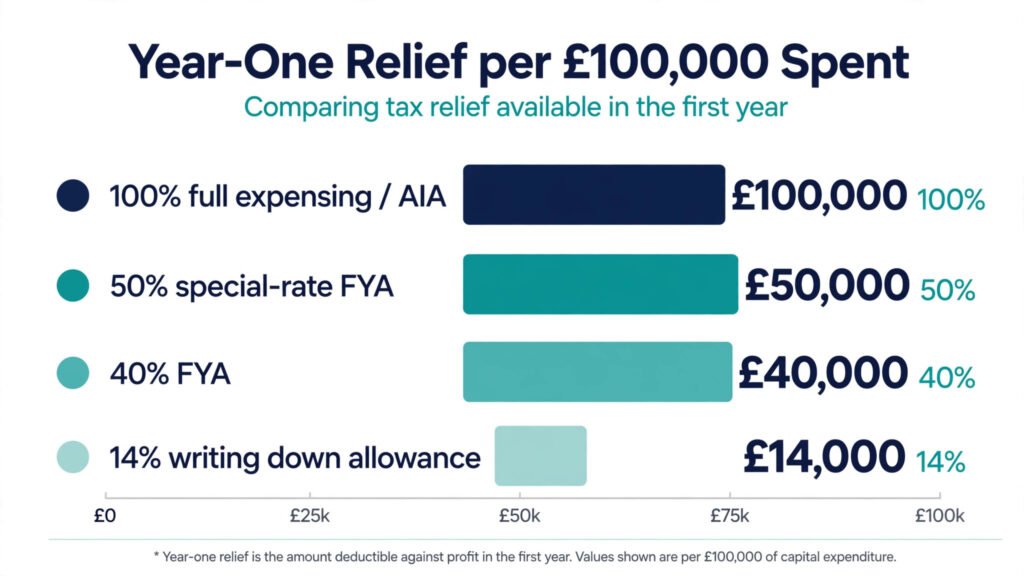
Year-one relief on £100,000 of spending
| Allowance | Year-one deduction | Tax saved at 25% |
|---|---|---|
| Full expensing or AIA | £100,000 | £25,000 |
| 50% first-year allowance (special rate) | £50,000 | £12,500 |
| 40% first-year allowance | £40,000 | £10,000 |
| Main pool WDA at 14% | £14,000 | £3,500 |
| Old 18% WDA (comparison) | £18,000 | £4,500 |
This assumes a 12-month period and a 25% tax rate. With the first-year allowances, the rest of the cost goes into a pool and starts earning writing down allowances from the next period.
Which allowance should you use first?
Work through these questions in order:
- Is it a car? Cars use their own rules and can’t use full expensing, the AIA or the 40% allowance.
- Is it a special-rate asset? Use the AIA first. Above the cap, companies get the 50% allowance. Unincorporated businesses fall back to 6%, because the 40% allowance doesn’t cover special-rate spending.
- Is it new, main-rate and owned by a company? Advisers such as PwC and Price Bailey usually favour the AIA first because disposal proceeds are treated less harshly. Use full expensing for the rest.
- Is it leased in the UK, or are you unincorporated and past the AIA? Claim the 40% first-year allowance.
- Is it second-hand? Use the AIA if you have room. Otherwise it goes into the pool at 14%.
The £1 million AIA is shared across groups and companies under common control, so check how much is left before you plan.
What changed in 2026?
Three things changed. A new 40% first-year allowance began, the main WDA fell to 14%, and the zero-emission car allowance was extended. Full expensing and the AIA stayed as they were.
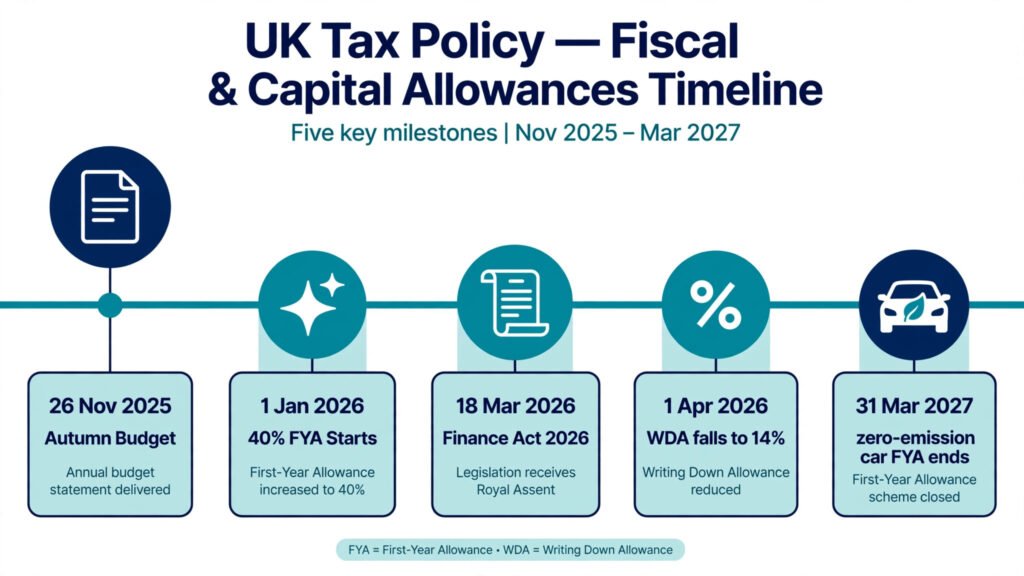
The changes were announced at the Autumn Budget on 26 November 2025. Finance Act 2026 received Royal Assent on 18 March 2026.
- 1 January 2026: 40% first-year allowance starts for companies
- 1 April 2026: main pool WDA drops to 14% for corporation tax
- 6 April 2026: the same WDA cut applies for income tax
- 31 March 2027 / 5 April 2027: 100% first-year allowance for zero-emission cars and EV charge points ends unless extended
The new 40% first-year allowance
The 40% allowance applies to new main-rate plant and machinery that doesn’t qualify for full expensing or another first-year allowance. It fills two gaps: unincorporated businesses and leased assets.
- Who: companies, sole traders and partnerships
- Leasing: it covers most assets leased for use in the UK, but not overseas leasing
- Excluded: cars, second-hand assets and special-rate assets
- How it works: you claim 40% in year one, and the other 60% enters the main pool and earns 14% from the next period
For companies, it applies to spending incurred on or after 1 January 2026. Sole traders and partnerships should confirm their start date. Most guidance points to 6 April 2026, and HMRC’s Capital Allowances Manual (CA23195 onwards) sets out the detail.
The cut to 14%, and the hybrid rate
The lower rate hits your existing pool balance straight away. There is no transitional protection for assets already in the pool.
If your accounting period spans the change date, you use a blended “hybrid” rate. It weights the days before and after the change and rounds up to two decimal places. HMRC’s example is a company with a 1 January to 31 December 2026 period: 90 days at 18% and 275 days at 14% gives 14.99%.
On a £1 million pool, that is £149,900 of relief instead of £180,000. The relief isn’t lost. It is spread over more years.
What didn’t change
Full expensing stays at 100%. The AIA stays at £1 million. The 50% special-rate allowance and the 6% special-rate WDA also stay. Rules can change at any Budget, so check GOV.UK before you commit to a large purchase.
Worked examples
A company buys a £1.4 million production line. It claims £1 million under the AIA and £400,000 under full expensing. The total deduction is £1.4 million, saving up to £350,000 at 25%.
A sole trader buys £1.2 million of equipment. The AIA covers £1 million. The 40% allowance gives £80,000 on the other £200,000, assuming it applies to their period. The year-one deduction is £1,080,000. The remaining £120,000 goes into the pool at 14%.
A leasing company buys £500,000 of new equipment for UK customers. Full expensing and the AIA aren’t available. The 40% allowance gives £200,000 in year one, worth £50,000 at 25%. The other £300,000 earns 14% later.
A company has a £250,000 main pool. The WDA falls from £45,000 to £35,000 a year (18% to 14%). That is £10,000 less relief and about £2,500 more tax at 25%.
How to claim full expensing
You claim full expensing in your company’s tax computation and Company Tax Return (CT600). Here are the steps:
- Find the date the cost was incurred. Full expensing is a first-year allowance, so you claim it in the period the cost is “incurred”. That is a technical tax term and isn’t always the payment date.
- Check the asset. It must be new, unused and main-rate, and not a car, a leased asset or a connected-party purchase.
- Use the AIA first where it fits. Then apply full expensing to the rest.
- Include the claim in your tax computation and CT600.
- Keep evidence. That means invoices, contracts, delivery notes and an asset register.
You can choose to claim less than the full amount. That can help if profits are low and you want to avoid creating a loss. Sole traders will find the basics in our guide to record-keeping requirements.
What happens when you sell an asset? The balancing charge
When you dispose of an asset that had full expensing, the sale proceeds are taxed as a balancing charge in the period of sale. This works differently from pooled assets, where proceeds usually reduce the pool instead.
For example, a company claims full expensing on £1 million of equipment in 2026 and sells it for £500,000 in 2028. The £500,000 is taxable in 2028. With the 50% special-rate allowance, only half of the proceeds are taxed on receipt. The other half reduces the special rate pool.
Disposal includes selling, scrapping or giving assets away. If you are selling property with fixtures, a section 198 election can help manage the clawback. If you are selling the whole business, how the price is split across assets affects the charge, so plan ahead with our guide to selling a small business.
Planning points and common mistakes
- Watch the timing. Full expensing is a first-year allowance. You can’t move earlier spending into a later period, and professional fees on multi-year projects need care.
- Check connected parties. Buying from a group company can remove the relief.
- Plan for losses. Full expensing can create a loss. You can carry it back to an earlier period or forward. Large losses carried forward can face annual restrictions.
- Recalculate your pools. Anyone with a large existing main pool now gets 14%, not 18%.
- Look at other reliefs. Research and development allowances can give 100% relief on assets used exclusively for qualifying R&D. Freeport and investment zone sites have their own allowances.
- Expect deferred tax. Allowances usually outpace accounting depreciation, so deferred tax on the balance sheet grows. Many accounting software options can track fixed assets.
- Don’t trust stale guides. Pages that quote an 18% WDA, or that say the 40% allowance excludes leasing, are out of date.
- Keep your evidence. HMRC can enquire into claims, and time limits apply to claims and amendments.
Full expensing FAQ
Is full expensing permanent?
Yes. The Autumn Statement 2023 made full expensing and the 50% first-year allowance permanent. They started on 1 April 2023 with no end date, and the Autumn Budget 2025 left them unchanged. Future Budgets could still change the rules.
Can sole traders claim full expensing?
No. Full expensing is for companies only. Sole traders and partnerships of individuals can use the £1 million AIA, then the 40% first-year allowance on eligible main-rate spending above it. Writing down allowances cover the rest.
Does full expensing apply to leased assets?
Generally no. Assets bought to lease out are excluded, except background plant and machinery leased with a building. Since 1 January 2026, the 40% first-year allowance can cover most UK leasing instead. Overseas leasing is excluded.
Can I claim full expensing on a company car?
No. Cars can’t use full expensing, the AIA or the 40% allowance. New zero-emission cars get a separate 100% allowance until 31 March 2027 for companies. Other cars go into the main pool at 14% or the special rate pool at 6%, depending on CO2 emissions.
Can I claim full expensing on second-hand equipment?
No. Full expensing needs new, unused assets. Used equipment can still qualify for the AIA up to £1 million. Beyond that it goes into the main pool at 14%. The 40% allowance also excludes second-hand assets.
Is full expensing better than the AIA?
Not always. Both give 100% relief in year one, but the AIA is capped at £1 million and is less harsh on disposal. Many advisers use the AIA first and full expensing for spending above the cap.
Your next step
List your planned purchases, mark each as new or second-hand, main or special rate, and owned or leased. Then match each one to an allowance using the ladder above. For large or complex spending, get a qualified adviser to check the claim before you buy. GOV.UK’s full expensing guidance is the official reference.
This guide is general information based on the rules in force at 21 September 2026. It isn’t tax advice.