
If you’re paying subcontractors, or being paid as one, on a UK construction job, HMRC expects you to be registered under the Construction Industry Scheme. Get it wrong and the taxman takes 30% instead of 20% off every payment. This guide walks through exactly who needs to register, what you need before you start, and the step-by-step process for contractors, subcontractors, and businesses based outside the UK.
What Is the Construction Industry Scheme (CIS)?
The Construction Industry Scheme (CIS) is a set of HMRC rules that control how contractors pay subcontractors for construction work in the UK. Under CIS, the contractor deducts money from a subcontractor’s payment and sends it straight to HMRC, as an advance payment toward that subcontractor’s own tax and National Insurance bill.
HMRC introduced CIS to cut down on tax evasion in an industry where a lot of work is done on a self-employed, cash-in-hand basis. Instead of trusting subcontractors to declare their income at year-end, the scheme collects tax at source, the same way PAYE works for employees, except subcontractors remain self-employed and settle any balance through Self Assessment.
How CIS Deductions Work
Here’s the basic flow:
- A subcontractor invoices a contractor for work completed.
- The contractor checks (verifies) the subcontractor’s CIS status with HMRC.
- The contractor deducts the correct percentage from the labour part of the invoice.
- The contractor pays the subcontractor the net amount.
- The contractor sends the deducted tax to HMRC and reports it on a monthly return.
The subcontractor then claims the deducted amount back against their tax bill at the end of the year. If too much was deducted, they get a refund.
Do You Need to Register for CIS?
Whether you need to register depends on which side of the transaction you’re on. Contractors must register before making any payments. Subcontractors technically don’t have to register, but if they don’t, they lose 30% instead of 20% on every payment, so in practice almost every working subcontractor registers.
Who Counts as a Contractor
You’re a contractor for CIS purposes if either of the following applies:
- You pay subcontractors to do construction work.
- Your business isn’t in construction, but you’ve spent more than £3 million on construction in the 12 months since your first payment. This is known as being a “deemed contractor” and it catches property developers, retailers, and other businesses that commission large building projects even though building isn’t their trade.
Who Counts as a Subcontractor
You’re a subcontractor if you do construction work for a contractor, whether you’re a sole trader, a partner, or trading through a limited company.
Can You Be Both a Contractor and a Subcontractor?
Yes, and it’s common. A small building firm might take on subcontractors for a big job while also working as a subcontractor for a larger main contractor on a different site. If this applies to you, you register for both roles separately, and you must meet the obligations of each: making deductions from the people you pay, while having deductions made from what you’re paid.
Work That’s Excluded from CIS
Not every task on a construction site falls under CIS. Architecture, surveying, scaffolding hire (without labour), and carpet fitting are generally outside the scheme. Broadly, CIS covers site preparation, alteration, construction, repairs, decorating, and demolition. If you’re unsure whether specific work counts, HMRC’s CIS guidance lists included and excluded operations in detail, and it’s worth checking before you assume either way.
If you’re also weighing up whether a worker should be on CIS or treated as an employee under IR35, our guide on taking on a contractor under IR35 rules covers that distinction.
What You Need Before You Register
Getting your paperwork together first makes the actual registration quick. Here’s what you’ll need, by business type.
For Sole Traders and Subcontractors
- Your legal business name (and trading name, if different)
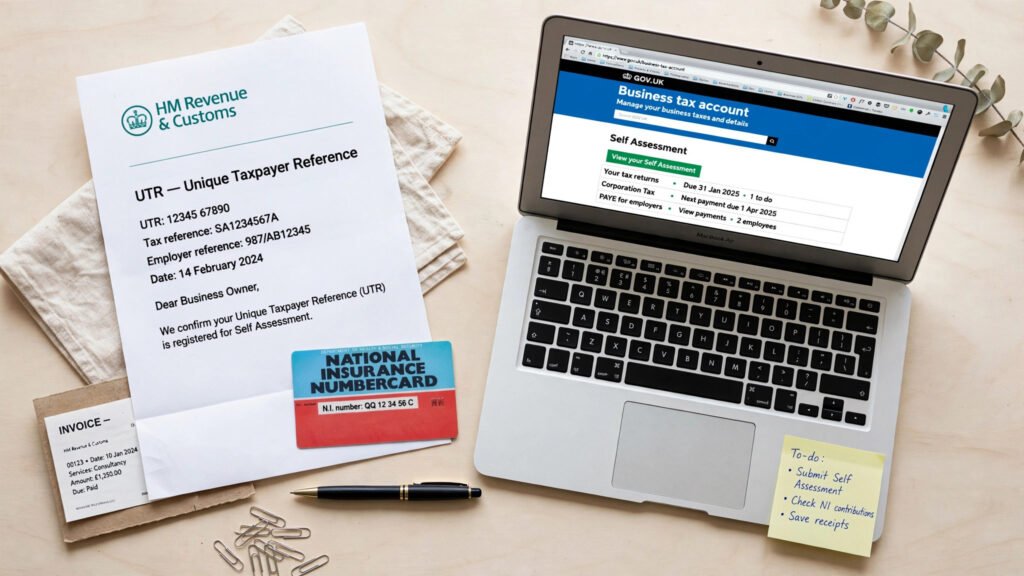
- Your Unique Taxpayer Reference (UTR)
- Your National Insurance number
- Your VAT registration number, if you’re VAT registered
- The date you started trading
If you don’t have a UTR yet, you’ll need to register for Self Assessment first, or do it at the same time as your CIS registration (more on that below).
For Partnerships
You’ll need everything a sole trader needs, plus the UTR and National Insurance number of each partner, and the partnership’s own UTR.
For Limited Companies
- The company’s legal name and registered office address
- The company’s UTR (from Corporation Tax registration)
- The Company Registration Number
- A live Corporation Tax record with HMRC
If You’re Based Outside the UK
CIS applies to construction work carried out in the UK, regardless of where your business is based. Sole traders and partnerships based abroad follow the same rules as UK-based ones. Limited companies must register before starting work and will need an original tax clearance certificate from their home country’s tax authority, plus a completed form 64-8 if an agent is handling the application on their behalf.
How to Register for CIS: Step-by-Step
Step 1: Register for Self Assessment or Corporation Tax First
You can’t register for CIS in isolation. Sole traders and partners need a live Self Assessment record; if you haven’t registered as self-employed yet, you can do this and register for CIS in the same online process by selecting “working as a subcontractor” when prompted. Limited companies need a live Corporation Tax record instead. If you haven’t set up as self-employed at all yet, our guide to registering for Self Assessment walks through that first step.
Step 2: Register Online via Government Gateway
The quickest and most reliable route is HMRC’s online service. You’ll need a Government Gateway user ID; if you don’t have one, you can create one during the application. Sign in, follow the prompts, and confirm your registration type.
Step 3: Choose Your Registration Type
When you register online, you’re registered for “net payment status” (also called “payment under deduction”) by default, meaning contractors will deduct 20% from your payments. You can apply for gross payment status at the same time or later, once you meet the eligibility tests covered below.
Step 4: Register by Post, If You Prefer
If you can’t or don’t want to register online, you can post a paper form. Which one you need depends on your setup:
| Business type | Registration route | Paper form |
|---|---|---|
| Sole trader (payment under deduction) | Online or post | CIS301 |
| Sole trader (gross payment) | Online or post | CIS302 |
| Partnership | Online or post | CIS304 |
| Company or unincorporated body | Online or post | CIS305 |
Postal applications take longer to process, so use them only if the online service genuinely isn’t an option for you.
How Long Does CIS Registration Take?
Online registration is usually processed within a few days, and you can check progress if you registered as a new business for Self Assessment at the same time. Postal applications typically take several weeks, since HMRC has to key in paper forms manually and, in some cases, carry out identity checks before confirming your registration. Build in extra time if you’re registering by post ahead of a start date on a job.
CIS Deduction Rates Explained
There are three CIS deduction rates, and which one applies to you depends entirely on your verification status with HMRC, not on anything the contractor decides.
| Rate | Who it applies to |
|---|---|
| 0% | Subcontractors with gross payment status |
| 20% | Subcontractors registered for CIS (standard rate) |
| 30% | Subcontractors who aren’t registered, or whose details HMRC can’t match |
Deductions are only calculated on the labour part of an invoice. Genuine materials costs, VAT, and certain other items like plant hire and consumable stores are stripped out first.
Worked Example
Say a subcontractor invoices a contractor £5,000 for a job, and £1,200 of that covers materials they paid for directly.
- Total payment (excluding VAT): £5,000
- Less materials: −£1,200
- Labour element subject to CIS: £3,800
- CIS deduction at 20%: −£760
- Net amount paid to subcontractor: £4,240
If that same subcontractor wasn’t registered, the deduction would jump to 30% of £3,800, which is £1,140, leaving them £3,860. That £280 difference on a single invoice is exactly why registration matters, and on a full year of work it adds up to a serious dent in cash flow.
Gross Payment Status: Is It Worth Applying?
Gross payment status means a contractor pays you in full, with no deduction, and you handle all your own tax and National Insurance through your tax return or company accounts. It’s attractive for cash flow, but HMRC only grants it to subcontractors who pass three tests.
Eligibility Tests
- Business test: your business must carry out construction work, or provide labour for it, in the UK, and be run through a bank account.
- Turnover test: you need a minimum annual turnover, generally at least £30,000 for a sole trader, with higher thresholds for partnerships and companies depending on the number of partners or directors.
- Compliance test: you must have a clean record of paying tax and National Insurance on time, and filing returns on time, in the period before you apply.
How to Apply
You can apply for gross payment status when you first register for CIS, or later once your business meets the criteria. HMRC reviews your business, turnover, and compliance history before deciding.
The 2026 Rule Changes You Need to Know About
Gross payment status carries more risk than it used to. Recent changes to Finance Act 2004 s.66 give HMRC power to cancel gross payment status immediately, with no prior notice, where they find grounds connected to fraud, in addition to the existing annual compliance review.
The bigger change is what happens if you lose it that way: the reapplication ban has been extended from one year to five years. During that period, you’re back on 20% (or 30% if unregistered) deductions on every payment, which can be a severe cash flow hit for a business that had structured its finances around gross payments.
There’s also a new personal liability risk. If HMRC can show a contractor knew, or should have known, that a transaction was connected to fraud, that contractor can be made liable for the lost tax, even if their own tax affairs are fully in order. Penalties of up to 30% of the lost tax can be charged not just to the business, but personally to directors and other individuals connected to it.
Practical takeaway: if you hold gross payment status, treat it as an asset that needs active protection. File on time, every time, keep clean records, and do basic due diligence on the subcontractors you engage. If you’re still building out your record-keeping processes, our guide on sole trader record-keeping requirements is a useful starting point, and good accounting software makes staying compliant far easier; see our comparison of Xero vs QuickBooks for UK small businesses if you’re choosing a system.
What Happens After You Register
If You’re a Contractor: Verification and Monthly Returns
Once registered, contractors have ongoing duties, not just a one-off form:
- Verify every subcontractor with HMRC before paying them for the first time, to confirm their registration status and correct deduction rate.
- Deduct the correct rate (0%, 20%, or 30%) based on HMRC’s response.
- Pay deductions to HMRC by the 22nd of the month if paying electronically (19th if by post) for the previous tax month.
- File a monthly CIS return, even if you haven’t paid any subcontractors that month, known as a nil return, by the 19th of the following month.
- Provide a payment and deduction statement to each subcontractor you’ve paid, within 14 days of the tax month ending.
Missing these deadlines, even for a nil return, can trigger automatic HMRC penalties.
If You’re a Subcontractor: What to Expect
You’ll receive a monthly statement from each contractor showing what they paid you and what they deducted. Keep these safe. You’ll need them to complete your Self Assessment return and claim credit for tax already deducted at source. If the deductions taken across the year add up to more than your actual tax bill, you’re due a refund.
Penalties for Not Registering or Getting It Wrong
The immediate penalty for not registering as a subcontractor is the higher 30% deduction rate rather than 20%, which is effectively a built-in financial penalty applied to every payment you receive.
For contractors, the consequences of getting CIS wrong are more serious:
- Late filing penalties start at £100 for a return that’s one day late, rising to £200 after two months, and can reach £300 or 5% of the deductions on the return (whichever is higher) after six months. After 12 months, penalties can climb to the greater of £3,000 or 100% of the tax due if information has been deliberately withheld.
- Incorrect verification or deduction rates can leave a contractor liable for tax they should have deducted but didn’t.
- Gross payment status revocation for compliance failures, with a five-year ban on reapplying under the 2026 rules, as covered above.
- Personal liability for directors in cases connected to fraud, alongside standard business penalties.
If you’re setting up a limited company and want to understand your broader legal duties, our overview of company director responsibilities in the UK is a helpful companion read.
CIS Registration FAQs
Do I need a UTR before I register for CIS?
Yes, for the standard route. If you don’t already have a Unique Taxpayer Reference, you can get one by registering for Self Assessment as a new business, choosing “working as a subcontractor” during that process. This registers you for Self Assessment and CIS together, so you don’t need to apply twice.
Can I register for CIS without being self-employed yet?
No. You need a live Self Assessment record (for sole traders and partners) or a live Corporation Tax record (for companies) before, or at the same time as, your CIS registration. The two are linked; CIS isn’t a standalone registration.
How do I check my CIS registration status?
If you registered online, you can sign in to your Government Gateway account and check your CIS online service. If you registered by post or as part of a new Self Assessment application, HMRC will send confirmation once processing is complete; you can check expected reply timeframes through your online account in the meantime.
What’s the difference between CIS and Self Assessment?
Self Assessment is the annual process where you report your total income and calculate your final tax bill. CIS is a monthly deduction-at-source system that collects tax in advance throughout the year. The two work together: CIS deductions taken during the year are offset against the final bill you calculate through Self Assessment.
Do I need to register if I only do one construction job?
Technically, subcontractor registration isn’t compulsory even for a single job, but if you’re not registered, the contractor must deduct 30% instead of 20%. For most people, registering before the first invoice is worth it purely on cash flow grounds, even for short-term or one-off work.
Can I register for CIS and gross payment status at the same time?
Yes. You can apply for gross payment status as part of your initial CIS registration, provided you already meet the business, turnover, and compliance tests. If you don’t meet them yet, you register at the standard 20% rate and can apply for gross payment status later once your business qualifies.
Registering correctly for CIS is a one-time task that pays off every month afterward, in the form of a lower deduction rate and a much smoother relationship with HMRC. If you’re setting up your wider business admin alongside CIS, from bookkeeping to invoicing, it’s worth getting the rest of your systems in order too; our guide to free accounting software for UK small businesses is a good next stop.