
The VAT margin scheme lets a VAT-registered UK business pay VAT on the margin of a second-hand item, not on its full selling price. The VAT due is one-sixth of the margin, which is 16.67%.
It covers second-hand goods, works of art, antiques and collectors’ items. It’s optional, and it only works if you meet HMRC’s record and invoice rules. This guide shows who qualifies, how to calculate the VAT, what to keep, how to report it and where people go wrong.
Last reviewed: October 2026.
What is the VAT margin scheme?
Definition: The VAT margin scheme is an optional HMRC scheme that taxes the difference between what you paid for an eligible item and what you sold it for, instead of the full selling price. You pay VAT at one-sixth (16.67%) of that difference.
Normally, a VAT-registered business accounts for VAT on the full price of everything it sells. That hurts resellers. You may have bought the item from a private seller, so there was no VAT to reclaim. Charging VAT on the whole price would tax value that was already taxed. The margin scheme avoids that.
Margin scheme vs normal VAT
Say you buy an item for £1,500 and sell it for £2,000. The normal VAT column assumes the £2,000 already includes 20% VAT.
| Normal VAT | Margin scheme | |
|---|---|---|
| VAT is worked out on | £2,000 (full price) | £500 (the margin) |
| VAT due | £333.33 | £83.33 |
| VAT shown on the invoice | Yes | No |
| VAT-registered buyer can reclaim VAT | Yes | No |
The margin scheme saves £250 on this one sale.
Who can use the VAT margin scheme?
You can use it if you are VAT-registered, you sell eligible goods, and you bought those goods with no VAT charged.
You must be VAT-registered
There is no separate sign-up for the scheme. You start using it by keeping the right records and reporting it on your VAT return. But it sits inside VAT, so you need a VAT number first.
You must register when your taxable turnover passes £90,000 in any rolling 12 months, or when you expect it to pass that figure in the next 30 days. You can also register voluntarily below that level. If you’re unregistered, you charge no VAT, so the scheme doesn’t matter yet.
Selling your own unwanted things isn’t a business. Buying items to resell, regularly, usually is. There’s no single test, so look at how often you trade and why you buy. If you are trading, you’ll also need to tell HMRC about the profits. Our guide to registering for Self Assessment shows how.
Goods that qualify
- Second-hand goods: items that can still be used, or could be used after repair.
- Works of art: most qualify. Technical drawings, theatre scenery and hand-decorated manufactured items don’t.
- Antiques: goods more than 100 years old.
- Collectors’ items: stamps, coins, currency and other items of scientific, historical or archaeological interest. Not everything people collect counts.
Goods and purchases that don’t qualify
- Precious metals, investment gold and precious stones.
- Any item you bought with VAT charged on the purchase.
- Any item where you reclaimed, or could have reclaimed, the VAT.
Works of art imported from outside the EEA, and art bought directly from the artist or their heirs, have special rules in VAT Notice 718.
Qualifying stock usually comes from private individuals, businesses not registered for VAT, or other dealers selling under a margin scheme.
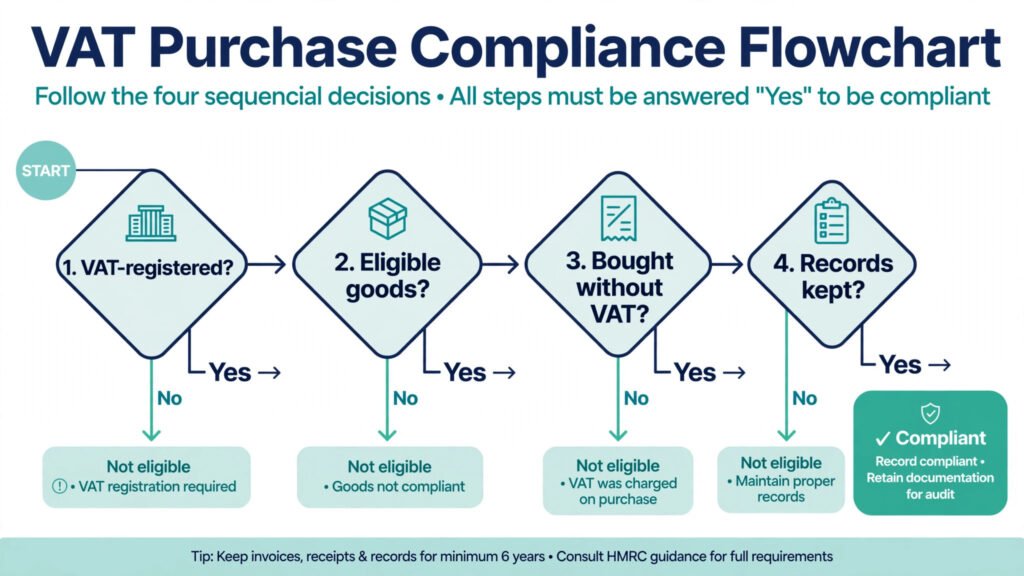
A four-question eligibility check
Run this on every item:
- Are you VAT-registered?
- Is the item second-hand, art, an antique or a collectors’ item?
- Did you buy it with no VAT charged?
- Can you show the stockbook entry and both invoices?
Four yeses mean you can use the scheme. Any “no” means you account for VAT in the normal way.
How to calculate VAT under the margin scheme
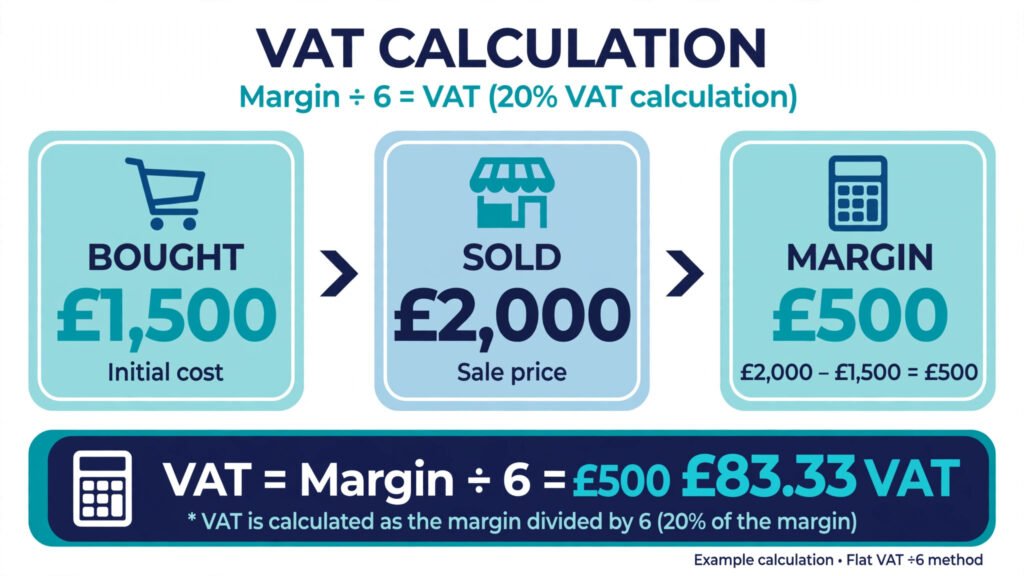
Subtract what you paid from what you sold the item for, then divide the result by six.
- Find the selling price. Use everything you receive for the item, including incidental charges linked to the sale.
- Subtract the purchase price. Use what you paid, with no extra costs added. This is your margin.
- Divide the margin by six. That’s the VAT due.
Why one-sixth? The margin is treated as VAT-inclusive. At a 20% rate, the VAT in a VAT-inclusive amount is one-sixth of it. So the scheme doesn’t add 20% on top of your margin.
Three worked examples
| Scenario | Paid | Sold | Margin | VAT due |
|---|---|---|---|---|
| Normal profit | £1,500 | £2,000 | £500 | £83.33 |
| Sold at a loss | £900 | £700 | None | £0 |
| Restored before sale (£150 spent) | £600 | £1,020 | £420 | £70 |
On a loss, no VAT is due. The loss can’t be set against VAT on other items under the item-by-item scheme. In the third example, the £150 restoration cost doesn’t reduce the margin.
What you can’t deduct
Repairs, parts, accessories and business overheads stay out of the calculation. Reclaim the VAT on those costs on your return in the normal way, where the usual rules allow.
Records: the stockbook
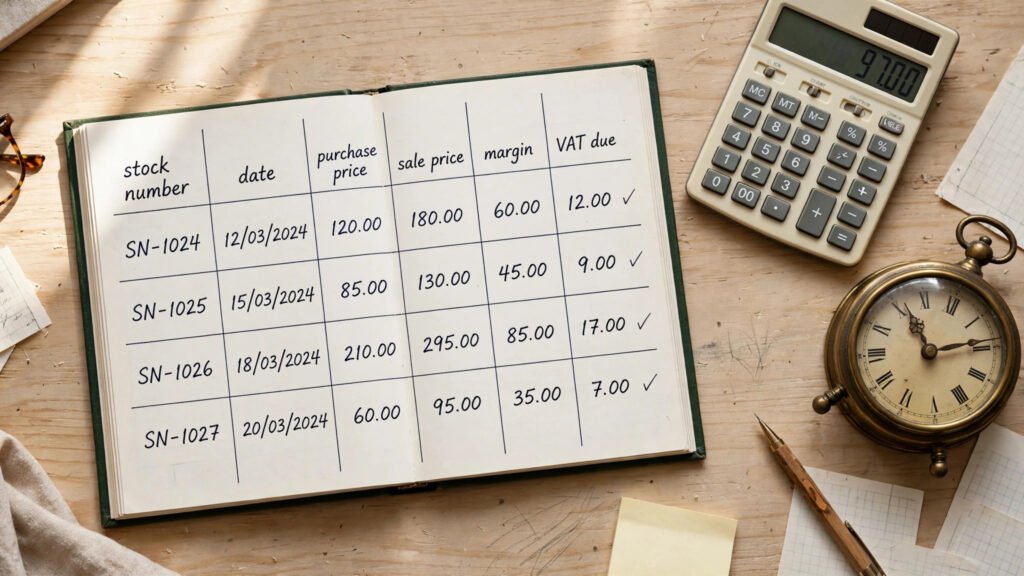
You must keep a stockbook that tracks each margin scheme item individually, plus purchase and sales invoices for every item.
| When | What to record |
|---|---|
| Purchase | Stock number (in numerical sequence), date, purchase invoice number, purchase price, seller’s name, item description |
| Sale | Date, sales invoice number, selling price or method of disposal, buyer’s name, margin, VAT due (one-sixth) |
If you made out the purchase invoice yourself, you don’t need to record a seller’s invoice number.
Keep VAT records for six years. If you hold stock bought more than six years ago that you plan to sell under the scheme, keep its records until the item is sold. The stockbook sits alongside your normal VAT records, so it helps to know the record-keeping rules for sole traders.
The risk of weak records is real. If you don’t meet the scheme’s requirements, you pay VAT on the full selling price of each item.
Invoices: required wording and fields
A margin scheme sales invoice shows one total price, no separate VAT figure and the scheme wording.
Margin scheme invoices follow different rules from ordinary VAT invoices. Your sales invoice must show:
- the date
- your name, address and VAT registration number
- the buyer’s name and address
- the item’s unique stockbook number
- the invoice number
- an item description
- the total price, with no VAT shown separately
- one of these phrases: “margin scheme – second hand goods”, “margin scheme – works of art” or “margin scheme – collectors’ items and antiques”
When you buy from another VAT-registered business, the purchase invoice needs the same wording, the stockbook number and a total price with no extra costs added.
Check that your invoicing software lets you hide the VAT line and add the scheme wording before you issue your first margin invoice.
Reporting on your VAT return
Show margin scheme sales and purchases in Boxes 1, 6 and 7. You don’t need Boxes 8 and 9 for them.
| Box | What to enter |
|---|---|
| Box 1 | Output tax due on eligible goods sold in the period |
| Box 6 | Full selling price of eligible goods sold, less the VAT due on the margin |
| Box 7 | Full purchase price of eligible goods bought in the period |
| Boxes 8 and 9 | Not needed for margin scheme goods |
VAT-registered businesses file through Making Tax Digital. Choose Making Tax Digital software that can handle margin scheme VAT codes. The wrong code can distort your return.
Special cases
Vehicles, bulk low-value stock, auctions and cross-border trade each have their own rules.
Second-hand vehicles
HMRC’s second-hand vehicle guidance (VAT Notice 718/1) applies. You can’t use the scheme for:
- new vehicles
- vehicles imported into the UK
- vehicles bought on an invoice showing VAT
- category A and B write-offs
- vehicles already sold under normal VAT rules
The purchase price excludes the cost of bringing the vehicle to sale, repairs, refurbishment, accessories and overheads.
Global Accounting Scheme
The Global Accounting Scheme is a simplified version for bulk, low-value stock. You work out one margin per VAT period instead of per item. That’s total eligible sales minus total eligible purchases, divided by six.
Each item must have a purchase price of £500 or less. That limit belongs to this scheme only. It doesn’t cap the standard margin scheme.
- A negative margin carries forward to the next period.
- You can’t use it for motor vehicles, boats, aircraft, caravans or horses.
- Invoices to VAT-registered dealers must say “global accounting invoice”.
- When you stop using it, you make a closing adjustment for unsold stock, unless the VAT on that stock is £1,000 or less.
Auctioneers, agents, pawns, horses and caravans
HMRC has separate guidance for auctioneers, agents, unredeemed pawns, horses and ponies and houseboats and caravans.
Northern Ireland, the EU and non-UK trade
Different rules apply if you buy and sell between Northern Ireland and the EU, or import from or export to countries outside the UK. Check them before using the scheme on those sales. For the wider process, see how to export goods as a UK small business.
Common mistakes that trigger full-price VAT
If you don’t meet every requirement, you pay VAT on the full selling price. These errors cause most of the problems:
- Assuming all second-hand goods qualify. Check each item.
- Using the scheme when the purchase invoice showed VAT.
- Working out 20% of the margin instead of one-sixth.
- Adding repairs, parts or overheads to the purchase price.
- Showing VAT on a sales invoice, or leaving off the scheme wording.
- Keeping a stockbook that doesn’t track items one by one.
- Applying the general rules to vehicles.
- Mixing eligible and ineligible stock under one VAT code.
If you’re still choosing software, compare Xero and QuickBooks and test margin scheme handling first. Careless errors can bring penalties, and good records are how you show reasonable care.
Should you use the margin scheme?
Use it when you sell mostly to consumers or to buyers who can’t reclaim VAT. Consider normal VAT when you sell to VAT-registered businesses that can reclaim it.
The scheme is optional. A margin sale shows no VAT, so a VAT-registered business buyer has nothing to reclaim.
Take a piece of used equipment you bought for £10,000.
- Margin scheme: you sell for £13,000. VAT is £500, so you keep £12,500. The buyer pays £13,000 with nothing to reclaim.
- Normal VAT: you sell for £12,500 plus £2,500 VAT, a £15,000 invoice. You keep £12,500. A VAT-registered buyer reclaims £2,500, so their net cost is £12,500.
Your profit is the same, and the buyer saves £500. For private buyers, the margin scheme gives a lower price. Ask an accountant before choosing normal VAT on an item that qualifies for the scheme.
FAQs
Can I use the VAT margin scheme if I’m not VAT-registered?
No. The scheme is part of VAT accounting, so you need a VAT registration number. There’s no separate application for the scheme. Once you’re registered, you start by keeping the right records and reporting it on your VAT return.
Do I show VAT on a margin scheme invoice?
No. Show one total price and the scheme wording, such as “margin scheme – second hand goods”. Showing VAT separately breaks the scheme rules and can cause problems for you and your customer.
Is margin scheme VAT charged at 20%?
No. VAT is one-sixth of the margin, or 16.67%. That’s the VAT fraction when a 20% rate is built into a VAT-inclusive amount. It isn’t 20% added on top of the margin.
Can I reclaim VAT on items I sell under the margin scheme?
There’s no VAT to reclaim on the purchase, because you can only use the scheme for goods bought without VAT. VAT on overheads, repairs, parts and accessories is reclaimed in the normal way.
How long must I keep margin scheme records?
Six years. If you hold stock bought more than six years ago and plan to sell it under the scheme, keep the records until you sell the item.
Does the margin scheme apply to used cars?
Yes, with separate rules. HMRC’s vehicle guidance (VAT Notice 718/1) lists the excluded vehicles and explains the purchase price. Repairs and refurbishment costs don’t reduce the margin.
Next steps and HMRC sources
Start with a stockbook and a margin scheme invoice template. Then read HMRC’s VAT margin schemes guide and VAT Notice 718. If you’re unsure about a particular item, contact HMRC or an accountant before you sell it.
Rules and thresholds can change, so check GOV.UK before you file. This article is general information, not tax advice.