


Hiring your first employee changes your business legally overnight. You stop being a one-person operation and become a UK employer, with duties to HMRC, The Pensions Regulator, and your new staff member that start from day one, sometimes before it.
Most guides scatter this information across HMRC, Acas and The Pensions Regulator websites. This one puts every step in order, with the real costs and the deadlines that catch people out.
Quick-answer checklist. To hire your first employee in the UK, you must:
- Confirm the person is genuinely an employee, not a contractor
- Work out the true cost, not just the salary
- Check their right to work in the UK (and a DBS check, if the role needs one)
- Register as an employer with HMRC before their first payday
- Take out Employers’ Liability insurance
- Give them a written statement of employment particulars on or before day one
- Set up workplace pension auto-enrolment
- Run your first payroll through PAYE and complete onboarding
Each step is covered in detail below.
1. Determine Employment Status: Employee vs Contractor
Before anything else, work out whether the person you’re hiring is legally an employee or a self-employed contractor. This decision drives which of the steps below actually apply to you.
An employee works under a contract of service. You control how, when and where they work, they use your equipment, and they can’t send someone else to do the job for them. A contractor works under a contract for services. They control their own hours, use their own tools, and can usually subcontract the work. Job title and what you call the relationship on paper don’t decide this. HMRC and employment tribunals look at how the work actually happens.
Why This Distinction Matters (IR35 and HMRC Pitfalls)
Getting this wrong is expensive. If HMRC decides someone you’ve treated as a contractor is really an employee, you can be liable for backdated PAYE tax, employer National Insurance, interest and penalties, sometimes going back years. This is the territory covered by IR35 rules, which specifically target disguised employment through personal service companies.
The safest approach for a genuine first hire is to be honest about the relationship you actually want. If you need someone at fixed hours, in your workspace, following your instructions, that’s an employee, and the rest of this guide applies to you. If you’re unsure how this compares with working for yourself, our guide to self-employed vs employed status in the UK breaks down the practical differences.
2. Calculate the True Financial Cost of Your First UK Hire
A £30,000 salary does not cost you £30,000. By the time you add Employer National Insurance and pension contributions, budget for roughly 12–15% on top of the base salary before you even factor in insurance, equipment or recruitment costs.
Beyond Salary: National Insurance, Pensions, and Holiday Pay
Here’s what an employer actually pays on top of a £30,000 annual salary, using 2026/27 rates:
| Cost Item | Annual Amount | Notes |
|---|---|---|
| Base salary | £30,000 | Gross pay before deductions |
| Employer National Insurance | £3,750 | 15% on earnings above the £5,000 secondary threshold (£30,000 − £5,000 = £25,000 × 15%) |
| Employer pension contribution | £713 | 3% minimum on qualifying earnings between £6,240 and £50,270 (£23,760 × 3%) |
| Employers’ Liability insurance | Roughly £60–£150+ | Varies by sector, risk level and provider; higher for manual or higher-risk roles |
| Total added cost | ~£4,500–£4,600 | On top of the £30,000 salary |
Two things most calculators leave out:
Employment Allowance can wipe out most of this. Eligible employers can claim up to £10,500 off their employer National Insurance bill for 2026/27. Hiring your first employee alongside yourself as a director is usually enough to make you eligible, because the exclusion only applies to companies where a sole director is the only person on the payroll. Once you take on staff, that exclusion typically no longer applies, so check your eligibility through your payroll software or an accountant.
Holiday pay isn’t usually an extra line item for salaried staff. If you pay an annual salary, the 5.6 weeks (28 days) of statutory annual leave is already built into that figure. Where holiday pay becomes a real added cost is for hourly or zero-hours workers, where it typically adds around 12.07% on top of hours actually worked, because there’s no fixed salary to spread the paid leave across.
The Apprenticeship Levy, which some guides mention as a hiring cost, only applies to employers with an annual pay bill over £3 million. It won’t affect a first hire.
3. Complete the Legal Pre-Employment Compliance Checks
You must check every new employee’s right to work in the UK before their first day. This isn’t optional, and it isn’t just good practice, it’s a legal requirement with serious penalties for skipping it.
Step A: Check Their Legal Right to Work in the UK
For most candidates, this means asking for their share code from the Home Office’s online right to work checking service, then verifying it yourself online. British and Irish passport holders can usually be checked using a manual document check instead. Keep a dated copy of whatever check you carry out. Employing someone without the right to work can lead to a civil penalty of up to £60,000 per illegal worker, and in serious cases, criminal prosecution.
Step B: Determine if You Need a DBS (Criminal Record) Check
A Disclosure and Barring Service check is only mandatory for specific roles, mainly those involving children, vulnerable adults, or certain regulated professions like healthcare and childcare. For a standard office, retail or trade hire, you generally don’t need one. If your role touches any of those areas, check the DBS eligibility guidance before your new starter’s first day, since some checks take several weeks to come back.
4. Register as an Employer with HMRC (PAYE Setup)
You must register as an employer with HMRC before your new employee’s first payday, but not more than two months before they start work. Registering online usually takes up to five working days to get your PAYE reference number, though it can take longer if you register by post.
When and How to Register for PAYE
Register through the GOV.UK employer registration service. You’ll need this even if you’re only paying one employee a small amount, unless every condition for the very limited exemption applies (none of your staff earn above the Lower Earnings Limit, get a second job, or receive expenses or benefits, and none already have another job or a pension). In practice, almost every first-time employer needs to register.
Once registered, you’re responsible for reporting pay and deductions to HMRC through Real Time Information every time you pay your employee, covered in Step 8 below.
5. Secure Mandatory Employers’ Liability Insurance
By law, you must have Employers’ Liability insurance as soon as you become an employer, with very few exceptions. The policy must cover you for at least £5 million, and it needs to be in place from the day your employee starts, not from whenever you get around to sorting it.
The Statutory £5 Million Requirement and Fines
Trading without valid cover can cost you £2,500 for every day you’re uninsured, and a further £1,000 if you fail to display your certificate where staff can see it (or keep it available electronically). Shop around before your start date, since cover for a single low-risk office role is often available for well under £150 a year.
A common edge case: hiring yourself as a director. If you’re the sole director of your own limited company and own 50% or more of the shares, with no other employees, you’re exempt from needing Employers’ Liability insurance for yourself. The moment you take on a second person, even a family member or part-time staff member, that exemption ends, and you need cover for both of you from their first day.
6. Draft a Written Statement of Employment Particulars (The Contract)
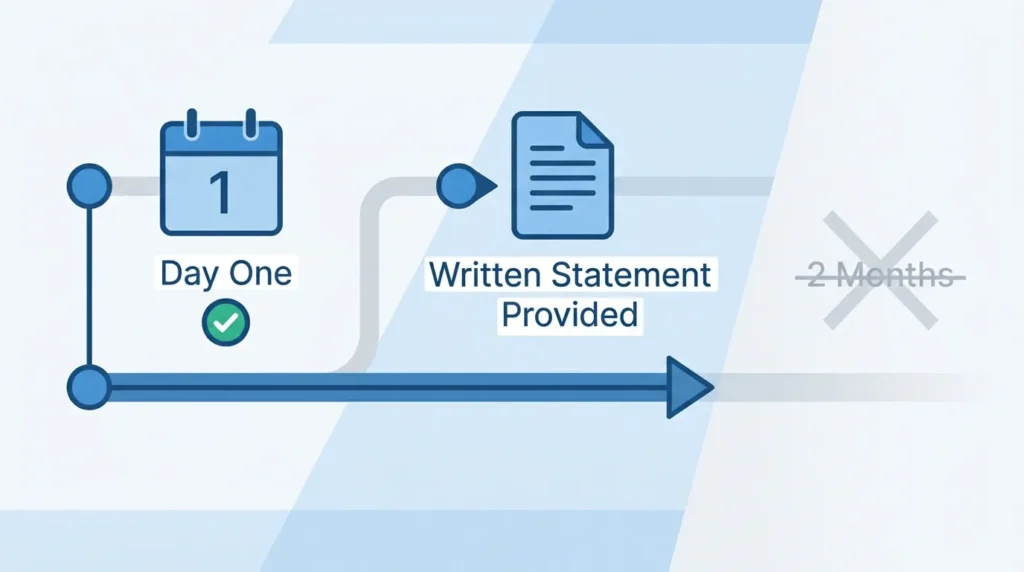
You must give every new employee a written statement of employment particulars on or before their first day of work. This isn’t a two-month grace period any more; it hasn’t been since April 2020. A surprising number of older guides still get this wrong, and it’s one of the most common compliance gaps we see among first-time employers.
What Is a Section 1 Statement?
Under the Employment Rights Act 1996, the written statement must include the job title, start date, pay and pay frequency, hours of work, holiday entitlement, place of work, and notice periods, at minimum. It doesn’t have to be a lengthy formal contract, but it does have to be in writing and handed over by day one. If a dispute ends up at an employment tribunal and you never provided one, you can be ordered to pay the employee an extra two to four weeks’ pay on top of any other award.
Key Legal Clauses: Probation, Notice Periods, and Intellectual Property
Beyond the legal minimum, most first-time employers benefit from adding a probationary period (commonly three to six months), clear notice terms, confidentiality obligations, and, if relevant, a clause confirming that any work created for the business belongs to the business rather than the individual. A short, clear contract beats a long, vague one. If you’re still deciding between structures for your business itself, see our guide on sole trader vs limited company in the UK, since your business structure affects how contracts and payroll are set up.
7. Set Up Workplace Pension Auto-Enrolment
You must automatically enrol eligible staff into a workplace pension scheme and contribute to it, even if you only employ one person. This applies from their first day of eligible earnings, and ignoring it is one of the most heavily penalised compliance failures for small employers.
Your Legal Obligations under The Pensions Regulator (TPR)
An employee must be automatically enrolled if they’re aged between 22 and State Pension age and earn more than £10,000 a year (the 2026/27 earnings trigger, unchanged from the previous year). Contributions are calculated on qualifying earnings between £6,240 and £50,270. The legal minimum is 8% of qualifying earnings in total: at least 3% from you as the employer and the rest, usually 5%, from the employee.
NEST (the National Employment Savings Trust) is the most common choice for small, first-time employers, since it was set up specifically to accept any employer regardless of size. You’ll need to formally declare your compliance with TPR within five months of your employee’s start date, even if everyone opts out. Missing this deadline is one of the most common reasons small employers receive a fixed penalty notice from TPR.
8. Run Your First Payroll & Onboarding
With registration, insurance, the contract and pension scheme in place, the final step is running payroll correctly from day one and completing onboarding paperwork.
HMRC Real Time Information (RTI) Submissions
Every time you pay your employee, you must submit a Full Payment Submission to HMRC on or before payday, reporting pay, tax and National Insurance deducted. If you only employ one person and have fewer than 10 staff in total, HMRC’s free Basic PAYE Tools software can handle this without you paying for a payroll provider, though many small employers move to paid HR and payroll software once they grow beyond one or two hires. Our guide on running payroll for a small UK business covers the practical setup in more depth.
Onboarding Checklist: P45s, New Starter Checklists, and GDPR
Ask your new employee for their P45 from a previous job so you can apply the correct tax code. If they don’t have one, ask them to complete a New Starter Checklist instead, which lets you assign an emergency or correct starting tax code and avoid over- or under-taxing their first payslip.
You’ll also be handling personal data from day one, so make sure you have a basic privacy notice explaining what employee data you hold and why, in line with UK GDPR. This doesn’t need to be complicated for a first hire, but it does need to exist.
What’s Changing in UK Employment Law for 2026 and 2027
UK employment law is moving fast right now, and some of it directly affects new hires.
The Fair Work Agency launched on 7 April 2026. It’s a new single enforcement body that has taken over responsibility for agency worker regulation and labour exploitation cases, and it’s set to take over National Minimum Wage enforcement from HMRC in April 2027. It can inspect proactively, without waiting for a complaint, so accurate records matter more than ever.
Statutory Sick Pay changed from 6 April 2026. The old three-day waiting period is gone, and the lower earnings limit no longer applies, so SSP is now payable from an employee’s first day of illness, regardless of how little they earn.
Employers must now keep annual leave and holiday pay records for six years, a duty introduced from 6 April 2026 under the Employment Rights Act 2025, and enforceable by the Fair Work Agency.
Unfair dismissal protection is changing from 1 January 2027. The qualifying period is set to drop from two years to six months. This won’t affect a brand-new hire immediately, but it means the probationary period and early performance management you build into your contract now matter far more than they used to. If you’re hiring staff from mid-2026 onwards, they’re likely to reach that new six-month threshold after the change takes effect. For wider context on how this legislation affects small employers, see our coverage of the UK’s workers’ rights reforms.
None of this changes the eight steps above. It does mean your written statement, probation clause and record-keeping need to be solid from day one rather than an afterthought.
Frequently Asked Questions
Do I need payroll software for one employee in the UK?
Not necessarily. HMRC’s free Basic PAYE Tools works for employers with fewer than 10 staff and covers the legal requirement to submit Real Time Information on or before each payday. Paid software adds convenience, like automated payslips and pension file uploads, but it isn’t a legal requirement for a single first hire.
How much does it cost to hire an employee in the UK?
Budget for roughly 12–15% on top of the base salary to cover Employer National Insurance and minimum pension contributions, plus Employers’ Liability insurance. On a £30,000 salary, that’s typically an extra £4,500–£4,600 a year, though Employment Allowance can offset up to £10,500 of your employer National Insurance bill if you’re eligible.
Can I employ someone without a contract in the UK?
No. You must provide a written statement of employment particulars on or before their first day of work. Even if you skip this, an employment relationship still legally exists the moment they start work under your control, so you’re bound by employee rights regardless of whether you’ve put anything in writing, you just also risk a tribunal penalty for not documenting it.
How long does it take to get a PAYE reference number?
Registering online usually takes up to five working days. Register as soon as you know your start date, and no earlier than two months before it, since you must have your PAYE reference in place before your employee’s first payday.
Do I need Employers’ Liability insurance if I’m hiring myself as a company director?
If you’re the sole director, own 50% or more of the company’s shares, and have no other employees, you’re exempt. The exemption ends the moment you employ anyone else, including a second director or a part-time staff member.