
Choosing between employment and self-employment in the UK isn’t just a lifestyle decision — it changes how you’re taxed, what happens if you’re ill, and how lenders see you when you apply for a mortgage. This guide sets out the real trade-offs using current 2026/27 figures, not the outdated rates still floating around most comparison articles.
Is It Better to Be Employed or Self-Employed in the UK?
There’s no universal answer — it depends on what you value more: security or control. Employment gives you a predictable salary, statutory sick pay, paid holiday and an employer-funded pension with none of the admin. Self-employment gives you control over your hours, clients and tax planning, but you carry all the risk, admin and safety-net costs yourself. The comparison table further down breaks this down point by point.
Clarifying Your Status: What Do “Employed” and “Self-Employed” Mean?
The Employed (PAYE) Status Explained
Under PAYE, your employer deducts Income Tax and National Insurance directly from your salary before you’re paid, and reports it to HMRC on your behalf. You get a fixed pay date, a contract, and statutory employment rights from day one or after a qualifying period, depending on the right.
The Self-Employed (Sole Trader or Director) Status Explained
As a sole trader, you are responsible for registering with HMRC, filing your own Self Assessment, and paying tax on your profits rather than your turnover. You can also work through a limited company as a director, which changes your tax treatment to Corporation Tax plus dividends. If you contract your services to one client through a limited company, check whether IR35 off-payroll working rules apply, as this affects how you’re taxed. Unsure which route suits you? See our comparison of sole trader and limited company structures or how to go about registering as a sole trader.
The Pros and Cons of Being Employed (PAYE)
The Benefits of Employment: Stability and Statutory Perks
Employees get a guaranteed salary, statutory sick pay if they’re unwell, at least 5.6 weeks (28 days) of paid annual leave, and automatic enrolment into a workplace pension with employer contributions on top of their own. Tax is deducted automatically, so there’s no year-end bill to plan for.
The Drawbacks of Employment: Caps on Control and Earnings
The trade-off for this stability is limited flexibility. Your salary is fixed regardless of how much value you create, your hours and holidays need approval, and your tax planning options are minimal — everything is deducted before you see it.
The Pros and Cons of Being Self-Employed
The Benefits of Self-Employment: Freedom and Financial Control
Self-employed workers choose their hours, clients and rates, and can claim business expenses you can claim against their profit before tax, from equipment to a share of home costs. There’s no earnings ceiling, and profit can be reinvested or drawn out according to your own plan rather than a fixed pay scale.
The Drawbacks of Self-Employment: Risk, Admin, and No Safety Net
Unlike employees, who are entitled to statutory sick pay, self-employed workers get nothing if they can’t work — no client invoices, no income. There’s no paid holiday, no employer pension contribution, and you’ll likely want professional indemnity insurance to cover claims your work or advice caused a loss. Income can be volatile, especially with a small number of clients, and you’re solely responsible for bookkeeping, invoicing and tax deadlines
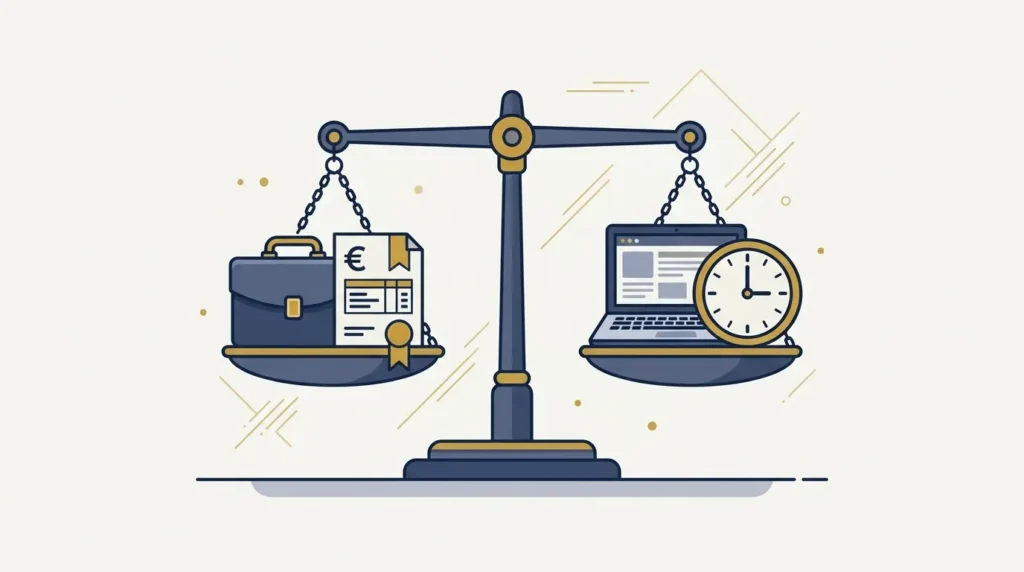
Head-to-Head Comparison: The Key Differences
Tax and National Insurance Structures
From a tax perspective, both employed and self-employed workers pay Income Tax at the same rates above the Personal Allowance of £12,570 — 20% basic rate, 40% higher rate, 45% additional rate. The difference is National Insurance. Employees pay Class 1 NICs at 8% on earnings between the primary threshold and the upper earnings limit. Self-employed workers pay Class 4 NICs at 6% on profits between £12,570 and £50,270, and 2% above that — plus, since April 2024, most no longer pay Class 2 at all once profits exceed £7,105, receiving an automatic State Pension credit instead. See how Sole Trader tax works or how employer National Insurance rates compare from the other side.
Pension Security and Auto-Enrolment
Employers must automatically enrol eligible staff into a workplace pension, contributing a minimum of 3% of qualifying earnings on top of the employee’s own 5%. Self-employed workers get no employer top-up at all — if you want a pension, you’re setting up and funding a personal pension or SIPP entirely yourself. It’s easy to defer this indefinitely when cash flow is tight, which is exactly why so many self-employed people reach retirement with a shortfall. Start setting up your own retirement savings early rather than treating it as optional.
Securing Mortgages and Personal Finance
To satisfy mortgage lenders, self-employed applicants typically need two to three years of accounts or an SA302 tax calculation alongside a Tax Year Overview, both obtainable once you’ve filed your Self Assessment return. Employees usually just need recent payslips and a P60. Lenders often average self-employed income across multiple years, so a strong recent year doesn’t always translate into a higher borrowing limit the way a pay rise would for an employee.
Legal Rights, Paid Leave, and Benefits
Employees are entitled to statutory sick pay, at least 5.6 weeks of paid holiday, and statutory maternity or paternity pay. Self-employed workers get none of these automatically — Maternity Allowance exists as a partial alternative via the DWP for those who qualify, but sick pay and holiday pay simply don’t exist unless you build the cost of taking time off into your own rates and savings.
The Modern Reality: Managing Admin and the “Making Tax Digital” Shift
Employees have essentially zero tax admin — their employer handles everything through PAYE. Self-employment comes with an ongoing administrative burden that’s growing, not shrinking. Making Tax Digital for Income Tax is now compulsory for sole traders with qualifying income above £50,000, requiring digital record-keeping and quarterly updates through software rather than one annual return. The threshold drops to £30,000 from April 2027 and £20,000 from April 2028, pulling in most self-employed people over time. Miss a deadline under the old or new system and Self Assessment penalties apply regardless — read more on Making Tax Digital for Income Tax if you’re approaching the threshold.
Self-Employed vs Employed Comparison Table
| Factor | Employed (PAYE) | Self-Employed |
|---|---|---|
| Income Tax | 20% / 40% / 45% above £12,570 | Same rates, on profit after expenses |
| National Insurance | Class 1 at 8% | Class 4 at 6%, Class 2 mostly credited free |
| Sick pay | Statutory Sick Pay | None — self-funded |
| Paid holiday | 5.6 weeks minimum | None — unpaid |
| Pension | Auto-enrolment + employer contribution | Self-funded personal pension or SIPP |
| Mortgage evidence | Payslips and P60 | SA302 and 2–3 years of accounts |
| Admin | None — employer handles tax | Self Assessment, bookkeeping, MTD |
| Earnings ceiling | Fixed salary | Uncapped, but volatile |
Decision Framework: Is Self-Employment Right for You?
Before making the switch, work through these questions honestly:
- Can you cover 3–6 months of expenses if client work dries up, since there’s no sick pay or redundancy safety net?
- Have you priced in your own “benefits” — pension contributions, holiday pay and insurance — into what you charge clients, rather than treating your day rate as pure profit?
- Do you have more than one client or income source, to avoid the risk of losing your entire income if a single relationship ends?
- Are you comfortable with irregular admin deadlines, including quarterly MTD reporting if your income is likely to cross £50,000?
A common mistake is underestimating the first tax bill — profits from your first 18 months can trigger a larger-than-expected payment once payments on account are added. Writing a simple business plan forces you to model this before you commit. If you’re not ready to leave employment outright, testing self-employment as a side hustle first lets you build a client base and a financial buffer before taking the full leap.
Frequently Asked Questions (FAQs)
Is it better to be employed or self-employed in the UK? Neither is objectively better — employment offers security and statutory benefits, while self-employment offers flexibility and tax control at the cost of a safety net. The right choice depends on your risk tolerance and financial buffer.
Do self-employed workers get statutory sick pay? No. Statutory Sick Pay only applies to employees. Self-employed workers who can’t work generally lose that income entirely, unless they’ve arranged private income protection insurance.
How do self-employed people get a mortgage in the UK? Most lenders ask for two to three years of accounts or an SA302 tax calculation and Tax Year Overview from HMRC, rather than the payslips an employed applicant would provide.
What are the main tax differences between PAYE and sole trading? Both pay the same Income Tax bands, but self-employed workers pay Class 4 National Insurance at 6% instead of Class 1 at 8%, and can deduct allowable business expenses before tax is calculated.
Can I be both employed and self-employed at the same time? Yes. Many people run a side business alongside a PAYE job. You’ll pay tax as normal through your employer and report your self-employed profit separately through Self Assessment.