


Congratulations — your certificate of incorporation has landed, and your business is now a real, legally recognised company. That’s a genuine milestone. It’s also where a lot of new directors quietly get themselves into trouble.
The moment Companies House approves your application, your company becomes a separate legal entity — distinct from you personally, with its own name, its own bank account, and its own set of legal obligations. That separation is what protects your personal assets. It’s also what creates a string of deadlines you didn’t have as a sole trader, and Companies House and HMRC don’t send friendly reminders before the fines start.
This guide walks through exactly what to do, in order, from the day your company is formed through to your first annual filings — including two 2025/26 changes that most other guides on this topic still haven’t caught up with.
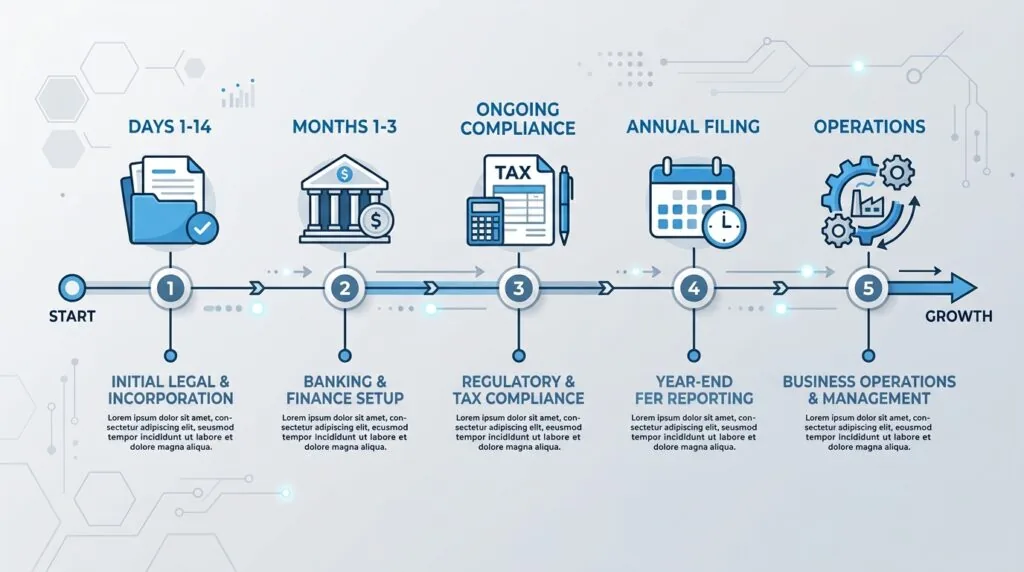
Phase 1: Immediate Statutory Tasks (Days 1–14)
1. Store and Verify Your Incorporation Documents
The very first step after registering a company in the UK is to check and safely store your incorporation paperwork. You’ll receive your Certificate of Incorporation, your Memorandum of Association, and your Articles of Association. If you allotted shares at formation, share certificates should follow.
Your Certificate of Incorporation carries your Company Registration Number (CRN) — an eight-character code you’ll use on almost every official filing, contract, and invoice from now on. Keep digital and physical copies somewhere secure; you’ll need them for banking, insurance, and tax registration.
2. Open a Dedicated Business Bank Account
You cannot run a limited company through your personal bank account. Because the company is a separate legal entity, its money is legally the company’s money, not yours — mixing the two blurs that separation and can undermine the limited liability protection you formed the company to get.
Most high-street and digital banks ask for your CRN, incorporation documents, and proof of ID for each director before they’ll open an account, and approval can take anywhere from a day to a few weeks. Comparing your options against a guide to opening a business bank account in the UK before you apply saves a lot of back-and-forth later.
3. Watch for Your Corporation Tax UTR Letter From HMRC
Within a few days of incorporation, HMRC automatically posts a letter to your registered office containing your company’s 10-digit Unique Taxpayer Reference (UTR). This isn’t optional paperwork — you’ll need this exact number to register for Corporation Tax, so don’t file it away unread.
If it hasn’t arrived within about three weeks, you can request it through your Government Gateway account rather than waiting indefinitely.
Phase 2: Register With HMRC (Months 1–3)
1. Register for Corporation Tax
You must register for Corporation Tax with HMRC within three months of starting to trade. The tricky part isn’t the deadline — it’s working out when “trading” actually begins, and this is where most guidance gets vague.
HMRC counts your company as active the moment you do any of the following, not just when you make your first sale:
- Buying or selling goods or services with a view to making a profit
- Advertising your business
- Renting business premises
- Employing someone
- Receiving income
If you registered a bank account and bought a laptop for the business two months before your first invoice, your trading clock started on the laptop purchase — not the invoice. Miss the three-month window and HMRC can issue a penalty even if no tax is actually owed yet, because the requirement is about registration, not liability.
If your company is genuinely dormant — no trading, no income, no significant transactions — you don’t need to register for Corporation Tax yet, but you should tell HMRC it’s dormant to avoid automated compliance letters.
For 2026/27, once you’re trading, Corporation Tax rates work on a sliding scale: 19% on profits up to £50,000, 25% on profits above £250,000, with marginal relief tapering the rate in between.
2. Set Up PAYE (Even If You’re the Only Employee)
If you plan to pay yourself or anyone else a salary through the company, you need to register as an employer and run PAYE with HMRC — even if you’re a sole director with no other staff. This applies from the first payment, and registration can take up to two weeks to process, so don’t leave it until payday.
Most director-shareholders take a modest salary through PAYE and top it up with dividends, since dividends aren’t subject to National Insurance. Working out the right mix is worth doing properly — see our guide on how to pay yourself as a limited company director and check the current dividend tax rates before you decide.
3. Check Whether You Need to Register for VAT
Direct answer: You must register for VAT once your VAT-taxable turnover exceeds £90,000 in any rolling 12-month period — not a fixed calendar or tax year. You then have 30 days from the end of the month you crossed the threshold to register.
This figure has held at £90,000 since April 2024, and it remains unchanged for the 2026/27 tax year — several older articles still quote the outdated £85,000 threshold, so double-check the source if you’ve seen a different number. The deregistration threshold, if your turnover later falls, is £88,000.
You can also register voluntarily below the threshold. This is common for B2B companies that want to reclaim VAT on setup costs, or that want to look more established to larger clients. Full detail is in our guide on how to register for VAT in the UK, and if you’re not sure whether you’re close to the VAT registration threshold, track your rolling turnover monthly rather than checking once a year.
Phase 3: Legal, Data and Insurance Compliance
1. Register With the ICO If You Handle Personal Data
This is one of the most commonly missed obligations for new companies, and it catches out businesses that don’t think of themselves as “data-driven.” If your company processes personal data electronically — and that includes something as ordinary as a customer email list, an online booking system, or CCTV outside your premises — you are legally required to register with the Information Commissioner’s Office (ICO) and pay the annual data protection fee.
For 2026, the fee is tiered by company size:
| Tier | Who it applies to | Annual fee |
|---|---|---|
| Tier 1 | Turnover under £632,000 or 10 or fewer staff | £52 (£47 by Direct Debit) |
| Tier 2 | Turnover under £36 million or up to 250 staff | £78 (£73 by Direct Debit) |
| Tier 3 | Larger organisations | £3,763 (£3,758 by Direct Debit) |
Almost every small limited company falls into Tier 1. Skipping registration isn’t a minor slip either — the ICO can issue fixed penalties, and trading without registering while processing personal data is a breach of the Data Protection Act 2018. Our ICO data protection fee guide walks through the self-assessment tool step by step.
2. Verify Your Identity With Companies House
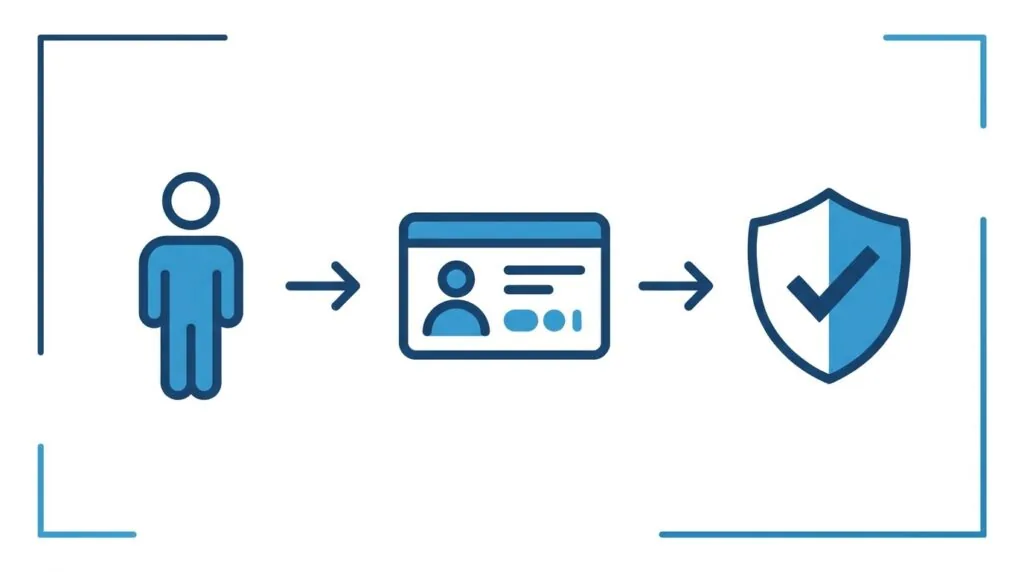
This is new, and it’s a requirement most existing checklists haven’t updated for yet. Since 18 November 2025, identity verification has been a legal requirement for every company director and Person with Significant Control (PSC), under the Economic Crime and Corporate Transparency Act 2023.
If you formed your company after that date, you should already have verified your identity as part of incorporation. If your company existed before then, you’re in a 12-month transition period — you must complete verification before your company’s next confirmation statement is filed, and the transition period closes on 17 November 2026 regardless.
You can verify either directly with Companies House through GOV.UK One Login, or through an Authorised Corporate Service Provider such as your accountant or formation agent. Once verified, you receive a personal verification code you’ll reuse for future filings — you only need to do it once. PSCs who aren’t directors have a separate deadline tied to the 14 days following their birthday month, so it’s worth checking your specific status rather than assuming a director’s timeline applies to everyone with significant control.
Miss this, and Companies House will simply refuse to accept your confirmation statement — which itself carries separate late-filing consequences.
3. Put the Right Business Insurance in Place
If you employ anyone — even a part-time member of staff — Employers’ Liability Insurance is a legal requirement, not an optional extra, and operating without it can result in a fine. Beyond that legal minimum, most companies also take out Professional Indemnity Insurance (especially if you give advice or services) and Public Liability Insurance (if clients or customers visit your premises). Our guide to UK business insurance breaks down what’s mandatory versus what’s simply sensible for your sector.
4. Display Your Company Details Correctly
Under the Companies Act 2006, you’re legally required to display your registered company name at your registered office address and any other location where you do business. You must also show your company name, registration number, and registered office address on your website, email footers, invoices, and letterheads. It’s a small detail, but Companies House does enforce it, and it’s an easy fix to make once and forget about.
Phase 4: Understand Your Director Duties
Many new directors treat the company as a passive box-ticking exercise once it’s formed. Legally, it isn’t. Under the Companies Act 2006, directors carry personal statutory duties, including the duty to:
- Act within your powers, in line with the company’s constitution
- Promote the success of the company for the benefit of its shareholders
- Exercise independent judgment
- Exercise reasonable care, skill, and diligence
- Avoid conflicts of interest
- Not accept benefits from third parties that could compromise your judgment
These aren’t abstract. Breaching them can, in serious cases, expose a director to personal liability — the exact protection incorporation is meant to provide can be pierced if duties are ignored. If you’re bringing in co-founders or investors, it’s worth reading up on company director responsibilities in the UK and putting a shareholder agreement in place early, before a disagreement forces the conversation.
Phase 5: Your Ongoing Annual Filing Obligations
The Confirmation Statement
Your confirmation statement is an annual snapshot confirming the information Companies House holds about your company — directors, registered office, shareholders, and PSCs — is accurate. It is not a financial document, and it’s due every 12 months from your incorporation date, regardless of whether you’ve traded. Since 1 February 2026, the online filing fee is £50 (up from £34); paper filing costs £110. Late or missing confirmation statements can lead to your company being struck off the register.
Annual Accounts
Your first accounts are due 21 months after incorporation; every year after that, they’re due nine months after your Accounting Reference Date (ARD) — your financial year-end. Small companies can typically file simplified accounts, but the deadline is fixed regardless of company size.
Company Tax Return (CT600)
Separately from your accounts, you must file a Company Tax Return (CT600) with HMRC within 12 months of your accounting period ending. Corporation Tax itself, though, is due earlier — nine months and one day after your year-end — so don’t assume the CT600 deadline and the payment deadline are the same date.
Phase 6: Getting Your Operations and Brand in Order
Choosing Accounting Software and an Accountant
Under Making Tax Digital rules, most companies need to keep digital records and file certain returns through compatible software rather than spreadsheets. Setting this up in month one — rather than retrofitting it before your first accounts are due — saves considerable admin time later. Many new directors bring in a chartered accountant (look for ICAEW or ICAS membership) at this stage specifically to handle Corporation Tax, payroll, and VAT together, rather than treating each as a separate task.
Protecting Your Business Name and IP
Incorporating your company name at Companies House stops another company registering the identical name — but it doesn’t give you trademark protection. If your brand name matters commercially, registering it as a trademark is a separate step; our guide on how to trademark a business name in the UK covers the process and cost.
Summary Checklist: What to Do and When
| Task | Deadline / Frequency | Regulatory Body | Mandatory? |
|---|---|---|---|
| Store incorporation documents | Immediately | — | Yes |
| Open business bank account | Before trading | — | Practically yes |
| Register for Corporation Tax | Within 3 months of trading | HMRC | Yes |
| Register for PAYE | Before first payment | HMRC | Yes, if paying salary |
| Register for VAT | Within 30 days of exceeding £90,000 | HMRC | Yes, once threshold met |
| Register with the ICO | Before processing personal data | ICO | Yes, in most cases |
| Verify director/PSC identity | Before next confirmation statement | Companies House | Yes |
| Employers’ Liability Insurance | Before employing staff | — | Yes, if employing |
| File confirmation statement | Every 12 months | Companies House | Yes |
| File annual accounts | 9 months after year-end | Companies House | Yes |
| File CT600 | 12 months after accounting period | HMRC | Yes |
| Pay Corporation Tax | 9 months + 1 day after year-end | HMRC | Yes |
Frequently Asked Questions
Can I keep my company dormant?
Yes. A company can stay dormant indefinitely if it has no significant accounting transactions. You still must file confirmation statements and dormant company accounts each year, but you don’t need to register for Corporation Tax until you start trading.
What happens if I miss a filing deadline?
Companies House and HMRC apply automatic, escalating penalties for late confirmation statements, accounts, and tax returns — some starting from the day after the deadline. Persistent non-compliance can lead to your company being struck off the register and its assets passing to the Crown.
Do I need to register for business rates?
Only if you operate from commercial premises rather than working from home. If you do, you’ll register with your local council, not Companies House or HMRC, and may be eligible for small business rates relief.
Do I still need to file a personal Self Assessment return as a director?
Often, yes — particularly if you take dividends. PAYE covers your salary, but dividend income and any other personal income usually still needs declaring through Self Assessment, and late filing penalties apply on the same escalating basis as company filings.
—
If this list feels like a lot at once, that’s normal — it is a lot, especially in the first three months. Working through it in the order above, rather than tackling whichever task feels most urgent that week, is what keeps new directors out of the penalty letters. If you’re still weighing up whether a limited company was the right structure at all, our comparison of sole trader versus limited company in the UK is worth a read before your first year-end.