

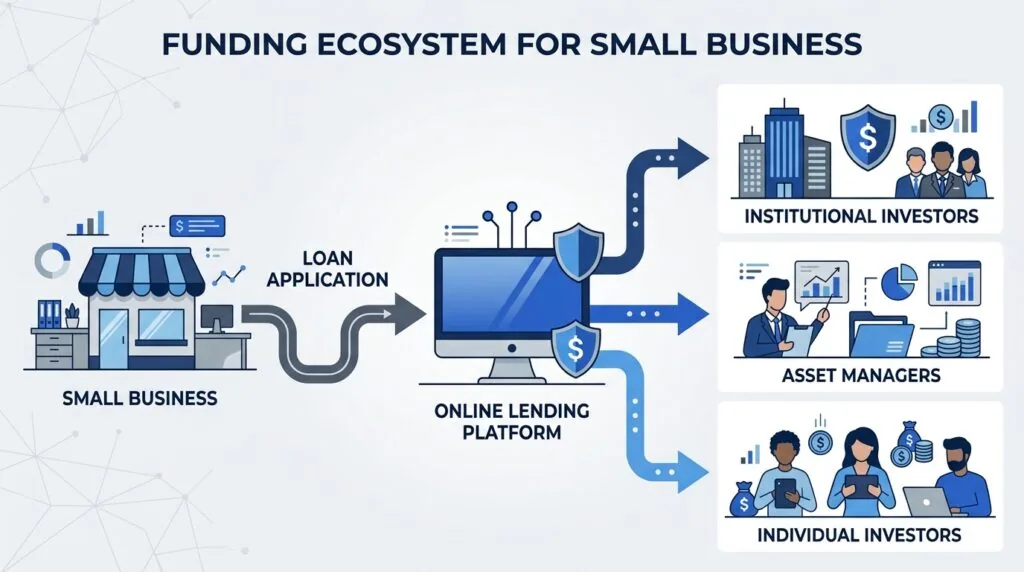
Peer-to-peer lending is a way for UK small businesses to borrow money through an online platform instead of a bank. The platform matches your loan application with capital from investors — which today usually means institutions, funds and asset managers rather than individual savers. If your business has been turned down by a high-street bank, or you simply need a faster decision, P2P lending is worth understanding properly before you apply.
What is Peer-to-Peer (P2P) Lending?
Peer-to-peer (P2P) lending is a form of debt finance that connects UK small businesses with investors through an online platform, bypassing the traditional intermediary role of a bank. The platform handles credit underwriting, sets the interest rate, collects repayments, and manages the loan on both sides.
It sits within the wider category of alternative finance, alongside invoice finance, revenue-based lending and small business grants. The loan itself works much like a standard business loan: you borrow a fixed amount, repay it with interest over an agreed term, and the debt sits on your balance sheet.
The Core Difference: P2P vs. Traditional Bank Loans
A bank lends from its own balance sheet using capital it holds as a deposit-taking institution. A P2P platform doesn’t lend its own money — it’s a marketplace that connects borrowers with third-party capital and takes a fee for arranging and managing the loan.
| Traditional Bank Loan | P2P Business Loan | |
|---|---|---|
| Source of funds | The bank’s own balance sheet | Institutional investors, funds, or (rarely) individuals |
| Decision speed | Often 4–8+ weeks | Typically 24 hours to 2 weeks |
| Credit criteria | Rigid, standardised scoring | More flexible, case-by-case underwriting |
| Security | Often required for larger sums | Varies — unsecured and secured options exist |
| FSCS protection | Deposits protected | Not applicable to business borrowers |
How Does P2P Business Lending Work in the UK?
You apply through an online platform, which checks your finances, sets a rate based on risk, and — if approved — funds the loan from investor capital rather than its own reserves. Most platforms can give an in-principle decision within a day, with money released once documentation is signed.
The Role of the Online Platform
The platform is the credit engine of the whole process. It pulls in your business bank data through Open Banking, cross-checks your filings at Companies House, runs a credit reference agency search, and prices the loan accordingly. It also handles ongoing loan servicing — collecting repayments and chasing arrears — so you deal with one point of contact throughout the term.
Retail vs. Institutional Funding (The 2026 Reality)
Older guides still describe P2P lending as “individuals lending to small businesses.” That’s largely no longer true. Funding Circle, the platform that pioneered the UK model, permanently closed its retail investor channel in March 2022 and now funds loans almost entirely through banks, asset managers and government-backed schemes. It has since sold its US arm and narrowed its focus to UK SME lending funded by institutional capital.
Some platforms — Folk2Folk is the clearest example — still run genuine retail-investor models, often through an Innovative Finance ISA (IFISA). Others, like CrowdProperty and Assetz Capital, blend individual and institutional money depending on the loan. The practical effect for you as a borrower is small either way: your application, pricing and repayment terms look the same regardless of who ultimately supplies the capital. But it matters if you’re also weighing up lending as an investor, since fewer platforms now accept retail money at all.
Types of P2P Loans Available for UK SMEs
Unsecured P2P Business Loans
Unsecured loans don’t require you to put up a specific asset as collateral, but they almost always require a personal guarantee from a director. Amounts typically range from £10,000 to £500,000, with terms of six months to six years. They suit working capital needs, stock purchases and short-term cash flow gaps.
Secured P2P Loans & Asset-Backed Funding
Secured loans are backed by a charge over a specific asset — commercial property, land, or company assets more broadly through a debenture. Because the lender has a legal claim on that asset if you default, secured loans usually carry lower interest rates and support larger amounts, often into the millions for property development or bridging finance through specialists like Folk2Folk or CrowdProperty.
The Benefits of P2P Lending for Small Businesses
1. Speed and Efficiency of Application
Open Banking integration lets platforms assess your cash flow in minutes rather than weeks. Many lenders give a decision within 24 hours for smaller unsecured loans, and funds can land within days of signing.
2. Flexible Lending Criteria
P2P underwriters look beyond a standardised credit score. A business with a short trading history, seasonal revenue, or a recent dip in profits can still get approved if the wider financial picture supports it — something high-street banks are usually far more rigid about.
3. Diverse Funding Sources
Because platforms draw on multiple capital providers, they can often say yes to deals a single bank would decline, particularly for niche sectors like property development or specialist manufacturing.
Risks and Drawbacks to Consider
1. Cost of Capital (Interest Rates & Platform Fees)
P2P business loan rates are typically quoted as the Bank of England base rate plus a margin that reflects your risk profile. With the base rate at 3.75% as of August 2026, unsecured P2P loans commonly land in the 8–18% APR range, while secured, asset-backed loans can start lower, from around 7–9%, depending on the loan-to-value (LTV) and asset quality.
On top of the headline rate, expect:
- Arrangement fee — usually 1% to 5% of the loan amount, deducted before funds are released.
- Non-utilisation fee — charged on undrawn facilities, common with revolving credit lines.
- Early repayment charge — some platforms charge a fee equivalent to a set number of months’ interest if you clear the loan ahead of schedule.
Always ask for the total cost of the loan in pounds, not just the headline APR — the arrangement fee alone can add thousands to a six-figure loan.
2. Personal Guarantees and Asset Risk
This is the part most guides gloss over. A personal guarantee (PG) means a director agrees to repay the debt personally if the business can’t. It bypasses the protection of limited liability for that specific debt. If the loan is secured with an all-assets debenture or a charge over property, the lender can also appoint an administrator or force a sale to recover its money — separate from, and in addition to, any personal guarantee. Read the guarantee document carefully and understand exactly what you’re putting at risk before signing, and see our guide on company director responsibilities in the UK for the wider legal context.
3. Early Repayment Charges & Penalties
If there’s a realistic chance you’ll want to clear the debt early — say, after a cash injection or pitching to investors — factor the exit penalty into your comparison between platforms. A slightly higher headline rate with no early repayment charge can work out cheaper overall than a lower rate with a rigid penalty.
Eligibility Criteria: Can Your Business Qualify?
Most platforms require a UK-registered limited company or LLP that’s been trading for at least 12 months, though some accept established sole traders. You’ll generally need minimum annual turnover of around £50,000–£100,000, a clean credit file with no unresolved county court judgments, and directors willing to provide a personal guarantee for unsecured facilities.
Typical Documentation Required
- Certificate of incorporation and Companies House details
- 6–12 months of business bank statements (via Open Banking where supported)
- Filed or management accounts, including a recent profit and loss statement
- Details of existing debt and any outstanding personal guarantees
- Proof of ID and address for all directors
Having these ready before you apply — rather than scrambling once a platform asks — is the single biggest factor in getting a same-day decision. If your accounts aren’t in good shape yet, our guide to sole trader record-keeping requirements is a useful starting point, even for limited companies applying the same discipline.
Regulation and Safety: The FCA Framework
P2P lending platforms operating in the UK are authorised and regulated by the Financial Conduct Authority (FCA), which sets rules on how they assess borrower affordability, disclose fees, and handle wind-down if the platform itself fails. This regulation protects process and conduct — it does not protect you from losing money if your business defaults.
Is P2P Lending Covered by the FSCS?
No. The Financial Services Compensation Scheme (FSCS) protects retail savers’ deposits at banks and building societies up to £85,000. It does not apply to P2P loans in either direction: as a borrower, you’re not protected from the debt itself, and if you were an investor, your capital wouldn’t be covered if a business defaulted or the platform collapsed. Some platforms hold IFISA-wrapped investments, which brings tax benefits but still carries capital risk, not FSCS protection.
Top Peer-to-Peer Lending Platforms for UK Businesses
| Platform | Focus | Typical Loan Type | Notable Feature |
|---|---|---|---|
| Funding Circle | General SME lending | Unsecured & secured | Institutional funding since 2022; large loan book |
| Folk2Folk | Rural & commercial property | Secured | Genuine retail investor base via IFISA |
| CrowdProperty | Property development & bridging | Secured, asset-backed | Specialist property underwriting |
| Assetz Capital | SME & property finance | Secured & unsecured | Mix of institutional and retail funding |
| ThinCats | Larger SME & growth loans | Unsecured & secured | Focuses on established businesses, higher loan sizes |
Check each platform’s current rate cards directly, since pricing moves with the Bank of England base rate and each lender’s own risk appetite.
FAQs About UK P2P Business Lending
How does P2P business lending work?
You apply through an online platform, which checks your finances and credit history, prices the loan based on risk, and funds it using capital from institutional or retail investors rather than its own reserves.
Is peer-to-peer lending safe for businesses?
The platforms are FCA-regulated, which covers fair process and disclosure, but the loan itself is a real debt. If your business can’t repay, you remain liable — including personally if you signed a guarantee.
What are the interest rates for P2P business loans?
As of August 2026, rates typically run from around 7–9% APR for secured, asset-backed loans up to 18% or higher for higher-risk unsecured loans, on top of the Bank of England base rate of 3.75%.
Do I need a personal guarantee for a P2P loan?
Usually yes for unsecured loans. Secured loans rely more on the underlying asset, though a guarantee may still be requested depending on the loan-to-value ratio.
Common Mistakes to Avoid
- Comparing headline rates only. A lower APR with a high arrangement fee and an early repayment penalty can cost more than a slightly higher rate with none.
- Signing a personal guarantee without reading the scope. Some guarantees cover the full debt; others cap your personal liability at a percentage.
- Applying with messy accounts. Late or disorganised bookkeeping is one of the most common reasons for rejection or a worse rate.
- Ignoring the impact on future borrowing. A debenture or all-assets charge can make it harder to secure additional finance later, since new lenders will want to know what’s already charged against your assets.
P2P lending isn’t automatically cheaper or safer than a bank loan — it’s faster and more flexible, at a cost that reflects the risk the platform is taking on. Know your numbers, read the guarantee terms properly, and compare at least two platforms before you commit.