
Going self-employed in the UK means you need to register with HMRC as a sole trader — and most people put it off longer than they should. This guide covers everything: how to register step by step, what National Insurance you’ll pay in 2026, the deadlines you cannot miss, and what happens after you’re set up. It’s written for people doing this for the first time, in plain English, with the actual 2025/26 figures.
What Is a Sole Trader?
A sole trader is a self-employed person who runs a business as an individual. You and the business are legally the same entity — which means you keep all the profit after tax, but you’re also personally responsible for any debts.
It’s the simplest business structure in the UK. No Companies House registration, no complex accounts, no corporation tax. You pay income tax and National Insurance on your profits through Self Assessment.
Most freelancers, contractors, tradespeople, and side hustlers start here.
Sole Trader vs Limited Company — Which Should You Choose?
The main trade-off is simplicity versus liability protection. As a sole trader, your personal assets are at risk if things go wrong. A limited company is a separate legal entity, which limits your personal exposure — but it comes with more administrative work and costs.
Read the full breakdown in our guide to sole trader vs limited company before you decide, especially if your income is expected to exceed £50,000 or you’re working in a high-risk field. You may also find our article on what is a limited company in the UK useful for understanding the differences in tax treatment.
For most people just starting out, sole trader is the right call.
Do You Actually Need to Register?
You must register as a sole trader if your self-employment income exceeds £1,000 in a tax year. This is called the trading allowance, and it covers one tax year (6 April to 5 April).
The £1,000 Trading Allowance — What It Covers
If you earn £1,000 or less from self-employment in a tax year, you don’t need to register or file a Self Assessment return for that income. HMRC created this allowance specifically for casual earners — selling things online, occasional freelance work, small side projects.
Once you go over £1,000, you must register. No exceptions.
The allowance applies per person, not per income source. If you have two self-employment income streams and together they exceed £1,000, registration is required.
When HMRC Requires Registration
You must also register if:
- You want to pay voluntary National Insurance to protect your State Pension record
- You’re claiming tax-deductible business expenses (you can only do this through Self Assessment)
- HMRC contacts you and asks you to register
- You have other untaxed income over £2,500 per year (for example, rental income)
When in doubt, register. The penalty for not registering on time is more painful than the paperwork.
How to Register as a Sole Trader with HMRC — Step by Step
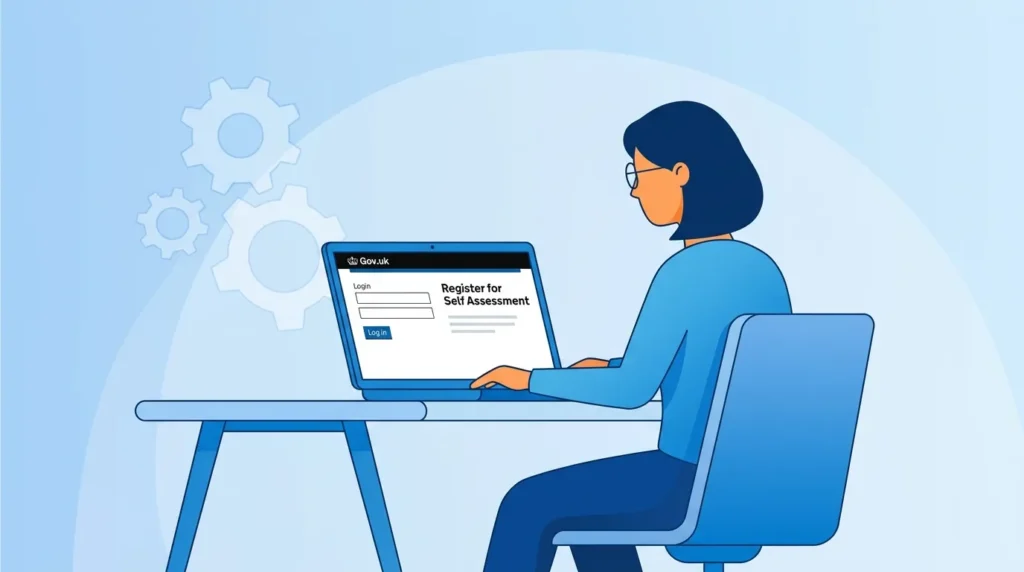
Registration is done online. The whole process takes 15–20 minutes if you have your details ready. <!– IMAGE SUGGESTION Image Prompt: A three-step horizontal infographic showing: Step 1 — a laptop with a login screen (Government Gateway), Step 2 — a form document with CWF1 labelled, Step 3 — a letter/envelope with “UTR Number” written on it. Flat design, HMRC green and navy colour scheme. No people. Name: sole-trader-registration-steps-hmrc Caption: The three steps to registering as a sole trader: set up a Government Gateway account, complete your HMRC registration form, then wait for your UTR number by post. Alt Text: Three-step infographic showing HMRC sole trader registration process including Government Gateway, CWF1 form, and UTR number –>
Step 1 — Set Up a Government Gateway Account
Go to gov.uk and create a Government Gateway account if you don’t already have one. You’ll need:
- Your National Insurance number
- A valid email address
- Proof of identity (passport, driving licence, or credit record check)
HMRC uses two-factor authentication, so have your phone ready.
If you already have a Government Gateway account from a previous employer or PAYE tax code, you can use the same login.
Step 2 — Fill In the Right Form (CWF1 vs SA1)
This is where people get confused.
CWF1 — Use this if you’ve never been in Self Assessment before and you’re starting self-employment for the first time. It’s the most common route.
SA1 — Use this if you’re already registered for Self Assessment (for example, you already file a return for rental income) and you now need to add self-employment income to it.
Both forms are completed online through your Government Gateway account under “Register for Self Assessment.” You don’t need to download or post anything.
You’ll be asked for:
- Your start date of self-employment
- The nature of your business (a brief description is fine)
- Your trading name, if different from your own name
Step 3 — Get Your UTR Number
After registration, HMRC will post your Unique Taxpayer Reference (UTR) number to your home address within 10 working days. This is a 10-digit number that identifies you for tax purposes.
Keep it safe. You’ll need it every time you file a Self Assessment return, deal with an accountant, or contact HMRC about your tax.
You can also view your UTR online through your Government Gateway account once registration is confirmed.
For a deeper look at how UTR numbers work within the Self Assessment system, see our full guide on how to do a self assessment tax return in the UK.
Sole Trader Registration Deadline
You must register by 5 October in the second tax year of your trading.
So if you started earning self-employment income in the 2024/25 tax year (which ended 5 April 2025), you had until 5 October 2025 to register.
If you started trading in 2025/26 (which runs until 5 April 2026), your deadline is 5 October 2026.
What Happens If You Miss the 5 October Deadline
Missing the registration deadline doesn’t result in an automatic fine — but it triggers a penalty process when you eventually file late.
HMRC charges a £100 fixed penalty for a late Self Assessment return, plus additional daily penalties if the delay extends beyond three months (£10 per day up to a maximum of £900). Interest then accrues on any unpaid tax.
The safest approach: register as soon as you start trading. There’s no benefit to waiting.
National Insurance for Self-Employed UK 2026
This is the section most guides get wrong — especially regarding Class 2. Here’s the accurate position for 2026. <!– IMAGE SUGGESTION Image Prompt: A clean data table graphic showing Class 2 and Class 4 National Insurance rates for self-employed UK 2026. Two rows with columns for “NI Class”, “Rate”, “Profit Threshold”. Navy and green colour scheme, modern sans-serif font. No people. Infographic style. Name: self-employed-national-insurance-rates-uk-2026 Caption: Class 2 and Class 4 National Insurance rates for self-employed people in the UK for the 2025/26 tax year. Alt Text: Table showing Class 2 and Class 4 National Insurance rates and thresholds for self-employed UK workers in 2026 –>
Class 2 NI — What Changed in April 2024 and What It Means Now
Class 2 National Insurance was effectively abolished for most self-employed people from 6 April 2024.
Before April 2024, sole traders paid £3.45 per week in Class 2 NICs (roughly £179 per year). That flat-rate charge is gone. Most self-employed people no longer pay Class 2 at all.
What replaced it? From 2024/25 onward, if your profits are above the Small Profits Threshold (£6,845 for 2025/26), you automatically receive State Pension entitlement through your Class 4 contributions alone. You don’t pay a separate Class 2 charge.
If your profits are below £6,845, you don’t gain a qualifying year for your State Pension automatically. In that case, you have two options:
- Pay voluntary Class 2 NICs (currently £3.45 per week) to protect your State Pension entitlement
- Pay voluntary Class 3 NICs (currently £17.45 per week) — a more expensive route to the same outcome
Most people with profits below £6,845 who want to protect their State Pension should pay voluntary Class 2. It’s significantly cheaper than Class 3.
Class 4 NI — 2026 Rates and Thresholds
Class 4 is the main NI charge for self-employed people. It’s calculated as a percentage of your profits, not a flat rate.
For 2025/26:
| Profit Band | Class 4 NI Rate |
|---|---|
| Up to £12,570 (Lower Profits Limit) | 0% |
| £12,570 to £50,270 | 6% |
| Above £50,270 | 2% |
So if you made £30,000 profit, you’d pay Class 4 NI on £17,430 (£30,000 minus £12,570) at 6% — that’s £1,045.80.
Class 4 is paid through your Self Assessment tax return, alongside income tax. You don’t pay it separately throughout the year.
Voluntary NI Contributions — Protecting Your State Pension
You need 35 qualifying years of National Insurance contributions to receive the full new State Pension (currently £221.20 per week). Gaps in your NI record reduce that amount.
If your self-employment profits are below the Small Profits Threshold, paying voluntary Class 2 NICs at £3.45 per week is usually worth doing — the annual cost (around £179) is small compared to the long-term State Pension impact.
You can check your NI record and State Pension forecast at gov.uk/check-state-pension.
Self Assessment After Registration — Key Dates
Once registered, you’ll file a Self Assessment tax return each year. The tax year runs 6 April to 5 April.
Key dates for the 2025/26 tax year:
- 5 April 2026 — tax year ends
- 31 October 2026 — paper Self Assessment deadline (if filing by post)
- 31 January 2027 — online Self Assessment deadline and payment deadline
- 31 July 2027 — second payment on account deadline
Our guide on self assessment tax returns covers the full filing process, including how to use HMRC’s online portal.
Payment on Account — The Surprise Most New Sole Traders Miss
In your first year of filing, HMRC will ask you to pay your tax bill plus advance payments toward the following year. These are called payments on account.
Each payment on account equals 50% of your current year’s tax bill. They’re due on 31 January and 31 July.
Example: If your 2025/26 tax bill is £3,000, you’ll pay £3,000 by 31 January 2027 — plus a first payment on account of £1,500 toward 2026/27. Total due by 31 January 2027: £4,500.
This catches a lot of first-time filers off guard. Budget for it from the start.
Allowable Business Expenses Worth Knowing
As a sole trader, you can deduct legitimate business expenses from your income before calculating your tax. Common deductions include:
- Office costs (stationery, software, a portion of home broadband)
- Travel (mileage at HMRC’s approved rates, train fares, parking for business purposes)
- Professional fees (accountant fees, legal advice related to the business)
- Marketing (website costs, advertising)
- Equipment (tools, laptop, camera — if used primarily for business)
- A proportion of home costs if you work from home (heat, electricity, mortgage interest on a pro-rata basis)
Keep every receipt. HMRC doesn’t ask for them upfront, but they can audit you for up to 20 years back in serious cases. Our article on smart tax tips for UK small businesses has more detail on which expenses you can legitimately claim.
Records You Must Keep as a Sole Trader
HMRC requires you to keep business records for at least 5 years after the 31 January submission deadline for that tax year. For the 2025/26 return (due January 2027), you must keep records until at least January 2032.
You need to keep:
- All sales records and invoices issued
- All purchase receipts and supplier invoices
- Bank statements (business and personal, if mixed)
- Mileage logs if claiming vehicle expenses
- Details of any business assets you’ve bought (for capital allowances)
- Records of any personal items you’ve used for business
Digital records are fine. A well-organised folder in cloud storage or accounting software works. Many sole traders use apps like FreeAgent, QuickBooks, or even a simple spreadsheet.
If you’re looking for help keeping your finances in order, our guide on small business accounting tips for UK owners is a practical starting point.
Common Mistakes When Registering as a Sole Trader
Registering late. The 5 October deadline matters. Missing it creates problems when you file your first tax return.
Using the wrong form. If you’re already in Self Assessment, use SA1. If you’re new to it, use CWF1. Mixing them up delays the process.
Not budgeting for payments on account. Put 25–30% of every payment you receive into a separate savings account for tax. When January arrives, you won’t panic.
Ignoring National Insurance. Class 4 is paid through Self Assessment, but if your profits are below the Small Profits Threshold and you skip voluntary Class 2, you lose a qualifying year toward your State Pension.
Mixing personal and business spending. It makes record-keeping messy and puts allowable expenses at risk. Open a separate bank account — even a basic one — for business transactions. See our guide on how to open a free UK small business bank account.
Underestimating VAT. You don’t need to register for VAT as a sole trader until your turnover exceeds £90,000 in a 12-month period. But if you’re approaching that threshold, start planning early. Our guide on understanding VAT for UK small businesses covers when and how to register.
Making Tax Digital — What’s Coming for Sole Traders
Making Tax Digital for Income Tax (MTD ITSA) is HMRC’s programme to move Self Assessment into quarterly digital reporting. It will apply to sole traders with income above £50,000 from April 2026, and those with income above £30,000 from April 2027.
This means affected sole traders will need to use HMRC-compatible software (not a spreadsheet) and submit quarterly income and expenditure updates — on top of the annual tax return.
If you’re starting out now and expect to grow toward these thresholds, it’s worth choosing accounting software that’s already MTD-compatible. For a full breakdown of what this means and how to prepare, read our guide on Making Tax Digital for income tax.
Frequently Asked Questions
Can I be employed and a sole trader at the same time?
Yes. You can work as an employee (paying tax through PAYE) and also earn self-employment income as a sole trader. You’ll pay income tax through your employer as normal, and report your self-employment income through Self Assessment. Your NI contributions from employment count toward your State Pension record separately.
Do I need a business bank account?
There’s no legal requirement for sole traders to have a separate business bank account. But it’s strongly recommended. Mixing personal and business money makes expense tracking difficult and increases the chance of errors in your tax return. Several banks offer free or low-cost accounts specifically for sole traders.
What if I trade under a different name?
You can trade under any name as a sole trader, provided it doesn’t include words requiring permission (like “Royal,” “Bank,” or “Limited”). You don’t need to register the trading name anywhere. You’ll still file tax returns and pay tax in your own personal name.
How long does HMRC registration take?
Online registration is immediate — HMRC confirms it on screen. Your UTR number arrives by post within 10 working days. Your online Self Assessment account may take up to 3 weeks to become fully active after registration, so don’t leave it until the last minute before a filing deadline.
Wrapping Up
Registering as a sole trader in the UK is genuinely straightforward — it takes under 20 minutes online through HMRC. The parts that trip people up are the deadlines (5 October to register, 31 January to file and pay), the payment on account shock in year one, and the Class 2 National Insurance changes that many guides still haven’t updated.