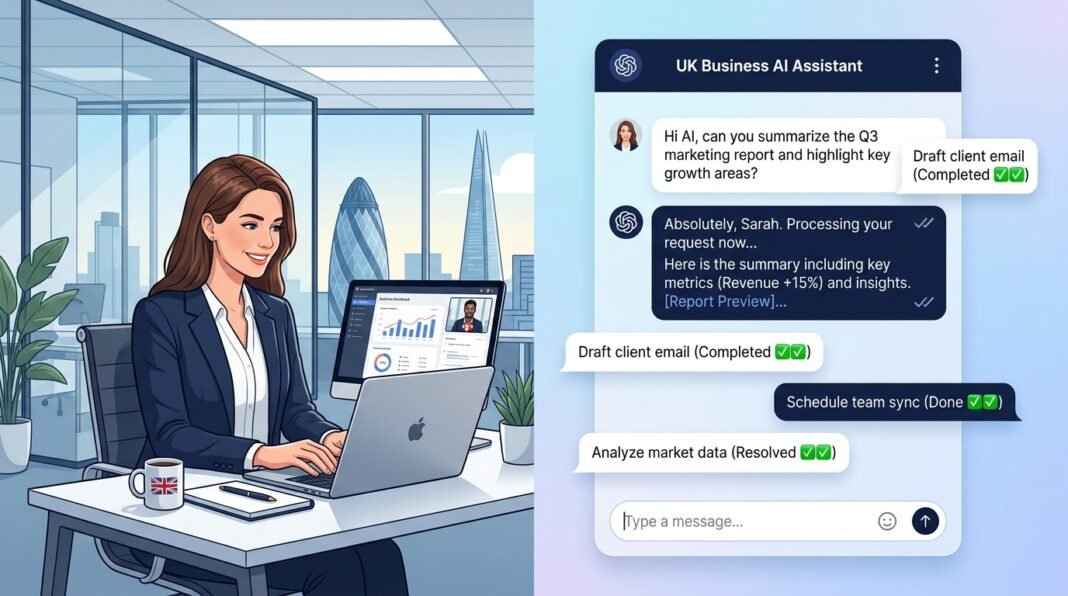

UK businesses are paying around £6 per human-handled customer interaction. An AI chatbot brings that down to roughly £0.50. At scale, that gap is significant. But cost isn’t the only reason companies here are switching — UK customers now expect instant replies across WhatsApp, email, and live chat, around the clock, and most support teams simply can’t deliver that without automation.
This guide covers the best AI chatbots for customer service in the UK right now, what features actually matter, how to stay on the right side of UK GDPR, and how to pick the right platform for your business size and budget.
What Is an AI Chatbot for Customer Service?
An AI chatbot for customer service is software that handles customer conversations automatically. It reads what a customer types, understands the intent behind it, and responds — without a human agent involved.
The difference between older chatbots and today’s AI-powered versions is significant. A traditional chatbot follows a rigid script. Ask it something outside its decision tree and it fails. AI chatbots, by contrast, use natural language processing (NLP) and large language models (LLMs) to understand what someone actually means, not just which keywords they used.
The Difference Between Old Chatbots and AI Agents
Basic rule-based chatbots were built on if-this-then-that logic. They worked for very simple FAQs but broke down fast under real customer queries. Most people who’ve had a frustrating “I don’t understand your request” experience were hitting the limits of one of these.
Modern AI chatbots — increasingly called AI agents — reason through problems. They can handle multi-step requests, pull data from your CRM in real time, process refunds, update accounts, and hand off complex cases to a human agent at exactly the right moment. That’s a fundamental shift in what automation can do for a support team.
Core Technologies: NLP, LLMs, and Agentic AI
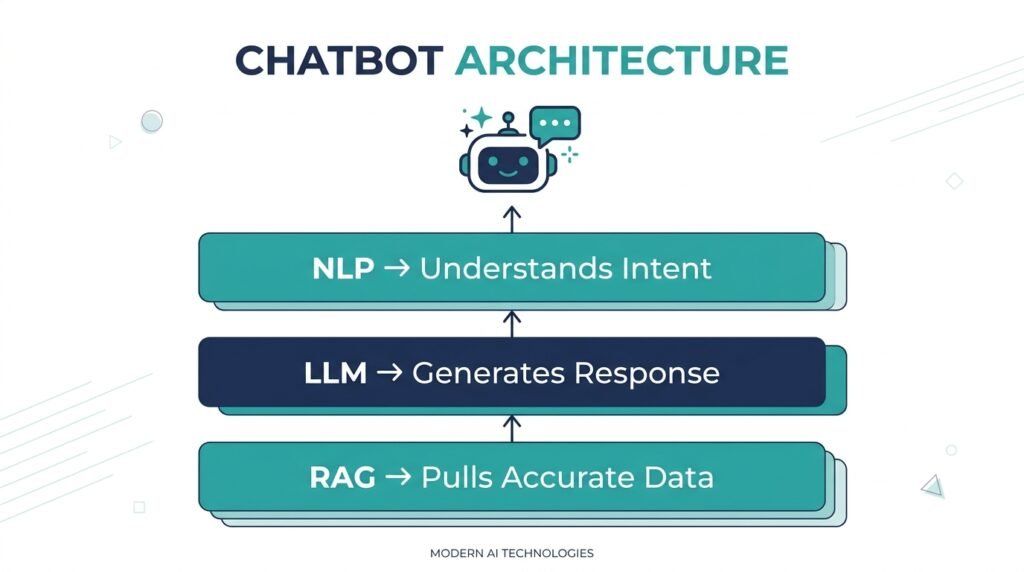
Three technologies sit at the core of modern customer service chatbots:
- Natural Language Processing (NLP): Allows the bot to interpret what a customer says regardless of how they phrase it.
- Large Language Models (LLMs): Models like GPT-4o and Claude provide human-like response generation trained on massive datasets.
- Retrieval-Augmented Generation (RAG): The bot pulls answers from your actual knowledge base rather than generating guesses. This matters — RAG-based systems are significantly more accurate than those relying on the model alone.
Why UK Businesses Are Switching to AI Chatbots in 2026
The shift isn’t just about technology — it’s about economics and consumer behaviour colliding at the same time.
The Numbers Behind the Shift
Chatbots now handle up to 80% of routine customer inquiries without human involvement. Businesses report cost reductions of up to 30% in customer service operations. One US salon chain, HelloSugar, automated 66% of all customer queries and saved $14,000 a month — enough to fund doubling its number of locations without adding headcount.
Globally, over 987 million people used AI chatbots in 2025. The average chatbot interaction costs around £0.50. The average human-handled interaction costs closer to £6. For a business handling thousands of support contacts each month, that maths is hard to ignore.
What UK Customers Actually Expect Now
British consumers have shifted away from email and phone for support queries. WhatsApp is now a default contact channel for millions of UK users. Customers expect replies in minutes, not hours — and they expect the answer to be correct, not generic.
Running a small or growing business means these expectations hit harder. You can’t afford a 24/7 support team, but your customers don’t care what time it is. That’s where AI chatbots fill the gap directly.
Understanding your broader costs as a business — including what you’re spending on staffing and tools like customer support software — is worth reviewing alongside any chatbot investment. Articles on business expenses you can claim as a UK company can help you understand what qualifies as a deductible operational cost.
Best AI Chatbots for Customer Service in the UK (2026)
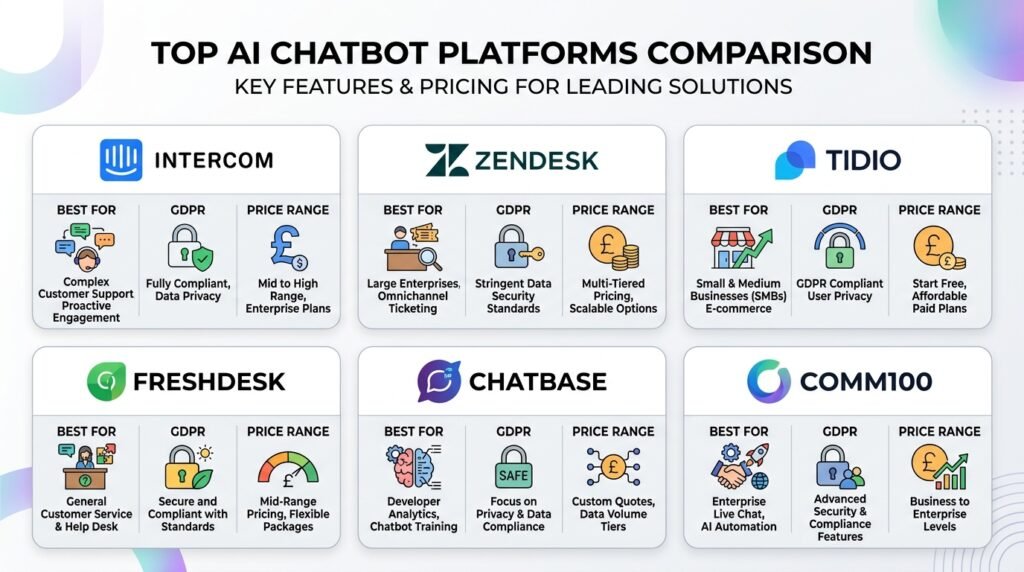
These platforms are the strongest options for UK businesses right now, evaluated on UK GDPR compliance, British English support, omnichannel capabilities, deployment speed, and overall value.
1. Intercom Fin
Best for: Mid-market to enterprise businesses wanting a high-resolution AI agent.
Intercom Fin is built on OpenAI and resolves complex, multi-step queries with a high degree of accuracy. It connects to third-party systems via API, handles account updates and payment processing, and routes to human agents when needed. It holds SOC 2 Type II, ISO 27001, GDPR, and HIPAA certifications, with EU data hosting in Dublin available since 2022.
The downside: Fin only works within Intercom’s broader platform. You can’t adopt it without committing to their full suite. Seat-based pricing starts at $39–$139 per agent per month, with resolution fees on top. For new buyers not already on Intercom, that’s a significant total cost.
Deployment speed: 1 week for existing Intercom customers; longer for greenfield buyers.
2. Zendesk AI Agents
Best for: Established businesses already on Zendesk, or teams that treat support as a data function.
Zendesk acquired Ultimate.ai in 2024 and now offers its combined product as Zendesk AI Agents (Advanced). It excels at intent detection — not just answering questions, but categorising them to surface business trends. Resolution rates vary widely (30–80%) depending on configuration, but compliance is strong. It holds SOC 2 Type II, ISO 27001, ISO 27018, GDPR, HIPAA, and FedRAMP Moderate authorisation, with EU data centres in Dublin.
Deployment speed: 1–3 weeks for existing Zendesk customers.
3. Tidio (Lyro AI)
Best for: UK SMEs wanting fast deployment without a technical team.
Tidio’s Lyro AI uses RAG architecture powered by Claude. It deploys in under 20 minutes, enforces British English tone, and offers transparent flat-rate pricing. For small businesses that need something live quickly without hiring a developer, this is one of the strongest options available.
Pricing: Starts from a low monthly flat rate; advanced features scale with usage.
4. Freshdesk (Freddy AI)
Best for: Teams wanting AI-powered ticket triage built into their helpdesk.
Freddy AI sits inside Freshdesk’s helpdesk platform and focuses on automating ticket routing and resolution. It integrates naturally with Freshdesk’s existing tools, making it a low-friction addition for teams already on the platform. The AI add-on costs $29 per agent per month on top of the base plan.
5. Chatbase
Best for: Businesses wanting a chatbot trained entirely on their own content.
Chatbase lets you build and deploy an AI agent trained on your knowledge base, documentation, and product data. Onboarding is fast, customisation is straightforward, and it integrates with Zendesk, HubSpot, Salesforce, and more. It’s particularly well-suited to businesses with a lot of existing support documentation they want the bot to use directly.
Pricing: Starts at $39/month.
6. Comm100
Best for: Businesses that need genuinely unified communication across every channel.
Comm100 handles live chat, email, social media, SMS, and voice from a single platform. Its AI layer manages triage and routing across all channels simultaneously. For businesses where the support query could come from anywhere, it removes the chaos of managing multiple tools.
Features That Separate Good Chatbots From Great Ones
Not all AI chatbots are equal. These five features are the real differentiators when comparing platforms.
Natural Language Understanding (NLU)
NLU is what allows a chatbot to understand “my order’s not shown up” and “where’s my parcel?” as the same query. Without strong NLU, bots force customers into rigid menus and fail on anything phrased unexpectedly. Look for platforms that explicitly mention NLU, not just NLP — NLU is the deeper capability.
Human Handoff Logic
The best chatbots know when to stop. Escalation rules define the conditions under which a conversation is passed to a human agent — by keyword, query complexity, customer sentiment, or time of day. A bot without good handoff logic frustrates customers and creates more work for agents.
Omnichannel Support
UK customers contact businesses through WhatsApp, email, Instagram DMs, live chat, and sometimes SMS. A chatbot that only works on your website is a limited tool. Omnichannel capability means one AI layer manages support across all channels consistently.
Sentiment Analysis and Mood Detection
Some platforms — notably CrafterQ and Intercom — include sentiment shift detection. The bot monitors how the customer’s emotional tone changes during a conversation and can trigger a human handoff before frustration escalates into a complaint. For high-value customers or sensitive industries, this is more than a nice-to-have.
CRM and Helpdesk Integrations
Your chatbot is only as useful as the data it can access. The best platforms integrate natively with Salesforce, HubSpot, Zendesk, and Freshdesk without custom engineering. Webhook-only integrations push the cost and complexity onto your team and slow deployment by weeks.
UK GDPR and AI Chatbot Compliance (2026)
This is where UK businesses need to pay close attention. Deploying an AI chatbot without proper data governance isn’t just a technical gap — it’s a legal one.
The ICO’s average fine rose from around £380,000 in 2024 to just under £3 million in 2025. Cumulative GDPR fines across Europe since 2018 now exceed €7.1 billion, with more than 60% of the total imposed since January 2023. AI processing of personal data is now the second most common trigger for enforcement action, after consent violations.
Data Processing Agreements — What to Ask Every Vendor
Before signing with any chatbot provider, you need a signed Data Processing Agreement (DPA). This is mandatory under UK GDPR for any vendor processing personal data on your behalf. The DPA must specify what data is collected, how it’s stored, and your rights to delete it.
If a vendor won’t sign a DPA or doesn’t have one ready, walk away.
UK Data Residency Requirements
UK GDPR doesn’t require data to be stored in the UK, but it does restrict transfers to countries without an adequacy decision. EU hosting (Dublin, Amsterdam, Frankfurt) generally satisfies this for UK businesses post-Brexit. Check specifically whether your chosen platform hosts data in the EU or US — US-hosted data creates additional compliance steps.
The Data (Use and Access) Act 2025
The UK’s Data (Use and Access) Act 2025 updated how automated decision-making is governed domestically. It allows automation in customer-facing decisions but requires that those decisions can be reviewed, challenged, and corrected. Your chatbot’s responses are treated as company statements — if the bot gives wrong information, the liability sits with you, not the platform provider.
ICO Oversight and Real Fines
UK AI chatbots fall under ICO oversight for data protection, FCA oversight for financial services use, and CMA oversight for consumer protection. Any chatbot that doesn’t clearly disclose it’s an AI — one that “pretends to be human” — risks a fine of up to £17.5 million or 4% of global revenue under UK GDPR’s transparency requirements.
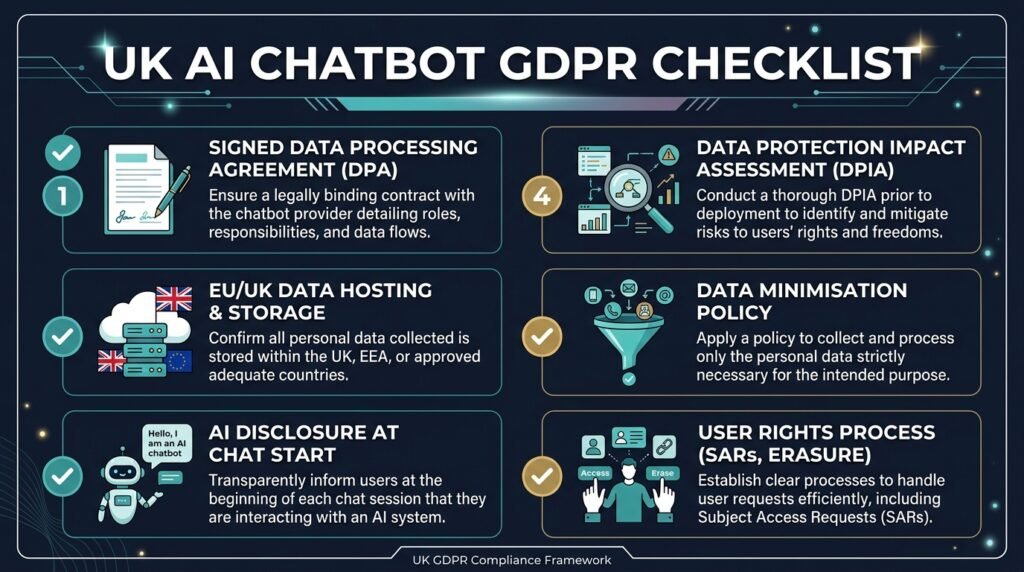
The practical checklist before you go live:
- Signed DPA with your vendor
- EU or UK data residency confirmed
- Clear AI disclosure at the start of every conversation
- DPIA (Data Protection Impact Assessment) completed if high-risk
- Data minimisation — only collect what you actually need
- User rights process — how customers can access or delete their data
If you’re operating as a limited company, understanding your legal obligations as a director matters here too. The guide to setting up a limited company in the UK covers the governance responsibilities that come with running a UK business — relevant context for anyone adding AI systems to their operations.
How to Choose the Right Chatbot for Your UK Business
The right platform depends on your size, your existing tech stack, and how much internal resource you have for setup and maintenance.
SME Buyers (1–50 Staff)
Prioritise fast deployment and transparent pricing. You don’t have a developer to build custom integrations or weeks to configure a system. Tidio (Lyro) and Chatbase are the strongest options here — both deploy quickly, don’t require coding, and offer flat-rate pricing you can budget reliably.
Avoid platforms with custom-quote pricing at the SME stage. “Contact us for enterprise pricing” is a red flag for a small business — the real cost is almost always higher than the feature value at your scale.
Mid-Market and Enterprise Buyers (50+ Staff)
At this scale, resolution rate accuracy, data governance, and integration depth matter more than deployment speed. Zendesk AI Agents or Intercom Fin are the strongest choices — both have the compliance certifications, integration ecosystems, and analytics depth that larger teams need.
Expect 1–3 weeks for deployment if you’re already on either platform’s ecosystem. New buyers switching their primary support tool should budget 4–8 weeks minimum.
Pricing Models Explained
Three main models exist:
- Per agent per month: Common with Zendesk and Intercom. Costs compound with team size.
- Per resolution: You pay for each query the bot resolves. Aligns costs with value but can be unpredictable at high volume.
- Flat fee: Fixed monthly cost regardless of volume. Tidio and Chatbase use this model. Easier to budget, especially for SMEs.
For businesses thinking carefully about their cost structure — including how software subscriptions sit in your accounts — the article on business expenses you can claim in the UK is worth reviewing. Chatbot subscriptions typically qualify as an allowable business expense, which affects your tax position.
How to Deploy an AI Chatbot — Step by Step
Most failed chatbot implementations fail for the same reason: the business went live before the bot was ready. These five steps reduce that risk significantly.
Step 1: Define What the Bot Must Solve
Don’t try to automate everything from day one. Start with your three to five highest-volume, most repetitive query types. Order tracking, appointment booking, returns policy, opening hours — these are the right starting points. Scope creep at the design stage is the main cause of long, expensive deployments.
Step 2: Build the Knowledge Base
Your bot is only as good as the information it has access to. Feed it your help centre articles, product documentation, returns policy, and FAQs. For RAG-based platforms, this is the core training material. Keep it accurate and up to date — stale content produces wrong answers.
Step 3: Set Escalation Rules
Define exactly when the bot hands off to a human. Common triggers: the word “complaint,” payment or refund requests, repeated failed resolution attempts, or customer sentiment turning negative. Good escalation logic is what separates a functional chatbot from a customer-frustrating one.
Step 4: Test in a Controlled Environment
Run the bot internally before exposing it to real customers. Test edge cases — unusual phrasing, complaints, sensitive topics. Have someone who didn’t build it try to break it. This is where you find the gaps.
Step 5: Monitor, Measure, Improve
Go live, then watch closely. Track resolution rate, escalation rate, customer satisfaction scores, and which queries the bot fails most often. Most platforms produce automated improvement recommendations. Act on them within the first 30 days — the first month of live data is the most valuable.
FAQs — AI Chatbot for Customer Service UK
What is the best AI chatbot for customer service in the UK?
The best option depends on your business size. Tidio (Lyro AI) is the strongest choice for UK SMEs — fast deployment, British English support, flat-rate pricing, and GDPR-compliant. For larger teams, Zendesk AI Agents or Intercom Fin offer deeper integrations and stronger compliance certification stacks.
How much does an AI chatbot cost in the UK?
Entry-level platforms start from around £30–£40 per month (Chatbase, Tidio). Mid-market platforms like Freshdesk with Freddy AI cost roughly £25–£30 per agent per month extra. Enterprise platforms (Zendesk, Intercom) start at £40–£120 per agent per month, with additional resolution fees on top.
Is an AI chatbot GDPR compliant?
That depends on the platform and how you deploy it. The platform must sign a Data Processing Agreement with you, store data in the EU or UK, and allow users to delete their data. Most major platforms (Zendesk, Intercom, Tidio, SiteGPT) are GDPR compliant — but compliance depends on your configuration, not just the tool.
Can an AI chatbot replace human customer service agents?
No — and it’s not designed to. Chatbots handle repetitive, high-volume queries effectively, typically 60–80% of incoming tickets. Complex complaints, sensitive cases, and relationship-critical conversations still need human handling. The best implementations use chatbots to free human agents for higher-value work.
How long does it take to deploy an AI chatbot?
Fast-tier platforms (Tidio, Chatbase) can be live in under an hour. Mid-market platforms typically take 1–3 weeks with proper configuration. Enterprise deployments where you’re changing your primary support tool take 4–8 weeks minimum.
Do I need technical skills to set up an AI chatbot?
Not with most modern platforms. Tools like Tidio, Chatbase, and Freshdesk are built for non-technical users. You configure them through a dashboard — no code required. More complex integrations (custom CRM connections, webhook workflows) may need developer input.
What regulations apply to AI chatbots in the UK?
UK AI chatbots fall under three regulatory regimes: the ICO (data protection, UK GDPR), the FCA (if used in financial services), and the CMA (consumer protection). The Data (Use and Access) Act 2025 also applies to automated decision-making. Any chatbot not clearly disclosed as AI risks ICO enforcement action.
Which AI Chatbot Is Right for Your UK Business?
AI chatbots in 2026 are not what they were three years ago. The scripted, frustrating bots that pushed customers toward the phone are mostly gone. What’s replaced them are systems that genuinely resolve queries, learn from interactions, and integrate into your existing tools.
For UK businesses, the deployment decision comes down to three things: compliance, cost model, and speed to value. Get a signed DPA. Confirm where your data is hosted. Pick a platform that matches your team size and technical capacity — not the most feature-rich option on the market.
An AI chatbot isn’t a replacement for good customer service. It’s what lets a small team deliver good customer service at a scale they couldn’t otherwise reach.
If you’re running a limited company and thinking about how tools like this fit into your cost structure and tax position, it’s worth understanding how your business expenses and operating costs interact with your overall tax bill. Decisions around corporation tax in the UK and what you can claim as a business expense can affect the real cost of software investments like this.