

If illness stops you working, your income stops too. This guide shows what money exists, how much it pays and how fast it arrives.
Quick answer: No. Sole traders, partners and anyone else who pays tax through Self Assessment cannot get statutory sick pay (SSP), because employers pay it. You may be able to claim New Style Employment and Support Allowance (ESA) or Universal Credit instead. Income protection insurance can cover the gap. Limited company directors paid through PAYE may qualify for SSP from their own company. Rates below are for 2026/27.
Can you get statutory sick pay if you’re self-employed?
No. SSP is the minimum sick pay an employer must pay an eligible worker. If you work for yourself, you have no employer to pay it. That stays true even if you have paid National Insurance for decades.
Why SSP only covers employees
A worker must be classed as employed for tax purposes to get SSP, as Acas explains. Anyone whose tax comes out through PAYE meets that test. Anyone who pays their own tax through Self Assessment does not. New to tax returns? Our guide to registering for Self Assessment covers the first steps.
HMRC guidance also rules out self-employed agency workers.
What changed on 6 April 2026 (and what didn’t)
The Employment Rights Act 2025 changed SSP for employees on 6 April 2026:
- SSP starts on the first day off sick. It used to start on the fourth.
- The lower earnings limit has gone, so there is no minimum weekly pay to qualify.
- The rate is £123.25 a week, or 80% of average weekly earnings if that is lower. It lasts up to 28 weeks.
At the top rate, 28 weeks of SSP adds up to £3,451. None of this reaches sole traders or partners. Older guides still quote £116.75 or £118.75 and mention waiting days. Those figures are out of date.
Which type of self-employed are you?
Your tax status decides whether you can get SSP, not your job title.
Sole traders and partners
You cannot get SSP. If you work in a partnership, read your partnership agreement. Some include a clause on how profits are shared when a partner is ill. Don’t have one? Our guide to setting up a business partnership covers what to include.
Limited company directors
You may qualify. A director paid through PAYE is an employee of their own company, so the company can owe them SSP. The normal conditions still apply, including a fit note after seven days off.
HMRC counts director fees, wages and dividends when it works out a director’s average weekly earnings. If you take only dividends and no payroll salary, check with an accountant or HMRC before you count on SSP. Some sole traders consider moving to a limited company partly for this reason. It’s a big step with tax and admin costs, so weigh it up first.
PAYE job plus freelance work, agency and gig work
If you have a PAYE job and freelance on the side, any SSP comes from the job. It’s based on your pay there, not your freelance income.
Agency and gig work needs care. Your working relationship decides your status, not the label on your invoice. If you’re unsure, use the GOV.UK Check employment status for tax tool. Some people who think they’re self-employed are employees for tax. They miss SSP they are owed.
What can you claim instead of sick pay?
Sole traders and partners can usually claim New Style ESA if their National Insurance record is strong enough. Universal Credit helps if household income and savings are low. PIP covers extra costs from a long-term condition. You can often claim more than one.
| Support | Who it suits | Amount in 2026/27 | Main condition |
|---|---|---|---|
| SSP | Employees and PAYE directors | £123.25 a week, or 80% of average earnings, up to 28 weeks | Employed for tax purposes |
| New Style ESA | Sole traders and partners with enough NI | £75.65 (under 25) or £95.55 (25+) for 13 weeks, then up to £95.55 or £145.90 | Fit note and enough NI |
| Universal Credit | Low household income and savings | Varies by household | Means-tested; minimum income floor may apply |
| PIP / Adult Disability Payment | Long-term condition with extra costs | Set by assessment | Not tied to work or NI |
| Income protection | Anyone who buys cover before illness | Often 50% to 70% of income | Policy in place first |
New Style ESA
ESA is the closest thing to sick pay for the self-employed. You must be under State Pension age and have a health condition or disability that limits your work. You also need enough National Insurance, usually from the last two to three years. National Insurance credits count too. You can apply for ESA on GOV.UK.
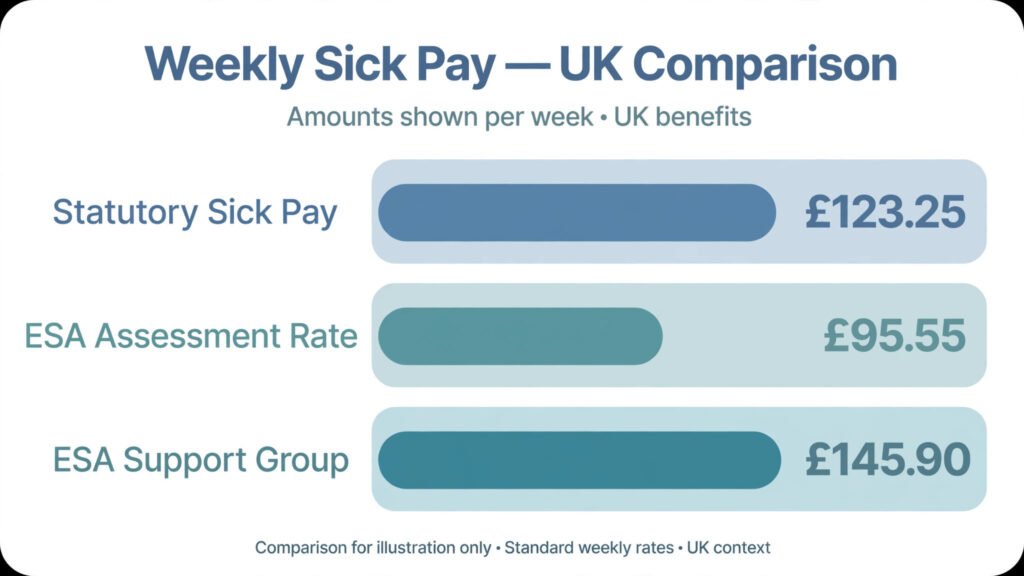
The first 13 weeks are the assessment phase. You get up to £75.65 a week if you’re under 25 and up to £95.55 if you’re 25 or over. After a work capability assessment, you join one of two groups. The work-related activity group pays up to £95.55 a week. The support group pays up to £145.90.
Payment isn’t instant. You usually get nothing for the first seven days of limited capability for work, though DWP can often backdate a claim by up to three months. You’ll need a fit note. Time in the work-related activity group is usually capped at 365 days, while the support group has no cap.
Here is the gap in real numbers. An employee on top-rate SSP gets £123.25 a week. A sole trader aged 25 or over on the ESA assessment rate gets £95.55. That is £27.70 less a week, or £360.10 over 13 weeks, before the seven waiting days.
You can do limited work while claiming. Permitted work means under 16 hours a week and no more than £203.50 a week in earnings. That includes work for your own business. Tell DWP before you start. Earning over the limit in any week means no ESA for that week.
Universal Credit
Universal Credit (UC) is a monthly payment for people on a low income, including the self-employed. Your award depends on your household income and savings. If you also get ESA, your UC is reduced by the ESA amount.
The rule that catches people out is the minimum income floor. DWP can treat you as earning a set amount, even when you earn less. It is based on the National Living Wage, £12.71 an hour from April 2026, for your expected weekly hours. If you have limited capability for work, the floor usually stops applying. So send your fit note to your work coach quickly.
Watch the health element too. From 6 April 2026, most new claimants assessed as having limited capability for work-related activity get £217.26 a month. People already on it, the terminally ill and those who meet the severe conditions test keep the higher £429.80 rate. The lower rate is frozen until 2029/30, and the element usually starts after a three-month wait.
The first UC payment can take up to five weeks. Ask about an advance if you can’t wait. You can check the rules on GOV.UK.
PIP and Adult Disability Payment in Scotland
Personal Independence Payment (PIP) helps with the extra costs of a long-term health condition or disability. It doesn’t depend on your work or National Insurance, and you can claim while working. In Scotland, Adult Disability Payment from Social Security Scotland replaces PIP for new claims. Both are set by an assessment of how your condition affects daily life and getting around.
Check your National Insurance record before you need it
ESA depends on your National Insurance record, so check it now, not when you are ill. You can check your record on GOV.UK.
Class 2 is treated as paid if your profits reach £7,105 in 2026/27, so the year still counts. Below that, you can choose to pay voluntary Class 2 at £3.65 a week. It’s a cheap way to protect your benefit rights. If you see gaps, ask HMRC how to fill them.
Income protection and savings
Income protection insurance is the private product closest to sick pay. It pays a regular income, usually tax-free, if illness or injury stops you working. Know these terms before you compare quotes:
- Payout: most policies pay 50% to 70% of your pre-tax income.
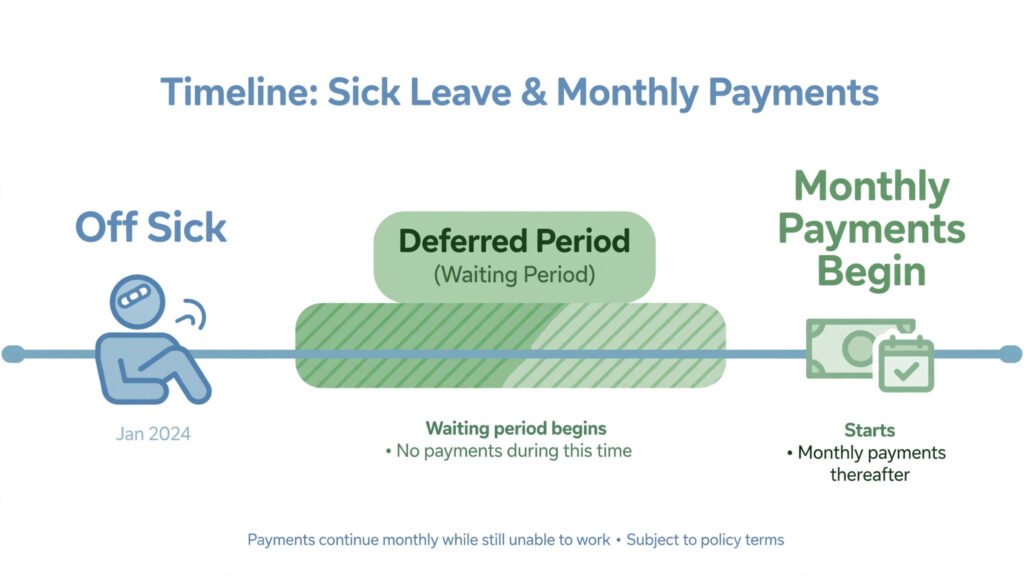
- Deferred period: the wait before payments start. Common choices are 4, 8, 13 or 26 weeks. Longer waits mean cheaper premiums.
- Length of cover: short-term policies pay for one to two years. Long-term policies pay until retirement age.
- Cost: age, job, health, smoking and level of cover all change the price.
- Exclusions: pre-existing conditions are usually not covered. Read the small print.
Match the deferred period to your savings. If you hold three months of outgoings, a 13-week wait fits. A common target is three to six months of outgoings. Free accounting software can forecast how long your cash would last.
Here’s a simple example. You make £2,500 a month and a policy pays 60%. That’s £1,500 a month, and it can’t be used for business costs.
Critical illness cover is different. It pays a lump sum if you get a named serious diagnosis. Standard business policies don’t cover your own illness either. Our guide to what UK business insurance you need shows what they do cover. Get quotes from several providers, or speak to an adviser.
What to do in your first week off sick
- Tell key clients and pause or hand over urgent work. Automating your invoicing keeps payments moving while you rest.
- Self-certify for the first seven days. After that, get a fit note from your GP.
- Check your National Insurance record on GOV.UK.
- Apply for New Style ESA online or by phone. If DWP suggests Universal Credit as well, you can say you only want ESA. Use a benefits calculator first.
- Claim Universal Credit if your household income is low. Send your fit note to your work coach.
- Contact your income protection insurer and note your deferred period.
- Keep clear records of income and expenses. Our guide to sole trader record keeping shows what to keep.
Avoid four common mistakes:
- Waiting to claim. ESA can often be backdated, but Universal Credit only rarely can.
- Working without telling DWP.
- Using old SSP rates when you plan your budget.
- Assuming a dividend-only director gets SSP.
FAQs
Can self-employed people get statutory sick pay?
No. SSP is paid by an employer to an employee, and sole traders and partners have no employer. You can claim ESA, Universal Credit or PIP instead, depending on your record and income. Directors paid through PAYE may qualify.
How much sick pay can a self-employed person get?
There is no automatic sick pay. New Style ESA pays up to £95.55 a week in the assessment phase for people aged 25 or over, and up to £145.90 in the support group. Universal Credit and income protection depend on your circumstances.
Can I claim Universal Credit and ESA together?
Yes. Your UC is reduced by the ESA you get. ESA is usually paid more often and earns different National Insurance credits, which count towards your State Pension. Use a benefits calculator to check the mix.
Do I need a fit note to claim?
Yes for ESA. You can self-certify for the first seven days, then you need a fit note from your GP. Ask for one early so your claim doesn’t stall.
Can a company director claim SSP from their own company?
Yes, if you are on the payroll and meet the normal conditions. Your company pays it, and the same rules apply as for any employee. Read up on company director responsibilities before you take on payroll duties.
Last updated: 21 September 2026. Rates are for 2026/27 and change each April, so check GOV.UK before you claim. This guide covers Great Britain and is general information, not financial or legal advice. Main sources: Acas, GOV.UK ESA guidance and HMRC SSP guidance.