
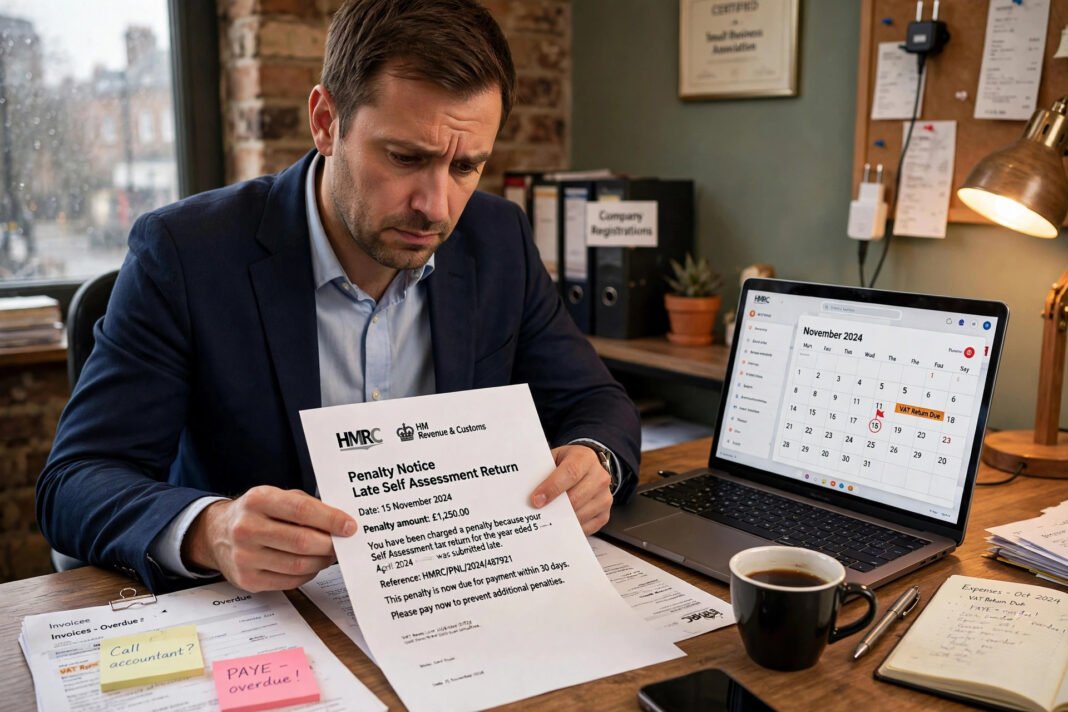

If you’ve missed a filing deadline for your limited company, you’re probably trying to work out one thing fast: how much this is going to cost, and whether it gets worse from here.
The short answer is that it depends on which deadline you missed. Your Company Tax Return and your annual accounts are two completely different filings, sent to two different government bodies, with two separate penalty systems. Miss both at once, and you can be fined by both at the same time.
This guide breaks down exactly what you owe, when it escalates, and how to appeal it.
What Counts as “Late Filing” for a Limited Company?
A limited company has two separate annual filing obligations, and each one carries its own late filing penalty.
HMRC Company Tax Return (CT600)
This is the return that reports your Corporation Tax. It’s filed with HMRC, not Companies House, and it’s what most people mean when they search for “HMRC late filing penalties.”
Annual Accounts — Filed with Companies House
Separately, every limited company must file annual accounts with Companies House. This is a public filing, not a tax return, and Companies House runs an entirely different, automatic penalty system for lateness.
Why These Get Confused
Both filings are usually due around the same time each year, and both relate to the same accounting period. That’s why directors often assume they’re one obligation. They’re not. If you’re late on both, HMRC and Companies House will each issue their own separate penalty — one missed year-end can cost you twice.
If you’re still setting up your reporting processes, it’s worth reviewing your company director responsibilities so you know exactly who is accountable for each deadline.
Key Deadlines Before We Talk Penalties
| Obligation | Deadline |
|---|---|
| Pay Corporation Tax (or confirm none is due) | 9 months and 1 day after your accounting period ends |
| File your Company Tax Return (CT600) with HMRC | 12 months after your accounting period ends |
| File annual accounts with Companies House | 9 months after your financial year ends (private company) |
| File first accounts with Companies House | 21 months after incorporation, or 3 months from your accounting reference date, whichever is longer |
Notice that your Corporation Tax payment is due before your CT600 filing. You can pay on time and still file late, or file on time and still owe interest for paying late. They’re tracked separately.
HMRC Corporation Tax Late Filing Penalties (CT600)
HMRC charges fixed penalties for a late CT600, regardless of whether you owe any tax. These are the current figures.
Rates for Filing Dates On or After 1 April 2026
Following Budget 2025, HMRC doubled its fixed late filing penalties for any Company Tax Return with a filing date on or after 1 April 2026, even if the accounting period itself ended earlier.
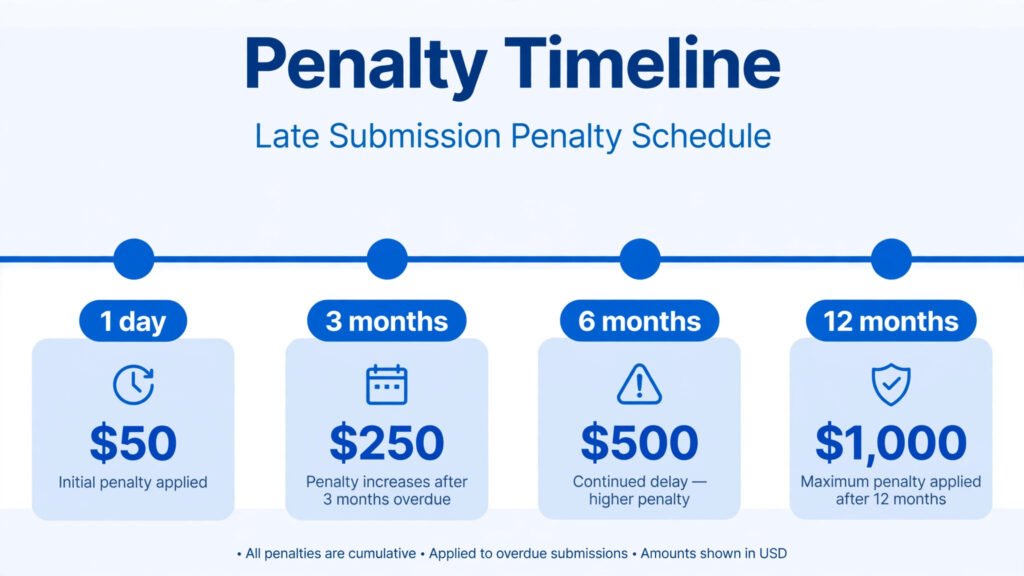
| Time after your deadline | Penalty |
|---|---|
| 1 day | £200 |
| 3 months | An additional £200 (total £400) |
| 6 months | HMRC estimates your tax bill and adds 10% of any unpaid tax |
| 12 months | A further 10% of any unpaid tax |
Rates for Filing Dates Before 1 April 2026
| Time after your deadline | Penalty |
|---|---|
| 1 day | £100 |
| 3 months | An additional £100 (total £200) |
| 6 months | HMRC estimates your tax bill and adds 10% of any unpaid tax |
| 12 months | A further 10% of any unpaid tax |
A number of accountancy sites are still quoting the older £100 figures. Check the filing date of your return, not just the accounting period, to know which table applies to you.
Repeat Offender Penalties
If your return is late three years in a row, the fixed penalties increase substantially:
- Filing date before 1 April 2026: £500 (within 3 months), £1,000 (more than 3 months late)
- Filing date on or after 1 April 2026: £1,000 (within 3 months), £2,000 (more than 3 months late)
Worked Example
Say your accounting period ended 30 June 2025. Your filing deadline is 30 June 2026 — after the rate change. You file 4 months late, and £15,000 of Corporation Tax is still unpaid at that point.
- £200 (day one) + £200 (past 3 months) = £400 fixed penalty
- No tax-geared penalty yet, because you’re not past the 6-month mark
Total penalty: £400, plus interest accruing daily on the unpaid £15,000.
What If My Tax Return Is 6+ Months Late? (Tax Determinations)
If your CT600 is still outstanding six months after the deadline, HMRC will issue what’s called a tax determination — their own estimate of how much Corporation Tax your company owes.
You cannot appeal a tax determination. The only way to remove it is to file your actual return and pay the real amount due. HMRC will then recalculate your interest and penalties based on the correct figures. Determinations are often higher than a company’s actual liability, which is one of the strongest reasons to file even if you can’t pay in full straight away.
Do I Still Get Fined If My Company Made No Profit or Is Dormant?
Yes. The fixed late filing penalties apply regardless of your company’s tax position. A dormant company, a loss-making year, or a company with zero Corporation Tax due still has to file its return by the deadline, and still faces the £200/£400 fixed penalties if it doesn’t.
Where a dormant or loss-making company does get a break is on the tax-geared penalties: 10% of nil unpaid tax is nil. So the percentage charges at 6 and 12 months won’t apply if there’s genuinely no tax owed — but the fixed penalties are unavoidable.
Companies House Late Filing Penalties (Annual Accounts)
Separately from HMRC, Companies House fines companies for late annual accounts. This penalty is automatic — there’s no warning notice before it’s issued.
Private Limited Company Penalties
| Time after your deadline | Penalty |
|---|---|
| Up to 1 month | £150 |
| 1 to 3 months | £375 |
| 3 to 6 months | £750 |
| More than 6 months | £1,500 |
Public Limited Company Penalties
| Time after your deadline | Penalty |
|---|---|
| Up to 1 month | £750 |
| 1 to 3 months | £1,500 |
| 3 to 6 months | £3,000 |
| More than 6 months | £7,500 |
If your accounts were also late the previous year, these penalties automatically double. Filing on time consistently is the only way to avoid this multiplier.
Other Penalties Directors Often Confuse With This
Self Assessment (Your Personal Return)
As a director, your Corporation Tax obligations are separate from your own Self Assessment tax return. If you’re new to filing personally, our guide on registering for Self Assessment covers the basics. Self Assessment late filing starts at a £100 fixed penalty, then £10 a day up to 90 days, then 5% of tax due (or £300, whichever is greater) at 6 and 12 months.
VAT Late Submission
If your company is VAT registered, late VAT returns use a points-based system rather than an immediate fine. You get one point per late submission, and only once you hit a threshold (4 points for quarterly filers, for example) does a £200 penalty apply.
Confirmation Statement vs. Accounts
A confirmation statement is not the same filing as your annual accounts, and it has its own separate deadline and consequences with Companies House. Don’t assume filing one covers the other.
Interest on Unpaid Corporation Tax
Interest is not a penalty — it’s a separate charge for the cost of the tax remaining unpaid. It’s calculated daily on your outstanding balance, based on the Bank of England base rate plus a margin, and it continues to accrue until the balance is cleared, even if you’ve agreed a payment plan with HMRC.
You can owe interest without owing a single penalty, simply by paying late while filing on time. The two run independently.
How to Appeal a Late Filing Penalty
Appealing an HMRC Corporation Tax Penalty
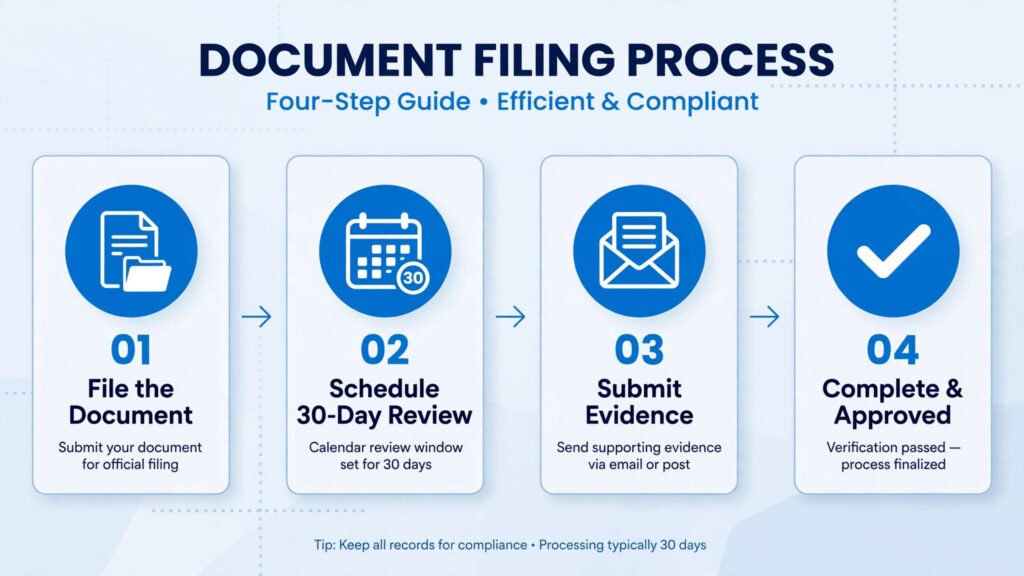
- File your overdue Company Tax Return first — HMRC won’t consider an appeal until the return is actually submitted.
- Submit your appeal within 30 days of the date on the penalty notice.
- Include your company’s Unique Taxpayer Reference (UTR), the penalty notice date, the penalty amount, and the end date of the relevant accounting period.
- Explain your reasonable excuse and provide supporting evidence if you have it.
If HMRC rejects the appeal, you can request an independent review or take the case to the First-tier Tribunal.
Appealing a Companies House Penalty
This is a separate process, submitted through the Companies House penalty appeal service. You’ll need your company number, the penalty reference, and your reason for appealing. Supporting documents are optional but strengthen your case.
What Actually Counts as a Reasonable Excuse
HMRC and Companies House both use a “reasonable excuse” test, but the bar is higher than most directors expect. Examples that are typically accepted include a serious unexpected illness close to the deadline, a bereavement, or a documented failure of HMRC’s own online filing system. Relying on an accountant who then failed to file is generally not accepted as a reasonable excuse on its own — though you may have a separate claim against the accountant.
What Happens If You Ignore the Penalty?
Ignoring a penalty notice doesn’t make it go away — it escalates. HMRC can pass unpaid penalties and tax to debt collection agencies, and in persistent cases can pursue legal action against the company. Companies House can eventually move toward striking a non-compliant company off the register, which brings its own complications for directors, creditors, and any remaining assets. If your company is heading toward serious financial difficulty rather than a one-off missed deadline, it’s worth understanding your options for closing a limited company properly rather than letting it be struck off by default.
How to Avoid Late Filing Penalties Going Forward
- Diarise both deadlines separately. Your CT600 and your Companies House accounts have different due dates — don’t rely on one reminder to cover both.
- File even if you can’t pay. The fixed filing penalty and the payment penalty are separate. Filing on time avoids the fixed penalty even if you need more time to pay.
- Use accounting software that flags deadlines automatically. Comparing Xero vs QuickBooks or looking at free accounting software options is a good starting point if you’re currently tracking deadlines manually.
- Keep records current throughout the year, not just before filing. Good ongoing record keeping practices make year-end filing faster and reduce the chance of last-minute delays.
- Contact HMRC early if you can’t pay. A Time to Pay arrangement won’t remove interest, but agreeing one before the deadline can prevent additional enforcement action.
Frequently Asked Questions
What is the penalty for filing a company tax return one day late?
For a filing date on or after 1 April 2026, it’s £200. For filing dates before that, it’s £100. This applies even if no tax is owed.
Do I still get fined if my company owes no Corporation Tax?
Yes. The fixed penalty applies regardless of your tax position. Only the later 10% tax-geared penalties are reduced to nil if there’s no unpaid tax.
Can HMRC waive a late filing penalty?
Only if you have a reasonable excuse, accepted on appeal, and only after you’ve filed the overdue return. HMRC cannot waive a tax determination — you have to displace it by filing.
Are HMRC and Companies House penalties the same thing?
No. They’re separate regulators, separate filings, and separate penalty systems. You can be fined by both for the same missed year-end.
What happens after 12 months of not filing?
By this point you’ll have accrued the full fixed penalty, two rounds of 10% tax-geared penalties if tax is unpaid, a tax determination from HMRC, and the maximum Companies House accounts penalty. This is the stage where professional advice is strongly recommended.