
From 6 April 2026, the Business Asset Disposal Relief rate rose to 18% — the third increase in three years. If you’re selling a business or disposing of assets this tax year, here’s exactly what you’ll pay and what you can claim to reduce it.
Capital Gains Tax (CGT) applies when you sell or give away a business asset that has gone up in value. You pay tax on the profit — the gain — not the full sale price. With rates rising again in 2026 and the annual exemption sitting at just £3,000, the cost of a poorly timed or unplanned disposal has never been higher.
This guide covers every relevant rate, relief, and deadline for the 2026/27 tax year. Whether you’re a sole trader, partner, or company director, this is what you need to know before you make any disposal.
What Is Capital Gains Tax on Business Assets?
CGT is charged on the gain you make when you dispose of a chargeable asset. Dispose means sell, gift, transfer, or exchange — not just outright sales.
Business assets that can attract CGT include:
- Land and buildings used in the business
- Goodwill
- Plant and machinery
- Fixtures and fittings
- Intellectual property and patents
- Shares in a trading company (for directors and employees)
One critical distinction: limited companies do not pay CGT — they pay Corporation Tax on profits from asset sales instead. CGT only applies when you, as an individual, make a personal gain — most commonly when you sell shares in your company, or when you retain business assets personally on exit.
Sole traders, partners, and directors selling personally owned assets or shares all fall under CGT rules.
CGT Rates on Business Assets in 2026/27
Following the October 2024 Budget, CGT rates on non-residential assets were increased and aligned with residential property rates. Those rates now apply directly to business assets.
Standard CGT rates for individuals in 2026/27:
| Taxpayer | Rate |
|---|---|
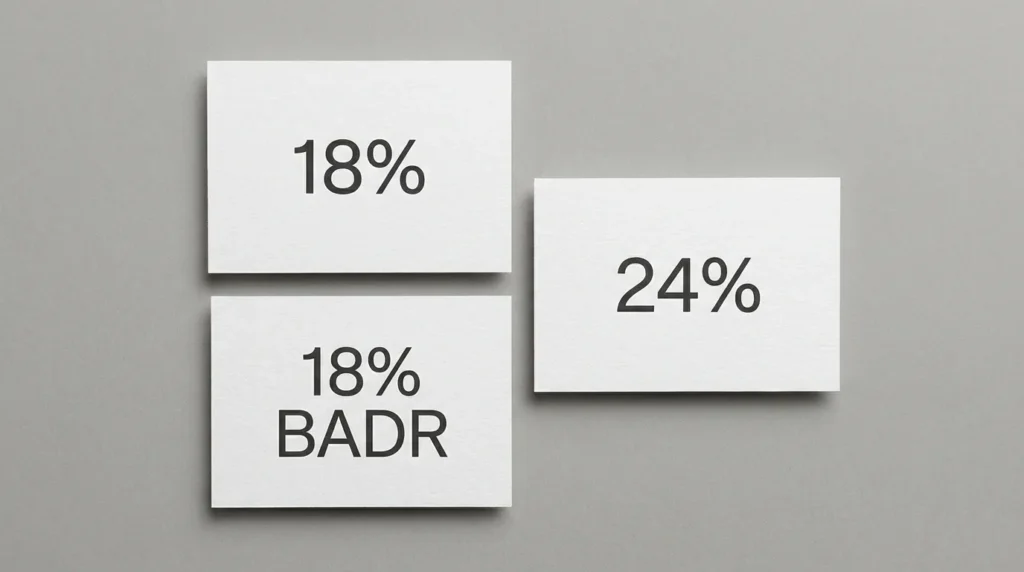
| Basic rate taxpayer | 18% |
| Higher or additional rate taxpayer | 24% |
| Under Business Asset Disposal Relief | 18% (flat rate) |
Your income band determines which standard rate applies. If your taxable income already sits in the higher-rate band (above £50,270), your entire business asset gain is taxed at 24% — unless BADR applies.
If you’re a basic-rate taxpayer but the gain pushes your total income over the £50,270 threshold, you’ll pay 18% on the portion within the basic-rate band and 24% on the remainder.
The £3,000 Annual Exempt Amount
Every individual gets a £3,000 annual exempt amount (AEA) — gains below this threshold are tax-free. The AEA has dropped sharply from £12,300 in 2022/23. Far more business owners are now paying CGT on disposals that would have been fully sheltered three years ago. The AEA can’t be carried forward; use it in the tax year or lose it entirely.
Business Asset Disposal Relief in 2026: The 18% Change
Business Asset Disposal Relief (BADR) — formerly Entrepreneurs’ Relief — lets eligible business owners pay a reduced flat rate of CGT on qualifying disposals, regardless of income band.
The rate has risen significantly over three years:
| Tax Year | BADR Rate |
|---|---|
| 2024/25 and earlier | 10% |
| 2025/26 | 14% |
| 2026/27 onwards | 18% |
Even at 18%, BADR still beats the standard 24% rate for higher-rate taxpayers. On a £1 million gain, the tax saving over the standard rate is £60,000.
Who Qualifies for BADR?
You must meet all of the following conditions for at least two continuous years before the disposal date:
- You own a trading business as a sole trader or partner, or
- You hold at least 5% of shares and 5% of voting rights in a qualifying trading company
- You’re an officer or employee of that company
- The business must be a genuine trading business — not one whose activity is mainly investment or property rental
The £1 Million Lifetime Limit
BADR applies to a maximum of £1 million in qualifying gains across your entire lifetime. It’s cumulative. If you claimed BADR on a £600,000 gain in 2022, only £400,000 of future qualifying gains can use the relief.
How BADR and the AEA Interact
This is missed by most guides. The £3,000 annual exempt amount deducts from your total gain before BADR applies. On a £200,000 qualifying gain, the first £3,000 is tax-free, and BADR at 18% applies to the remaining £197,000 — not the full £200,000. Small difference on large gains, but it still affects your liability calculation.
Worked Example: Sole Trader Selling Business Assets
A sole trader sells her printing business in June 2026. The disposal involves:
- Goodwill: sold for £180,000 (original value nil)
- Plant and machinery: sold for £40,000 (original cost £15,000, gain = £25,000)
Total gain: £180,000 + £25,000 = £205,000
Less Annual Exempt Amount: £205,000 − £3,000 = £202,000 taxable
She qualifies for BADR on the full amount (within her £1m lifetime limit).
CGT with BADR: £202,000 × 18% = £36,360
CGT without BADR (higher-rate taxpayer): £202,000 × 24% = £48,480
BADR saving: £12,120 — secured through a single claim on her Self Assessment return.
Other Business Reliefs That Reduce or Defer CGT
Rollover Relief
If you sell a qualifying business asset and reinvest the proceeds into a new qualifying asset within three years (or one year before sale), you can defer the CGT. The gain is “rolled over” into the base cost of the new asset. You don’t pay tax now; you pay it when you eventually sell the replacement.
Qualifying assets include land, buildings, and fixed plant used in a trade.
Gift Hold-Over Relief
When you give away business assets or shares in a trading company, you can elect to defer the gain using Gift Hold-Over Relief. The gain doesn’t disappear — the recipient inherits your original base cost and will pay CGT when they sell. Most useful for family business transfers.
Investors’ Relief
Investors’ Relief works like BADR but for external investors who hold unlisted shares in a trading company for at least three years. From April 2026, the lifetime limit was cut from £10 million to £1 million. The CGT rate is also 18% in 2026/27. If you’re an investor in qualifying early-stage companies, this change is significant.
Capital Loss Offsetting
Losses on other disposals in the same tax year can be offset directly against your business asset gains. Any remaining losses carry forward indefinitely — they never expire. Review all disposals across the year before calculating your final CGT.
Asset Sale vs Share Sale: Which Is More Tax-Efficient?
When exiting a limited company, you can either sell the shares (the buyer acquires the whole company) or sell the underlying assets (the company sells its assets, then you extract the proceeds).
On a £500,000 gain, the numbers look starkly different:
Share sale (director selling shares personally):
- Potentially qualifies for BADR at 18%
- CGT after £3,000 AEA: approximately £89,460
Asset sale (company sells assets, director extracts cash):
- Company pays 25% Corporation Tax on the gain: £125,000
- Director then pays Dividend Tax or Income Tax on the remaining cash extracted
- Effective combined tax rate: considerably higher in almost every scenario
For most owner-managed businesses, a share sale is the more tax-efficient route by a significant margin. Buyers sometimes prefer an asset sale for their own commercial or legal reasons — which makes this a key negotiation point in most business exit deals. Before agreeing to either structure, take advice on the full tax picture for both parties.
Reporting and Paying CGT on Business Assets to HMRC
Unlike residential property gains (which require a 60-day CGT report to HMRC), business asset gains are reported through your annual Self Assessment tax return.
Key deadlines for 2026/27 disposals:
| Submission type | Deadline |
|---|---|
| Paper Self Assessment return | 31 October 2027 |
| Online Self Assessment return | 31 January 2028 |
| CGT payment due | 31 January 2028 |
Filing late triggers an automatic £100 penalty from HMRC, which compounds the longer the return remains outstanding — additional penalties apply at three months, six months, and twelve months.
Claiming BADR on Your Return
BADR is not applied automatically. You claim it in the Capital Gains pages of your Self Assessment return. HMRC allows up to four years from the 31 January following the end of the tax year to amend a claim. For 2026/27 disposals, the amendment deadline is 31 January 2032.
What Records to Keep
Keep: original purchase contracts, sale agreements, professional valuation reports, records of all allowable improvement costs, and any BADR claim documentation. HMRC can open an enquiry into a CGT return up to four years after submission — keep records accordingly.

Six Ways to Reduce Your CGT Bill Before You Sell
- Claim BADR if you qualify. The difference between 18% and 24% on a £500,000 gain is £30,000. One section of your Self Assessment return.
- Time disposals across tax years. Completing part of a disposal after 5 April gives you a fresh £3,000 annual exempt amount for the following year.
- Transfer assets to a spouse or civil partner first. Transfers between spouses are CGT-free. Your spouse then sells using their own AEA and potentially a lower income tax band.
- Offset all capital losses in the year. Review shares, investment properties, and other disposals. Any capital losses directly reduce your taxable gain before CGT is applied.
- Consider Rollover Relief if you’re reinvesting. If you’re selling one business asset and buying another, you can defer the entire gain rather than paying it now.
- Don’t rush the disposal date. April completions give you maximum time to plan payment and potentially split large disposals across two tax years.
Frequently Asked Questions
Does my limited company pay CGT when it sells business assets? No. Limited companies pay Corporation Tax on profits from asset disposals, not CGT. CGT applies when you, as an individual, make a personal gain — most commonly on a share sale.
Can I still claim BADR if I’ve already used part of my £1 million lifetime limit? Yes. BADR applies cumulatively to total qualifying gains up to £1 million. If you’ve previously claimed on £300,000 of gains, you have £700,000 of the lifetime limit remaining.
What is the CGT rate on business assets for a basic-rate taxpayer in 2026? The standard rate is 18%. Under BADR, it’s also 18% — so basic-rate taxpayers gain no rate advantage from BADR. The relief matters most for higher-rate and additional-rate taxpayers, where the saving is 6 percentage points.
When exactly do I pay CGT on a business asset sold in 2026? If the disposal falls in the 2026/27 tax year (6 April 2026 to 5 April 2027), payment is due by 31 January 2028 alongside your Self Assessment return.
Final Thoughts
The CGT picture for business assets in 2026 is less favourable than it was five years ago. The BADR rate has nearly doubled from 10% to 18%, the annual exemption has fallen by 77% from its 2022/23 level, and standard rates are now 6–14 percentage points higher than they were in the early 2020s.
That said, meaningful planning is still possible. BADR reduces your rate to 18%. Rollover Relief defers gains into the future. Spouses can double the annual exemption. Capital losses reduce the taxable gain directly. Each of these requires action before the disposal — not after.
If you’re planning a business exit or selling significant assets this year, the gap between a well-structured disposal and an unplanned one can comfortably reach five or six figures in avoidable tax.