


Most “best lead generation tools” lists are written for the US market. Prices are in dollars, phone data barely covers the UK, and compliance advice stops at “make sure you’re GDPR compliant” — which tells you nothing useful. This guide fixes that. It’s built around what UK small businesses actually need: accurate local contact data, a stack you can afford, and a clear understanding of what UK GDPR and PECR actually allow.
The UK Lead Generation Landscape: Why General Tools Often Fail SMEs
Global lead generation platforms are usually built around the US market first. That creates two problems for a UK small business: the data often doesn’t cover UK contacts well, and the compliance rules the tool was designed around don’t match UK law.
The Local Coverage Gap (UK vs. US Databases)
US-first databases like the standard ZoomInfo tiers are strong on American direct dials and email accuracy, but coverage thins out noticeably once you search for UK mobile numbers or SME contacts outside London. If your ideal customer is a finance director at a Manchester manufacturing firm rather than a VP at a US SaaS company, a US-weighted database will waste your credits on stale or missing records. UK-and-EMEA-first providers such as Cognism build their data specifically around European and UK compliance and phone-verification standards, which tends to produce better direct-dial accuracy for domestic prospecting.
The Non-Negotiable Compliance Hurdle (UK GDPR & PECR)
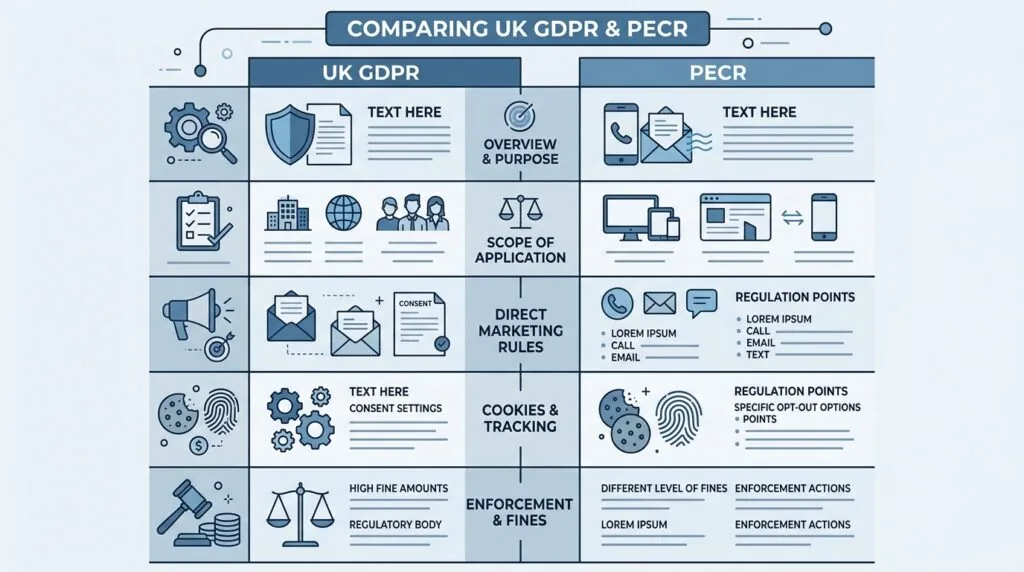
Since Brexit, the UK runs its own version of GDPR — UK GDPR — sitting alongside the Data Protection Act 2018. It’s very similar to EU GDPR but is enforced separately by the Information Commissioner’s Office (ICO), and UK guidance can diverge from EU interpretation over time. On top of that, B2B email and phone outreach is governed by PECR (the Privacy and Electronic Communications Regulations), which sets separate rules for unsolicited marketing communications. Getting this wrong isn’t a minor risk — ICO fines and enforcement notices are real, and “I used a US tool” isn’t a defence.
Top Lead Generation Tools for UK SMEs (Categorised)
The right tool depends on whether you’re doing outbound prospecting, catching inbound interest, or identifying visitors who never filled in a form. Here’s how the main options compare.
| Tool | Primary Use Case | UK Compliance Level | Approx. Pricing (GBP) |
|---|---|---|---|
| Cognism | Outbound sales intelligence, verified mobile numbers | Strong — built around UK/EU compliance | Custom quote, typically £1,000+/year for small teams |
| Apollo.io | Outbound prospecting on a budget | Moderate — US-weighted data | Free tier; paid plans from roughly £40–£90/user/month |
| Lusha | Contact enrichment, browser plugin | Moderate | Free tier; paid plans from roughly £30–£70/user/month |
| Leadinfo | Website visitor identification (B2B) | Strong — Dutch/EU-based, GDPR-first | From roughly £120/month |
| Snitcher | Website visitor identification | Moderate — US-based provider | From roughly £70/month |
| Typeform | Inbound lead capture forms | Strong — EU-based | Free tier; paid plans from roughly £25/month |
| OptinMonster | On-site lead capture pop-ups | Moderate | From roughly £8/month (annual billing) |
| Ocean.io | Lookalike company and niche target discovery | Moderate | Custom quote |
| Clay | Data enrichment and workflow automation | Moderate — depends on data sources used | From roughly £120/month |
1. Outbound Prospecting & Sales Intelligence (Cognism, Apollo.io)
Cognism is the stronger choice if UK and European mobile-number accuracy matters more than price, since its data infrastructure is built with UK/EU compliance in mind from the start. Apollo.io is the better fit for a founder on a tight budget who needs decent coverage and doesn’t mind supplementing it with manual verification.
2. Website Visitor Identification (Leadinfo, Snitcher)
These tools de-anonymise B2B website traffic by matching visiting IP addresses to company records — useful for spotting warm prospects who browsed your pricing page but never filled in a form. Leadinfo, being EU-based and GDPR-focused by design, is generally the safer default for UK businesses that want visitor tracking without a compliance headache.
3. Lead Capture & Inbound Forms (Typeform, OptinMonster)
If your traffic is already coming from local SEO or a Google Business Profile, the priority shifts from finding people to converting the ones who arrive. Typeform handles multi-step qualification forms well; OptinMonster is built for exit-intent pop-ups and on-page capture.
4. Semantic Lookalike & Niche Target Discovery (Ocean.io, Clay)
Once you know which customers convert best, tools like Ocean.io find companies that look similar — same sector, size, and technology stack. Clay goes a step further, pulling enrichment data from multiple sources and automating the workflow that turns a raw list into a ready-to-contact one.
How to Choose a Lead Generation Stack on a Tight Budget
Don’t buy tools in isolation. Build a small, connected system instead: one tool to find or capture leads, one to enrich the contact data, and one to push it into your pipeline automatically.
Integration with Your Existing CRM
Before subscribing to anything, check native integrations with your CRM. Most modern lead tools connect directly to HubSpot or Pipedrive, but the depth of that integration varies — some only push a name and email, others sync call notes, enrichment fields, and lead scores automatically. If you’re still deciding between platforms, this HubSpot vs Salesforce comparison is worth reading first, since your CRM choice will shape which lead tools fit cleanly.
Database Pricing Structures: Credits vs. Flat Rates
Lead databases typically charge in one of two ways: per-credit (you pay each time you reveal a contact) or flat monthly seats with unlimited or capped lookups. Credit-based pricing suits businesses doing occasional, targeted prospecting. Flat-rate seats suit a dedicated salesperson running high volumes daily. Buying the wrong structure is the single most common way small teams overspend.
Practical example: a two-person founder-led sales effort doing 20–30 targeted outreach conversations a week rarely needs more than a mid-tier credit plan. A dedicated SDR making 50+ calls a day will burn through credits fast and is usually cheaper on an unlimited seat.
Compliance Checklist: Is Your Lead Generation Legal in the UK?
Direct answer: Yes — cold outreach to UK businesses is legal under PECR and UK GDPR, provided you’re contacting a corporate body (not a sole trader or individual acting in a personal capacity), you have a documented legitimate interest for processing their data, and every message includes a clear, immediate way to opt out.
Legitimate Interest Assessments (LIA) for Outbound Emails
A Legitimate Interest Assessment is a short internal document proving you’ve thought through why contacting this person is reasonable, proportionate, and doesn’t override their own privacy interests. It’s not optional paperwork — the ICO can ask to see it, and not having one is treated as a compliance gap in itself. A basic LIA covers three questions: what’s the purpose of contacting them, is this the least intrusive way to achieve it, and would the person reasonably expect this contact given their role.
The Critical Difference Between Corporates and Sole Traders Under PECR
This is the detail most competitor guides skip entirely. Under PECR, unsolicited marketing emails to corporate subscribers — limited companies, PLCs, LLPs — are treated more leniently than emails to individual subscribers, which includes sole traders and partnerships. A sole trader’s business email address is legally treated the same as a personal one. That means the same cold email you can send to a Ltd company’s info@ address may require prior consent if the recipient is a sole trader. Any UK lead list needs to flag company type before outreach begins, not after.
Common mistake: treating every “@companyname.co.uk” address the same. A quick Companies House lookup on unfamiliar prospects avoids accidentally marketing to sole traders without consent.
Frequently Asked Questions (FAQ)
What is the best free lead gen tool for UK startups?
Apollo.io’s free tier offers the most usable outbound prospecting for a UK startup with no budget, though verify UK mobile numbers manually before relying on them, since free-tier accuracy for UK contacts is inconsistent.
Can you legally buy lead lists in the UK?
You can buy B2B lead lists in the UK, but the seller must be able to demonstrate the data was collected lawfully and that a legitimate interest basis applies to your intended use — buying a list doesn’t transfer compliance responsibility to the seller.
Does ZoomInfo work well for UK-specific targeting?
ZoomInfo’s enterprise-tier data is strong overall, but its UK and European direct-dial coverage is generally less accurate than UK/EMEA-focused providers like Cognism, so it’s a better fit for businesses primarily targeting US buyers.
Summary: Building Your Privacy-First Lead Engine
The businesses that generate leads well in the UK aren’t necessarily the ones with the biggest software budget — they’re the ones who match the tool to the task and treat compliance as part of the strategy, not an afterthought. Start with one outbound tool with strong UK data, one inbound capture tool, and a documented LIA before you send a single cold email. If you’re still building your broader GDPR compliance toolkit, pair it with this list rather than treating lead generation and data protection as separate projects — for a small business, they’re the same project.