
Cold calling lists are drying up. Ad costs keep climbing. Most UK businesses trying to grow their pipeline in 2026 are turning to AI, not because it’s trendy, but because manual prospecting no longer scales fast enough to compete.
Done badly, AI lead generation gets your domain blacklisted or your business a call from the ICO. Done properly, it turns a slow, expensive sales process into a system that runs around the clock and stays within UK data protection law.
What Is AI Lead Generation?
AI lead generation is the use of automated tools, large language models, and data enrichment software to find prospects, gather their contact details, score how likely they are to buy, and reach out to them with personalised messages, largely without a human doing the manual work at each stage.
It replaces the old model, where a salesperson manually searched LinkedIn, copied names into a spreadsheet, and wrote each email by hand, with a pipeline built from connected tools that pull data, enrich it, and act on it automatically.
Manual Prospecting vs Programmatic Pipelines
| Manual Prospecting | AI-Powered Pipeline | |
|---|---|---|
| Speed | Hours per 50 contacts | Hundreds of contacts per hour |
| Personalisation | Deep, but slow | Automated, context-aware at scale |
| Data accuracy | Prone to human error | Verified through enrichment waterfalls |
| Cost per lead | High (staff time) | Low after setup |
| Consistency | Varies by rep | Same standard every time |
Why Speed to Lead Matters
Most buyers contact several suppliers at once. The business that responds first usually wins the deal, not the one with the best product. A five-minute response time converts far better than a next-day one. This is why AI matters as much on the inbound side, capturing and qualifying enquiries the moment they arrive, as it does for outbound prospecting.
The Four Pillars of an AI Lead Generation Engine
- Automated prospecting and list building – sourcing contacts from directories, LinkedIn, and public records like Companies House, rather than searching manually.
- Data enrichment – filling gaps in a contact record (email, job title, company size, tech stack) by cross-checking multiple providers.
- Intent signal monitoring and lead scoring – ranking prospects by how likely they are to buy soon, based on hiring activity, website visits, or funding news.
- Personalised multi-channel outreach – reaching prospects by email, LinkedIn, and sometimes voice, with messages shaped around what the tool has learned about them.
How to Build an AI Lead Generation Pipeline in 5 Steps
Step 1: Define Your Ideal Customer Profile (ICP)
Before any automation starts, define exactly who you’re targeting: industry, company size, job titles, location, and the problem your product solves for them. A vague ICP produces a messy list and wastes enrichment credits on the wrong companies.
Step 2: Source Prospects Programmatically
Pull contacts from tools like Apollo.io or LinkedIn Sales Navigator, and cross-reference UK companies against Companies House data to confirm they’re active and correctly registered. Feed the resulting list straight into your CRM so every contact is tracked from first touch onward.
Step 3: Run a Data Enrichment Waterfall
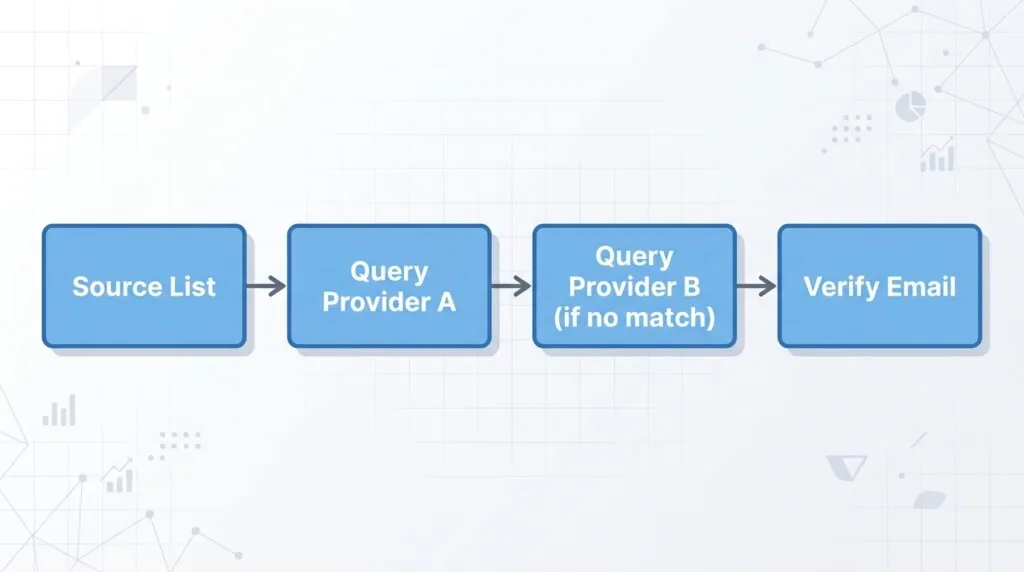
This is where most generic guides stop short. A waterfall means querying more than one data provider in sequence, not relying on a single source. A typical setup looks like this:
- Query Apollo for the contact’s verified work email and job title.
- If Apollo has no match, query Lusha for the same fields.
- Run any email found through a verification tool such as Hunter or Debounce to confirm it’s live and won’t bounce.
- Only pass records that clear verification into your outreach sequence.
This layered approach typically recovers 20 to 40% more verified contacts than relying on one provider alone, and it protects your domain’s sending reputation by keeping bounce rates low.
Step 4: Scrape and Filter With an LLM
Once you have a verified list, use a large language model such as ChatGPT or Claude to read each prospect’s website and summarise what the business actually does, what problems it likely has, and whether it’s a genuine fit for your ICP. This step filters out mismatched leads before a human or an outreach tool wastes time on them.
Step 5: Draft Context-Aware Outreach
Feed the LLM’s summary of each prospect into an AI writing tool to draft a first-touch message that references something specific to that business, not a generic template with a first name swapped in. Messages that reference a real detail about the recipient’s company get noticeably higher reply rates than templated blasts, and they’re far less likely to be flagged as spam.
Turning Website Traffic Into Qualified Leads
Outbound prospecting fills the top of the funnel, but most UK businesses also waste inbound traffic that never converts. AI closes that gap on the inbound side.
Website chatbots answer questions instantly and can qualify a visitor before a human ever gets involved. An AI chatbot built on Botpress or Voiceflow can ask a handful of qualifying questions, then book a call directly into your calendar.
Voice AI agents, built on platforms like Vapi or ElevenLabs, answer inbound phone enquiries around the clock, capture the caller’s details, and route qualified calls to a human. For businesses that get most enquiries by phone, this closes the speed-to-lead gap without hiring extra staff.
Is AI Lead Generation Legal Under UK GDPR?
Yes, provided you have a documented lawful basis and you don’t target individual consumers without consent. UK B2B cold email to a named person’s work address is generally allowed under PECR without prior consent, because PECR distinguishes between corporate and individual subscribers. But PECR compliance isn’t the whole picture: UK GDPR still requires a lawful basis for processing that person’s data, and for most B2B outreach, that basis is legitimate interest.
Since the Data (Use and Access) Act 2025 came into force, direct marketing has been formally written into UK GDPR as an example of a legitimate interest. That doesn’t remove the requirement to run a proper balancing test; it just removes the argument about whether direct marketing can ever qualify. To rely on legitimate interest, you should:
- Complete a Legitimate Interests Assessment (LIA) before you send, covering purpose, necessity, and a balancing test against the recipient’s privacy.
- Identify your business clearly in every message.
- Include a working opt-out and honour it immediately.
- Keep a suppression list of anyone who has objected or unsubscribed.
Since February 2026, PECR penalties have been raised to match UK GDPR: up to £17.5 million or 4% of global turnover, whichever is higher. Use a proper GDPR compliance tool to keep your LIA records, consent logs, and suppression lists in one place, and check the current ICO data protection fee requirements if you’re processing personal data as part of your enrichment workflow.
Common Mistakes That Get UK Businesses Into Trouble
- Scraping personal email addresses (Gmail, Outlook.com) and treating them like corporate contacts. PECR does not extend the same leeway to individual subscribers.
- Buying old, unverified lists. High bounce rates damage domain reputation and often include people who’ve already opted out elsewhere.
- Sending without an unsubscribe link, or ignoring opt-outs when they come in. This is one of the most common triggers for an ICO complaint.
- Skipping the LIA. Without a documented assessment, you have no defence if a recipient complains or the ICO investigates.
- Over-personalising in a way that feels invasive. Referencing a prospect’s LinkedIn post is fine; referencing details that make them wonder how you got them is not.
Essential AI Lead Generation Tools for UK Businesses
| Category | Tools | What They Do |
|---|---|---|
| Prospecting | Apollo.io, LinkedIn Sales Navigator | Build initial prospect lists from filters and search |
| Enrichment | Clay, Lusha, Hunter.io | Fill in missing contact and company data |
| Outreach automation | Make.com, n8n, Zapier | Connect tools and trigger sequences automatically |
| Conversational AI | Botpress, Voiceflow | Qualify website visitors and book meetings |
| Voice AI | Vapi, ElevenLabs | Handle inbound calls and qualify callers |
| CRM | HubSpot, Salesforce | Store, track, and manage the resulting pipeline |
Most of these tools connect to your existing email marketing software, so outreach sequences and lead capture stay in one system rather than scattered across separate logins.
Keeping a Human in the Loop
AI can build your list, enrich your data, and draft your first message, but it shouldn’t run unsupervised. Review a sample of outreach messages before they go out, monitor reply and bounce rates weekly, and have a person check any lead the system scores as high-intent before it reaches a salesperson’s calendar.
The businesses getting the best results from AI lead generation in the UK right now aren’t the ones automating everything. They’re the ones automating the repetitive 80%, sourcing, enriching, first-draft writing, so their sales team spends its time on the 20% that actually needs a human: judgment, relationship-building, and closing. Since these workflows also touch prospect and customer data, it’s worth reviewing your cybersecurity setup alongside your compliance checklist, and keeping an eye on how the UK AI Act may affect automated decision-making as regulation develops.
Frequently Asked Questions
Is cold emailing with AI legal in the UK?
Yes, for B2B outreach to named individuals at corporate email addresses, provided you have a documented lawful basis (usually legitimate interest), identify your business, and offer a working opt-out.
What’s the difference between B2B and B2C rules under PECR?
PECR treats corporate subscribers and individual subscribers differently. Corporate email addresses don’t need prior consent for marketing, but personal addresses (like a sole trader’s Gmail account) generally do, unless a soft opt-in applies.
What is a data enrichment waterfall?
It’s the practice of querying more than one data provider in sequence, for example, Apollo first, then Lusha if there’s no match, then verifying with Hunter, so you recover more accurate contact data than a single source would provide.
How much can the ICO fine a business for non-compliant AI lead generation?
As of February 2026, PECR fines have risen to match UK GDPR: up to £17.5 million or 4% of global annual turnover, whichever is higher.
Do I need a Legitimate Interests Assessment for cold outreach?
It isn’t a legal requirement to have one on file, but without it, you have no documented defence if the ICO investigates or a recipient complains. Most compliance teams treat it as mandatory in practice.