

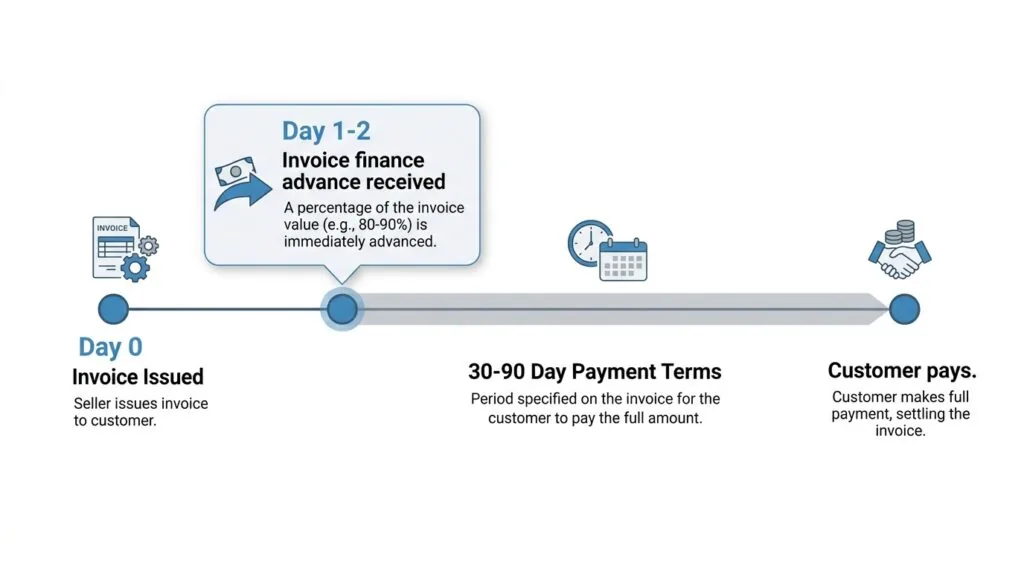
Invoice financing lets you borrow against unpaid customer invoices instead of waiting 30, 60, or even 90 days to get paid. A lender advances you a percentage of the invoice value, usually 80% to 95%, often within 24 to 48 hours. You collect the rest once your customer pays, minus fees.
For UK small businesses, this is one of the fastest ways to release cash that’s already sitting in your sales ledger, without taking on a traditional term loan. This guide breaks down exactly how it works, what it costs, who qualifies, and how to pick the right facility for your business.
What is Invoice Financing and How Does It Work for UK SMEs?
Invoice financing is a funding facility secured against your accounts receivable. Rather than waiting on customer payment terms, you use unpaid invoices as collateral to access cash almost immediately.
The Core Concept: Unlocking Cash from Your Sales Ledger
Every unpaid invoice on your sales ledger represents money you’ve already earned but can’t yet spend. If you’re growing fast, or your clients pay on 60- or 90-day terms, that gap can strangle your working capital even when your business is profitable on paper.
Invoice finance solves this by treating your sales ledger as an asset. Instead of borrowing against property or equipment, you borrow against the value of goods or services you’ve already delivered and invoiced.
Step-by-Step Breakdown of an Invoice Finance Transaction
- You deliver goods or services and issue an invoice to your customer as normal.
- You submit the invoice to your invoice finance provider, usually through an online portal.
- The lender advances a percentage of the invoice value — typically 80% to 95% — into your business account, often within 24 to 48 hours.
- Your customer pays the invoice on its original due date, either directly to you or into a trust account controlled by the lender, depending on the facility type.
- The lender pays you the remaining balance, minus the service fee and discount charge.
Keeping accurate invoice records and documentation in order speeds up this process significantly, since lenders verify each invoice before advancing funds.
Key Types of Invoice Financing: Factoring vs. Discounting vs. Selective
The three main types of UK invoice finance differ mainly in who manages collections and whether your customers know a lender is involved.
| Feature | Invoice Factoring | Invoice Discounting | Selective / Spot Finance |
|---|---|---|---|
| Who collects payment | The lender | You (confidential) | You or the lender (varies) |
| Customer awareness | Usually visible | Confidential | Confidential |
| Best suited for | Smaller businesses without credit control resource | Established businesses with an in-house credit control team | Businesses that only want to fund specific invoices |
| Typical minimum turnover | Around £30,000+ | Around £250,000–£500,000+ | No fixed minimum; varies by lender |
| Contract commitment | Whole ledger, ongoing | Whole ledger, ongoing | Single invoice or short-term |
Invoice Factoring: Dedicated Sales Ledger Management & Collections
With factoring, the lender takes over credit control and chases customer payments on your behalf. This suits businesses without the time or staff to manage collections, particularly smaller companies scaling quickly. The trade-off is that your customers will usually know a finance company is involved, since they pay the lender directly.
Invoice Discounting: Confidential Cash Flow Injection
Invoice discounting works the same way financially, but you keep control of collections and your customers are never aware a lender is involved. Because it relies on your own credit control processes, lenders typically expect a more established finance function and higher turnover before approving this facility.
Selective & Single Invoice Finance: Spot-Funding Flexibility
Also called spot factoring, this lets you fund individual invoices rather than committing your entire sales ledger. It’s useful if you only occasionally need a cash injection, for example to cover one large order, without locking into a long-term contract.
Cost Structure & Fees Explained
Invoice finance costs are made up of two separate charges: a service fee and a discount fee. Understanding both, with real numbers, is the only way to compare providers accurately.
Service Fees vs. Discount Charges (Interest Rates)
The service fee (sometimes called the management fee) covers administration and, with factoring, credit control. It typically runs from 0.5% to 5% of each invoice’s value.
The discount charge is effectively interest, charged on the amount advanced for the number of days it’s outstanding. It’s usually quoted as a margin above the Bank of England base rate, applied daily or monthly.
Worked example:
Say you submit a £50,000 invoice with a 45-day payment term.
- Advance rate: 90% → you receive £45,000 upfront
- Service fee: 0.75% of £50,000 = £375
- Discount charge: base rate + 3% (roughly 7.5% annualised) applied to the £45,000 advance for 45 days: £45,000 × 7.5% × (45 ÷ 365) = £415.75
- Total fees: £790.75
- Balance paid to you once the customer settles: £50,000 − £45,000 − £790.75 = £4,209.25
So on a £50,000 invoice, you’d receive £45,000 within a day or two, then £4,209.25 more once your customer pays — a total cost of roughly 1.6% of the invoice value for six weeks of funding. Costs vary by lender, invoice volume, and customer credit quality, so always ask for a full worked quote before signing.
Tracking these fees alongside your everyday business accounting records makes it much easier to spot when a facility is becoming expensive relative to your margins.
Recourse vs. Non-Recourse Financing & Bad Debt Protection
This is one of the most misunderstood parts of invoice finance, and where many guides fall short.
Recourse financing means that if your customer doesn’t pay, you have to buy the invoice back or repay the advance yourself. It’s cheaper because the lender carries less risk, but it leaves your business exposed to bad debt.
Non-recourse financing includes bad debt protection. If your customer becomes insolvent or fails to pay within an agreed period (commonly 90 to 180 days after the due date), the lender absorbs the loss, usually up to an agreed credit limit per customer. This costs more, but it removes a major risk for businesses with concentrated or higher-risk customer bases.
In practice, non-recourse cover almost never protects against a customer simply disputing an invoice over quality or delivery issues — only genuine non-payment or insolvency. Read the definition of “protracted default” in your agreement carefully, as this is where disputes most often arise.
Hidden Charges & Extra Fees to Avoid
Beyond the headline service fee and discount charge, watch for:
- Audit fees — periodic checks of your sales ledger, sometimes charged even if nothing is found.
- Refactoring fees — extra charges on invoices that stay unpaid past an agreed age (often 90 days).
- Minimum usage fees — a charge if you don’t factor enough invoice volume in a given period.
- CHAPS or same-day payment fees — for faster fund transfers.
- Exit and termination fees — for leaving the contract early, particularly common in longer fixed-term agreements.
Reputable UK lenders who are members of UK Finance follow the UK Finance Invoice Finance and Asset Based Lending Code, which requires clear, upfront disclosure of all fees before you sign. Always ask for these in writing.
Invoice Finance vs. Traditional Business Loans & Bank Overdrafts
| Factor | Invoice Finance | Business Loan | Bank Overdraft |
|---|---|---|---|
| Speed to funds | 24–48 hours | 1–4 weeks | Days, once agreed |
| Scales with sales | Yes — grows as your invoicing grows | No — fixed amount | No — fixed limit |
| Collateral | Your sales ledger | Often assets or personal guarantee | Often personal guarantee |
| Best for | Cash flow gaps from payment terms | One-off capital investment | Short-term buffer |
| Cost structure | Service fee + discount charge | Fixed or variable interest | Interest + arrangement fee |
Unlike an unsecured business loan, invoice finance funding limits rise automatically as your turnover grows, since the facility is tied to your sales ledger rather than a fixed sum. That makes it particularly well suited to fast-growing B2B businesses.
It’s not the only alternative worth comparing, though. If you have physical equipment to leverage, asset finance may suit you better. For businesses not yet generating consistent invoice volume, small business grants or peer-to-peer lending are worth exploring too.
Eligibility & Qualification Requirements for UK Small Businesses
Most competitor guides are vague here. In practice, UK lenders assess these specific factors:
| Requirement | Typical Threshold |
|---|---|
| Minimum annual turnover | £30,000–£100,000+ (varies by lender and facility type) |
| Business structure | B2B sales only — B2C invoices generally aren’t eligible |
| Customer creditworthiness | Lender checks your debtors’ credit scores, not just yours |
| Invoice age | Usually must be under 90 days old |
| Debtor concentration | Most lenders cap exposure to any single customer (often 20–40% of the ledger) |
| Trading history | Typically 6–12 months minimum, though some lenders fund newer businesses |
| Personal guarantee | Often required for limited companies, particularly smaller facilities |
Lenders will also register a debenture — a legal charge over your company’s assets — and may require a personal guarantee from directors, especially for smaller or higher-risk facilities. This is worth discussing with your accountant before signing, and understanding your responsibilities as a company director matters here, since a personal guarantee can put personal assets at risk if the business defaults.
Sole traders can access invoice finance too, though fewer lenders offer it and terms are often tighter. Keeping clean, up-to-date sole trader financial records and having your business bank account properly set up will both speed up approval.
Industry Breakdown: Who Benefits Most from Invoice Finance in the UK?
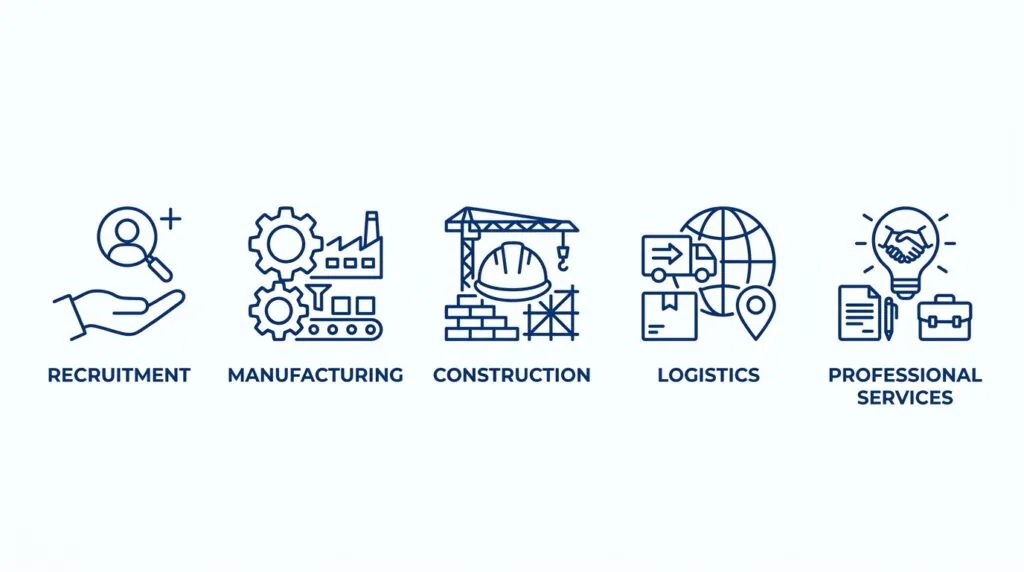
Invoice finance suits industries where long payment terms are standard practice and margins can be squeezed by delayed payment:
- Recruitment and staffing agencies — weekly payroll obligations against monthly client invoicing make this one of the most common users of factoring.
- Manufacturing and wholesale — large purchase orders and 60–90 day retailer terms create significant working capital pressure.
- Construction and trades — stage payments and retention clauses often delay cash for months.
- Transport and logistics — fuel and driver costs are immediate, but client payment terms rarely are.
- B2B professional services — agencies and consultancies billing large corporate clients on extended terms.
Businesses in these sectors often pair invoice finance with free cash flow tracking tools to monitor exactly which invoices are funded and which are still outstanding.
Frequently Asked Questions About UK Invoice Financing
How quickly can I get cash from an invoice?
Most UK lenders release the first advance within 24 to 48 hours of approving an invoice, though your very first facility setup can take one to two weeks to arrange.
Do my customers know I’m using invoice financing?
With invoice discounting, no — it’s confidential and you keep managing collections. With factoring, customers usually pay the lender directly, so they will be aware.
What happens if a customer doesn’t pay?
Under recourse financing, you must repay the advance or buy back the invoice. Under non-recourse financing, the lender absorbs the loss up to an agreed credit limit, provided the non-payment falls within the policy terms.
Is invoice financing regulated in the UK?
Standard commercial invoice finance isn’t directly regulated by the FCA in most cases, since it’s a business-to-business facility rather than consumer credit. Reputable lenders instead follow the UK Finance Invoice Finance and Asset Based Lending Code of Conduct, which sets standards for transparency, fair fees, and dispute handling. Always check whether a provider is a UK Finance member before signing.
How much does invoice financing cost?
Total cost typically runs between 1% and 3% of invoice value per transaction, combining the service fee (0.5%–5%) and the discount charge (a margin over base rate applied for the days outstanding). Get a full worked quote rather than comparing headline rates alone.
Can a start-up get invoice financing?
Some lenders will fund businesses with as little as three to six months of trading history, provided you have solid B2B customers and clean invoicing. Terms are usually less flexible than for established businesses.
What’s the difference between invoice finance and a business loan?
A business loan gives you a fixed lump sum repaid over a set term, regardless of sales. Invoice finance scales automatically with your invoicing volume and is secured against your sales ledger rather than requiring separate collateral in most cases.