

The Seed Enterprise Investment Scheme (SEIS) is a UK government scheme that gives individual investors up to 50% income tax relief for backing very early-stage UK companies, in exchange for taking on the risk of investing in a business with little or no trading history. A qualifying company can raise up to £250,000 through SEIS over its lifetime, and an individual investor can put in up to £200,000 per tax year.
Those figures come from the April 2023 expansion of the scheme, and they’re still current. The Autumn Budget 2025 and the Finance Act 2026 left SEIS limits untouched — the changes that tax year were aimed at EIS and VCTs instead. So if you’ve read an article saying the company cap is £150,000 or the age limit is two years, you’re looking at outdated guidance. This one reflects the rules as they stand for the 2026/27 tax year.
Two different people usually land on this page. If you’re a founder trying to work out whether your company qualifies, go straight to Company Eligibility Criteria. If you’re an investor trying to work out what you’d actually get back, go to SEIS Tax Reliefs for Investors.
What Is the Seed Enterprise Investment Scheme (SEIS)?
SEIS exists because early-stage companies are hard to fund through normal means. Banks won’t lend to a business with no trading history and no assets to secure a loan against, and most investors won’t touch something this risky without a strong incentive. The UK government created SEIS in 2012 to close that gap, using generous tax relief to persuade individuals to back the riskiest stage of company formation — the point before a business has proven anything.
The mechanism is simple: an investor buys new ordinary shares in a qualifying company, and in return gets several layers of tax relief that, combined, sharply reduce their real financial exposure if the investment fails. You can see the full maths on that in the loss relief example below.
SEIS vs EIS: Key Differences at a Glance
SEIS is the first step. EIS (the Enterprise Investment Scheme) is the second, larger step for companies that have outgrown SEIS. Most startups that qualify for both use SEIS first, then move to EIS for a bigger follow-on round — SEIS shares must be issued before EIS or VCT shares in the same funding round.
| Feature | SEIS | EIS |
|---|---|---|
| Company age limit | Under 3 years trading | Up to 7 years (10 for knowledge-intensive) |
| Company lifetime raise limit | £250,000 | £24 million (£40m knowledge-intensive) |
| Gross assets limit | £350,000 | £30 million pre-investment |
| Employee limit | Fewer than 25 | Fewer than 250 |
| Investor income tax relief | 50% | 30% |
| Investor annual limit | £200,000 | £1 million (£2m knowledge-intensive) |
| CGT exemption after holding | 3 years | 3 years |
Because SEIS offers double the income tax relief of EIS, it’s reserved for genuinely early-stage businesses — the trade-off is a much smaller amount of money on the table.
SEIS Tax Reliefs for Investors (The Benefits)
In short: a SEIS investor can get 50% of their investment back as income tax relief, pay no CGT on any profit after three years, halve the CGT on unrelated gains they reinvest, and claim loss relief if the company fails — all of which combine to sharply cut their real downside risk.
1. 50% Income Tax Relief
This is the headline benefit. Invest £10,000 in a SEIS-qualifying company and you can reduce your income tax bill for the year by £5,000, provided you owe at least that much tax. The relief applies to investments up to £200,000 in a single tax year, giving a maximum relief of £100,000. You claim it through your Self Assessment tax return, either for the year you invested or the previous year if you choose to carry the claim back.
2. Capital Gains Tax (CGT) Reinvestment Relief
If you’ve made a gain elsewhere — selling shares, a second property, or another business asset — you can reinvest that gain into SEIS shares and get 50% of the reinvested amount exempt from CGT. Put a £20,000 gain into SEIS and £10,000 of it becomes permanently tax-free, not just deferred. Because the maximum income tax relief you can claim is £200,000, the maximum reinvestment relief available in a tax year is capped at £100,000.
3. CGT Exemption on Profit
Hold your SEIS shares for at least three years and any profit you make when you sell is completely free of Capital Gains Tax, with no upper limit on the amount exempted. This is on top of the income tax relief you already claimed.
4. Loss Relief (Downside Protection Explained)
This is the piece most articles gloss over, and it’s the reason SEIS numbers look so different once you run them properly. If the company fails and your shares become worthless, you don’t lose the amount you invested — you can offset the remaining loss against your income tax bill at your marginal rate.
SEIS Loss Relief: What Happens If the Company Fails
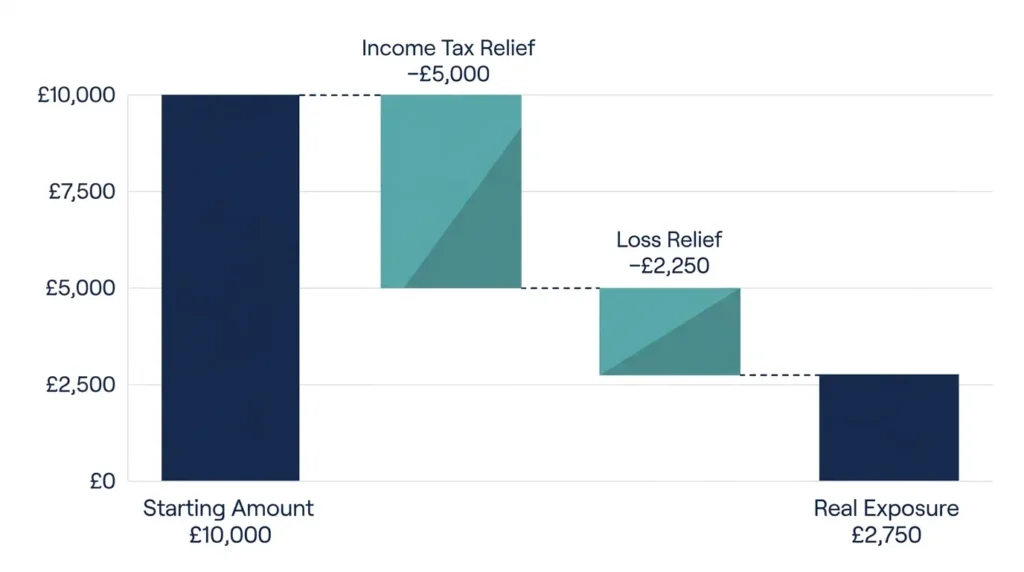
Here’s a real worked example for a 45% additional-rate taxpayer investing £10,000 in a startup that later fails completely.
| Step | Calculation | Amount |
|---|---|---|
| 1. Initial investment | — | £10,000 |
| 2. Income Tax relief claimed (50%) | 50% × £10,000 | −£5,000 |
| 3. Net cost after Income Tax relief | £10,000 − £5,000 | £5,000 |
| 4. Company fails, shares worth £0 — allowable loss | equal to net cost | £5,000 |
| 5. Loss relief at marginal rate (45%) | 45% × £5,000 | −£2,250 |
| 6. Total tax recovered | £5,000 + £2,250 | £7,250 |
| 7. Real financial exposure | £10,000 − £7,250 | £2,750 |
A £10,000 investment that goes to zero ends up costing this investor £2,750 — 27.5p in every pound, not the full pound. That’s the actual number to hold in your head when weighing up SEIS risk, not the headline “50% relief” figure on its own. A basic-rate taxpayer would recover less through loss relief and end up with a slightly higher real exposure; an additional-rate taxpayer gets the most protection.
5. Inheritance Tax (IHT) Relief
Hold your SEIS shares for at least two years and still hold them at death, and they typically qualify for Business Relief, which removes them from your taxable estate entirely.
One important update for 2026: following the Autumn Budget 2024 and a further revision in December 2025, Business Relief changed from 6 April 2026. There’s now a combined £2.5 million cap per person on the value of business and agricultural assets that get 100% relief; anything above that gets 50% relief instead, which works out as an effective 20% IHT charge. SEIS companies are unquoted trading businesses, so they sit in the category that still gets 100% relief up to that cap. For most SEIS investors — whose holdings are nowhere near £2.5 million — this is background information, not a real constraint. If you’re a high-net-worth investor with a large portfolio of business assets across several holdings, it’s worth checking your combined position with an adviser.
Company Eligibility Criteria for SEIS
In short: to qualify for SEIS, a UK company must be trading for less than three years, have gross assets under £350,000, employ fewer than 25 full-time equivalent staff, carry on a qualifying trade, and have a permanent UK establishment.
1. The Age Limit (Trading History)
The company must be within three years of its first commercial sale when the SEIS shares are issued — not three years since incorporation. This distinction matters more than most guides admit. A company can be incorporated for four or five years while it spends time on product development, and still qualify for SEIS as long as it hasn’t started trading commercially yet. HMRC treats “trading” as beginning at the first sale to a genuine customer, not the day the company was registered at Companies House. If you’re setting up a UK limited company with a long R&D runway ahead of any sales, this clock doesn’t start ticking until you actually sell something.
2. Gross Asset Limits
The company’s gross assets — everything it owns, including cash, equipment and property, without deducting liabilities like loans — must be under £350,000 immediately before the investment. This is a “gross” test, not a net worth test, so a company with £350,000 in assets and £300,000 in debt still fails if its gross assets exceed the cap.
3. Employee Count Limit
The company must have fewer than 25 full-time equivalent employees at the time of the share issue, counting directors and pro-rating part-time staff. This is a low bar for most seed-stage teams, but it’s worth checking carefully once you’re hiring your first employee and beyond, especially if you use a lot of contractors who might count.
4. The Permanent Establishment Requirement
The company must be UK-incorporated and carry on its trade through a permanent UK establishment. It doesn’t need to be UK-owned, but the actual trading activity has to happen here.
5. Qualifying Trades vs. Excluded Activities
Most trading businesses qualify, but HMRC excludes a specific list of activities it considers too low-risk or asset-backed to need this kind of relief. Excluded activities include:
- Dealing in land, commodities or financial instruments
- Banking, insurance, and other financial services
- Legal or accountancy services
- Property development
- Leasing or letting assets on hire
- Farming, market gardening and forestry
- Running a hotel, care home or nursing home
- Generating or exporting electricity, heat, gas or fuel
- Coal or steel production
- Providing services to another business under common control
If your company falls into a grey area — for example, a software business with a leasing component — get specialist advice before applying, since the trade has to be “wholly or mainly” a qualifying one.
Companies doing genuine product development alongside their trade may also want to look at R&D tax relief, which can be claimed alongside SEIS funding rather than instead of it.
The Risk-to-Capital Condition and Excluded Structures
Beyond the numeric limits, HMRC also applies a “risk-to-capital condition” introduced in 2018 to stop SEIS being used for low-risk, asset-backed investments dressed up as startups. It has two parts: the company must have genuine long-term growth objectives, and there has to be a real risk that the investor could lose more capital than the net return they’d get from the tax relief alone. In practice, this rules out structures designed mainly to generate a guaranteed, low-risk tax-efficient return — SEIS is meant for businesses that could plausibly fail.
How to Apply for SEIS: Step-by-Step for Founders
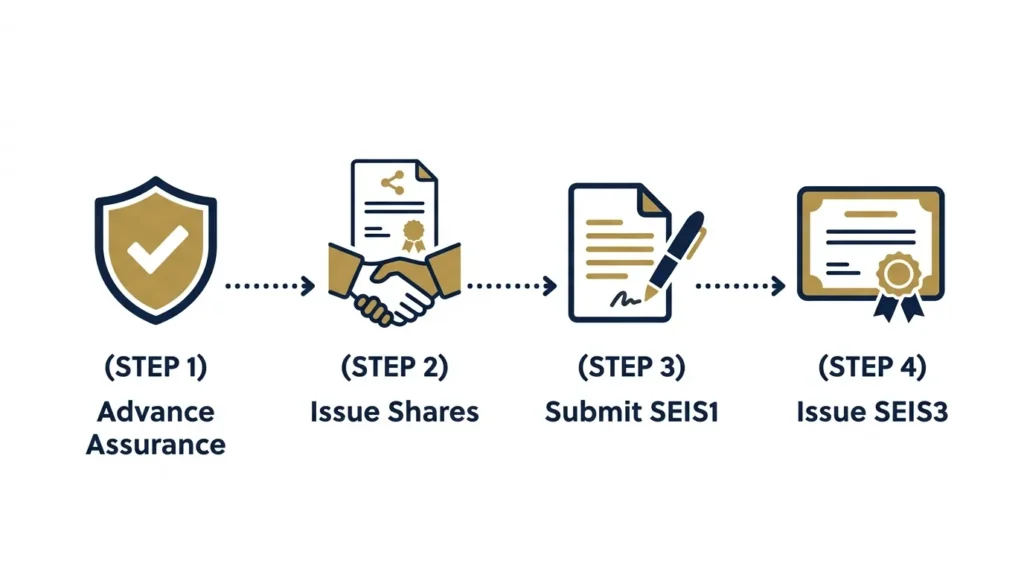
In short: founders typically apply for Advance Assurance before fundraising, issue shares once the money arrives, then file a SEIS1 compliance statement with HMRC and pass on SEIS3 certificates to investors.
- Secure Advance Assurance (AA). This is written confirmation from HMRC that your company is likely to qualify, and most serious investors won’t commit funds without it. You apply online with a business plan, financial projections and details of the shares you plan to issue. HMRC doesn’t publish a guaranteed turnaround time, but straightforward applications are typically assessed in four to eight weeks — incomplete ones, or those with unusual trading activities, can take considerably longer. Build this into your fundraising timeline early, and make sure your business plan is specific rather than generic; vague plans generate the most follow-up questions.
- Receive the investment and issue shares. Once you’ve got commitments — whether from angel investors or an equity crowdfunding platform — issue new, fully paid-up ordinary shares. They must carry no special preferential rights over other shareholders.
- Submit the SEIS1 form to HMRC. You can’t file this straight away. You need to have either been trading for four months, or have spent 70% of the money raised on qualifying business activity — whichever happens first.
- Distribute SEIS3 certificates to investors. Once HMRC authorises your compliance statement, they’ll send SEIS3 certificates for you to pass to each investor. This is the document investors need to actually claim their relief.
Common Pitfalls and How to Avoid Them
The 30% Investor Connection Rule
No individual investor, together with their associates, can hold more than 30% of the company’s shares, voting rights or loan capital — either at the time of investment or within three years afterward. Breach this and the relief is withdrawn. This catches founders out most often when a friend or family member invests a large amount relative to a very early, low-valuation round.
Getting the Sequencing Wrong
SEIS shares must be issued before any EIS or VCT investment in the same funding round, and once a company has taken EIS or VCT money, it generally can’t go back and raise under SEIS afterward. If you’re planning to use both schemes, raise your SEIS round first and be deliberate about the order.
Spending the Money on the Wrong Things
The funds raised must go toward a qualifying business activity — usually the trade itself, or research and development intended to lead to it. Using SEIS funds to buy property, repay existing loans, or acquire another business can jeopardise the relief. If debt is part of your funding mix, keep it separate — a startup business loan or non-dilutive small business grant can sit alongside SEIS, but the SEIS money itself has to go toward qualifying activity.
Treating Advance Assurance as a Guarantee
Advance Assurance is HMRC’s opinion based on the facts you provided — it’s not legally binding. If your business changes materially between assurance and your SEIS1 filing (a change of trade, a merger, new activities that stray into excluded territory), HMRC can still refuse the compliance statement. Keep HMRC updated if anything significant changes.
Frequently Asked Questions
How does SEIS loss relief work? If a SEIS investment fails, you can offset the loss — after deducting the Income Tax relief you already claimed — against your income tax bill at your marginal rate. Combined with the initial 50% relief, this can reduce a total loss on a £10,000 investment to around £2,750 for an additional-rate taxpayer.
What are the SEIS company eligibility rules? A company must be trading for less than three years, have gross assets under £350,000, employ fewer than 25 full-time equivalent staff, carry on a qualifying trade, and have a permanent UK establishment.
Can a director get SEIS tax relief? Yes. Unlike EIS, SEIS specifically allows a company director to invest in their own company and claim relief, provided they aren’t disqualified by the 30% connection rule.
How long does HMRC take for SEIS advance assurance? There’s no published guarantee, but straightforward, well-documented applications are usually assessed within four to eight weeks. Incomplete submissions or applications with unusual trading activity often take longer.
What are the SEIS limits for 2026? Companies can raise up to £250,000 in total through SEIS. Investors can put in up to £200,000 per tax year and claim 50% income tax relief. These figures haven’t changed since April 2023 and remain in place for the 2026/27 tax year.
Can I use SEIS and EIS together? Yes, but the order matters. SEIS shares must be issued before EIS shares in the same funding round, and most companies raise a SEIS round first, then use EIS for larger follow-on funding once they’ve outgrown SEIS’s limits.
The Bottom Line
SEIS rewards genuine early-stage risk with genuine tax relief — but the numbers only make sense once you run them properly rather than quoting the 50% headline figure in isolation. If you’re a founder, the eligibility rules are more forgiving than they look, especially on the trading-age clock, but the paperwork sequence matters and Advance Assurance is worth the wait. If you’re an investor, the loss relief maths is the number that should actually drive your decision, not the tax relief on its own. Either way, the current 2026/27 figures — £250,000 for companies, £200,000 for investors, 50% income tax relief — are the ones to work from, and they’ve been stable since 2023 despite a wave of changes to EIS and VCTs around them.