There is no single “best” antivirus for every UK small business, but the right choice usually comes down to what you already own. If your team already pays for Microsoft 365 Business Premium, Microsoft Defender for Business is very likely already included in your subscription, and buying a second product is a waste of money. If you need dedicated, centrally managed protection with strong ransomware rollback, Bitdefender GravityZone Business Security and Sophos Intercept X Advanced are the strongest all-round options for UK SMEs in 2026.
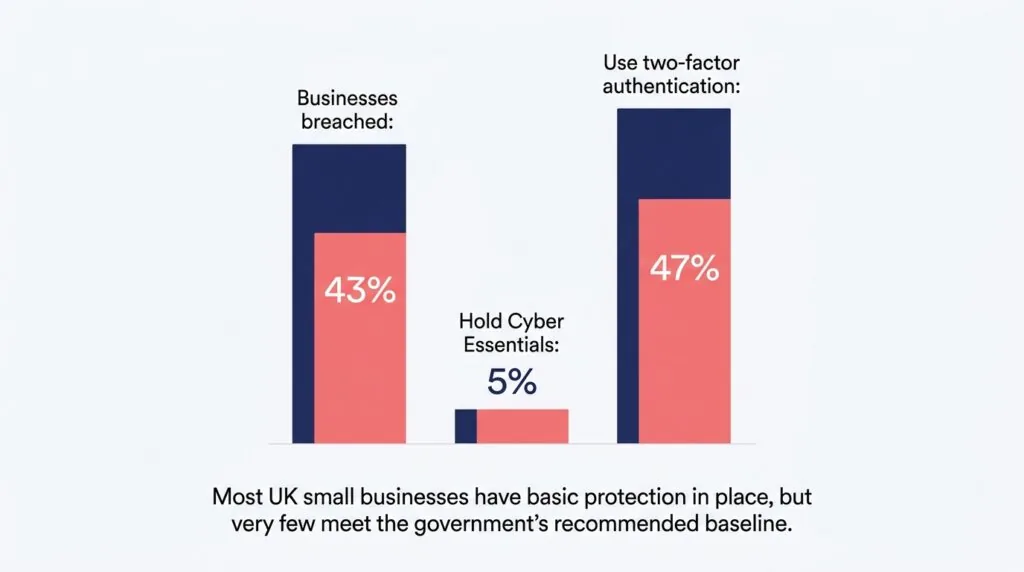
Standard consumer antivirus, the kind built into a home laptop, is not designed for business use. It lacks centralised management, audit logging and the compliance evidence that UK GDPR and Cyber Essentials assessments require. Government figures published in April 2026 show that 43% of UK businesses, around 612,000 organisations, identified a cyber breach or attack in the previous 12 months, with small businesses reporting a 46% breach rate. Phishing remains the dominant threat, involved in 38% of all incidents.
The practical takeaway: match the software to your existing Microsoft licensing first, then layer in dedicated endpoint detection and response (EDR) if you handle client data, hold Cyber Essentials Plus, or need cyber insurance at a reasonable premium.
The UK Cyber Threat Landscape: Why Standard Antivirus Is No Longer Enough
Basic antivirus scans files against a list of known threats. It cannot catch an attack it has never seen before, and most modern ransomware is built specifically to evade signature-based scanning. That gap matters more than most small business owners realise: only 5% of UK businesses currently hold Cyber Essentials certification, even though 81% already run some form of malware protection. Having antivirus and being properly protected are not the same thing.
Signature-Based vs. Behavioural Detection (EDR)
Signature-based antivirus checks files against a database of known malware fingerprints. It is fast, cheap and still useful, but it is reactive. Endpoint Detection and Response (EDR) instead watches how programs behave on a device in real time. If a piece of software starts encrypting files rapidly or trying to disable backups, an EDR tool flags and blocks it, even if it has never seen that exact malware before. This is called behavioural or heuristic detection, and it is what stops zero-day attacks that pure antivirus misses.
For a small business, the practical difference shows up during a ransomware attempt: standard antivirus might miss a brand-new variant entirely, while EDR can isolate the infected device from the network automatically and roll back encrypted files, often before anyone notices anything wrong.
The Cost of a Breach: UK GDPR, ICO, and Cyber Essentials
Under UK GDPR, a breach involving personal data must usually be reported to the Information Commissioner’s Office within 72 hours of your business becoming aware of it. Failing to report, or failing to show you had reasonable technical safeguards in place, increases both regulatory risk and the chance of an ICO enforcement action.
Cyber Essentials, the government-backed certification scheme, is also getting stricter. From 27 April 2026, the updated Requirements for IT Infrastructure (version 3.3, using the new “Danzell” assessment) made multi-factor authentication mandatory wherever a cloud service offers it. If MFA is available and you have not switched it on, that is now an automatic assessment failure rather than a point for later remediation. The update also tightened patching rules: high-risk and critical security updates must be applied within 14 days of release. Endpoint software that reports patch status and enforces MFA policy centrally makes hitting these deadlines far easier than checking each laptop by hand.
Top 5 Business-Grade Antivirus & Endpoint Security Solutions Compared
Prices below are indicative GBP figures for smaller device counts (typically 3–25 devices) based on published list pricing, excluding VAT. All vendors offer volume discounts, so always request a quote for your exact headcount.
| Solution | Best For | Approx. Price (ex. VAT) | EDR Included? | UK/EU Hosting |
|---|---|---|---|---|
| Bitdefender GravityZone Business Security | Best overall protection | From around £27–£29 per device/year | On Premium tier | Yes, EU data centres |
| Microsoft Defender for Business | Best value for Microsoft 365 users | Included in Business Premium (from ~£16.90/user/month), or ~£24/device/year standalone | Yes, from entry tier | UK/EU residency options |
| Sophos Intercept X Advanced | Best ransomware defence | From around £65–£70 per device/year | Yes, full EDR | UK-headquartered, EU hosting available |
| ESET PROTECT | Best lightweight, customisable option | From around £33–£46 per device/year, tier-dependent | From Elite tier (custom pricing) | EU-based (Slovakia), GDPR-native |
| CrowdStrike Falcon Go | Best AI-powered option for tech-focused SMEs | From around £24–£48 per device/year | Yes, from entry tier | EU cloud region available |
1. Bitdefender GravityZone Business Security (Best Overall Protection)
GravityZone pairs strong independent lab scores with a genuinely usable cloud console, which matters most for a business with no dedicated IT department. The Business Security tier covers antivirus, firewall and ransomware mitigation with automated rollback; stepping up to Business Security Premium adds proper EDR and cloud sandboxing. Pricing runs roughly £27–£29 per device per year for small volume bands, dropping as device count rises. The main catch: smaller teams sometimes find the policy engine more complex than they need, so budget a little setup time.
2. Microsoft Defender for Business (Best Value for Microsoft 365 Users)
If your business already pays for Microsoft 365 Business Premium (from roughly £16.90 per user per month), Defender for Business is already included at no extra cost, covering next-generation antivirus, attack surface reduction and basic EDR for up to 300 users. Bought standalone, it costs around £24 per device per year. This is the single most common way UK small businesses accidentally overspend on security software: paying for a competing product when equivalent protection is already sitting unused in their existing licence.
3. Sophos Intercept X Advanced (Best Advanced Ransomware Defence)
Sophos, headquartered in the UK, built Intercept X around a deep-learning model specifically tuned to catch ransomware behaviour and roll back encrypted files automatically. For businesses in professional services or finance, where a single ransomware incident can be genuinely business-ending, this is the strongest dedicated option. Pricing for the 1–9 user Essentials tier runs around £65–£70 per device per year; the full Advanced with XDR tier costs more but adds cross-platform threat correlation.
4. ESET PROTECT Platform (Best Lightweight & Highly Customisable Option)
ESET’s reputation for a light footprint holds up well on older hardware, which matters for small businesses still running a mix of ageing laptops. The platform scales from a basic Entry tier (file server and endpoint protection, roughly £33 per device per year) up to Complete, which adds Microsoft 365 and Google Workspace protection plus patch management. Full EDR/XDR only arrives at the Elite tier, which requires custom pricing and a 25-device minimum, so smaller teams needing behavioural detection may outgrow the lower tiers quickly.
5. CrowdStrike Falcon Go (Best AI-Powered Option for Tech-SMEs)
Falcon Go brings CrowdStrike’s cloud-native, AI-driven detection down to a small business price point, starting at roughly £24 per device per year and capped at 100 devices. It includes next-generation antivirus and device control from the entry tier, which is unusual; most competitors reserve behavioural detection for a higher tier. The step up to Falcon Pro, which adds firewall management, brings a noticeably steeper price jump, so confirm your growth plans before committing.
Essential Buying Criteria for UK Small Businesses
Centralised Cloud Console Management
Without a dedicated IT team, you need to see every device’s protection status, patch level and MFA compliance from one screen. A good console flags problems before Cyber Essentials assessors do, and lets you push policy changes to every laptop remotely, rather than visiting each machine in person.
UK/EU Data Residency & GDPR Alignment
Where your provider stores telemetry and log data matters for GDPR compliance, particularly if you handle client personal data. Confirm whether the vendor offers UK or EU-based hosting, or at minimum a GDPR-compliant data processing agreement, before signing a contract.
Pricing Structure and GBP Transaction Support
Check whether pricing is billed in GBP directly or converted from USD at checkout, since currency conversion fees add up over a multi-year contract. Also confirm the device-count bands: several vendors apply a steep per-device discount once you cross 15 or 25 devices, so it is often worth grouping a purchase to hit the next pricing tier.
Common Buying Mistakes (and How to Avoid Them)
Buying consumer-grade software for a registered business. Products like standard consumer suites are licensed for personal use only, lack centralised deployment, and will not satisfy a Cyber Essentials assessor asking for evidence of managed malware protection across your device fleet.
Paying twice through the “M365 double-pay” trap. Many UK small businesses buy a third-party antivirus product without checking that Microsoft 365 Business Premium, which they already pay for, includes Defender for Business as standard. Before buying anything, check your existing Microsoft licence tier first.
Treating MFA as optional. Under Cyber Essentials v3.3, effective from 27 April 2026, failing to enable available MFA on a cloud service is an automatic assessment failure, not a minor deduction. If your endpoint platform can enforce MFA policy centrally, use that feature rather than relying on staff to switch it on individually.
Assuming any “antivirus” label means EDR-level protection. Several vendors gate real behavioural detection behind a premium or Elite tier. Read the feature list for your specific plan, not just the product name, before assuming you are covered against zero-day ransomware.
Frequently Asked Questions
Can I use free antivirus software for my business?
No, not for a registered UK business handling any customer or financial data. Free consumer antivirus licences typically exclude commercial use, offer no centralised management, and cannot provide the audit evidence Cyber Essentials assessors and cyber insurers require.
Do I need separate firewalls alongside business antivirus?
Usually yes, at the network level. Most business antivirus and EDR tools include a software firewall on each device, but Cyber Essentials also requires a boundary firewall protecting your whole network, typically built into your router or a dedicated network appliance.
How does endpoint protection help with Cyber Essentials certification?
Cyber Essentials requires evidence of up-to-date malware protection, secure configuration and timely patching across every device in scope. A managed endpoint platform with a central console makes it far easier to generate that evidence quickly, rather than manually checking each machine before an assessment.
Is Windows Defender enough for a small business?
The free, built-in version of Windows Defender offers basic protection but no centralised management, reporting or EDR. Microsoft Defender for Business, the paid business tier included in Microsoft 365 Business Premium, adds the centralised console, attack surface reduction and reporting most small businesses actually need for Cyber Essentials and general protection.