


A Community Interest Company (CIC) is a type of limited company created specifically for people who want to run a business for the benefit of a community, rather than for private profit. It sits between a standard limited company and a registered charity — you get the flexibility of a company, but with legal safeguards that keep its assets and profits working for a social purpose.
CICs were introduced by the Companies (Audit, Investigations and Community Enterprise) Act 2004 and are regulated by the Office of the Regulator of Community Interest Companies. If you’ve been searching for a structure that lets you trade commercially while proving to funders, customers and staff that your mission won’t be sold off or diverted, a CIC is usually the answer.
What is a Community Interest Company (CIC)?
A CIC is a non-charitable limited company registered at Companies House that must pass a “community interest test” and is legally locked into using its assets and profits for a stated social purpose. It’s the middle ground between a fully commercial company and a charity.
The Legal Framework of a CIC
Every CIC is a company first. It’s incorporated under the Companies Act 2006, then registered as a CIC under the CIC Regulations 2005 and the 2004 Act mentioned above. This dual layer means a CIC files normal company accounts with Companies House, but it also submits an additional annual document — the CIC34 report — to the CIC Regulator, explaining how it has served the community that year.
Who is a CIC Designed For?
The structure suits founders who want to trade — sell products, deliver services, win contracts — but plough the proceeds back into a defined community benefit. Common examples include community cafés, local transport schemes, renewable energy co-operatives, employment training providers, and housing or regeneration projects. If your idea earns revenue and has a clear social or environmental purpose, a CIC is worth serious consideration.
The Two Core Pillars of a CIC
Two legal tests define everything about how a CIC operates: the community interest test and the asset lock. Both are checked by the Regulator before registration and monitored every year afterwards.
1. The Community Interest Test
To register, your company must prove that a “reasonable person” would consider its activities to benefit the community. You do this by defining, in your application, exactly who benefits and how. The test excludes companies set up purely for a narrow political purpose or for the benefit of a closed group with no wider public gain.
2. The Asset Lock
Under the rules of the statutory asset lock, a CIC cannot transfer its assets — including cash, property or intellectual property — for less than full market value, except to another asset-locked body such as a charity or another CIC. This applies even if the company is wound up: any surplus assets left after debts are paid must go to another asset-locked organisation, not to shareholders or directors. The asset lock is the single feature that distinguishes a CIC from an ordinary company and is what gives funders and the public confidence that the mission is protected long-term.
Types of Community Interest Companies
You must choose one of two legal forms when you register, and this choice affects who controls the company and whether it can raise share capital.
CIC Limited by Guarantee (LBG)
This is the most common form, used where there are no shareholders — instead, members give a nominal guarantee (often £1) towards debts if the company folds. It suits membership-based or community-governed projects where profit isn’t being distributed to investors.
CIC Limited by Shares (LBS)
This form has shareholders, which makes it possible to raise social investment or private capital. Shareholders can receive dividends, but — because of the asset lock — those dividends are restricted by the dividend cap explained below.
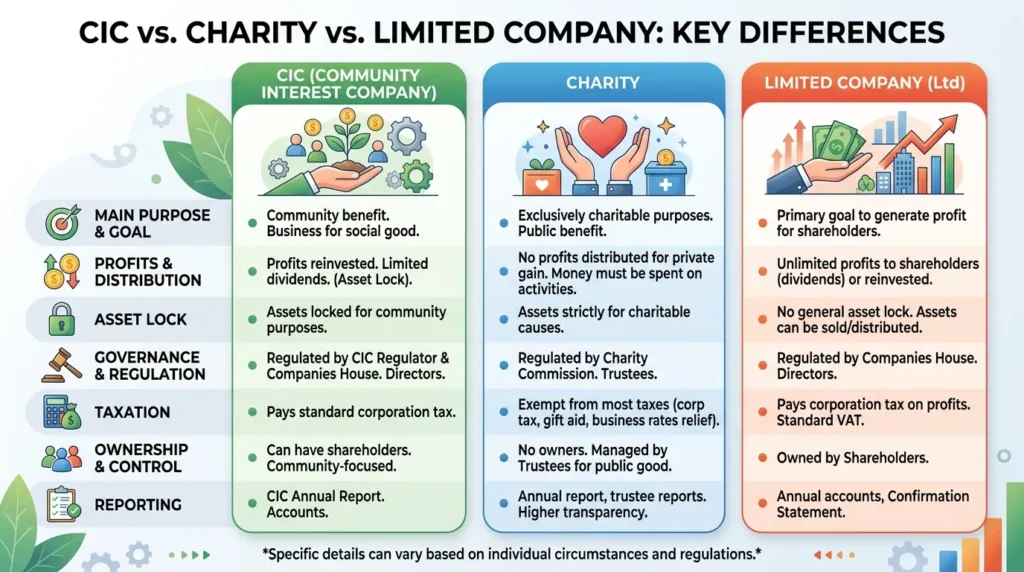
CIC vs. Charity vs. Limited Company: Key Differences
Is a CIC a Charity?
No. A CIC is not a charity, and it doesn’t receive charitable tax reliefs. It’s regulated as a business by Companies House and the CIC Regulator, not by the Charity Commission. This is one of the most common points of confusion for new founders, and it matters because it changes what tax breaks and funding routes are open to you.
Comparing Structure, Funding, and Tax Reliefs
| Feature | CIC | Registered Charity | Standard Ltd Company |
|---|---|---|---|
| Primary purpose | Community benefit, can trade freely | Charitable purpose only | Any lawful purpose, profit for owners |
| Can pay directors | Yes, if reasonable | Restricted, usually unpaid trustees | Yes |
| Corporation Tax | Pays in full, no automatic relief | Largely exempt | Pays in full |
| Business rates relief | Not automatic (may get discretionary relief) | Mandatory 80% relief | Not automatic |
| Access to grants | Some, but many charity-only grants are closed to it | Wide access, including charity-only funds | Limited, mostly commercial finance |
| Asset lock | Yes, statutory | Yes, via charity law | No |
| Regulator | CIC Regulator + Companies House | Charity Commission | Companies House only |
Pros and Cons of Registering as a CIC
Advantages of a CIC
- Quick to set up — usually faster than gaining charitable status
- Directors can be paid a market-rate salary
- The asset lock builds trust with funders, customers and local authorities
- More commercial freedom than a charity, including the ability to trade without restriction
- A recognisable, badge-like status that signals social purpose to the public
Disadvantages and Limitations
- No charitable tax exemptions — a CIC pays full Corporation Tax on its profits
- Excluded from grants and funds reserved for registered charities
- The dividend cap limits how much can be paid out to shareholders
- Ongoing CIC34 reporting is an extra compliance layer on top of standard company filings
- Cannot easily convert back once asset-locked, without transferring assets to another locked body
How to Set Up and Register a CIC in the UK
Registering a CIC follows the standard company formation route, with two extra CIC-specific documents layered on top.
- Draft the Articles of Association. Use the CIC-specific model articles for either limited by guarantee or limited by shares, adapted to your purpose.
- Complete Form CIC36. This declaration sets out your community interest statement and confirms the asset lock provisions.
- Apply via Companies House. Submit Form IN01 alongside your Articles and CIC36, either online (£27) or by post (£35). The CIC Regulator reviews the community interest statement before approval, which typically adds a few extra days compared with a standard limited company registration.
You’ll also need a registered office address, a company name (which the Regulator can reject if it’s misleading), and at least one director.
Ongoing Compliance: The CIC34 Annual Report
Every CIC must file a CIC34 Annual Community Interest Company Report alongside its yearly accounts, at a cost of £15. This report explains what the company did for the community that year, discloses any director remuneration, and confirms the asset lock and any dividends paid stayed within the rules. The Regulator can act if a CIC pays directors an unreasonable salary or distributes profits improperly — so treat the CIC34 as a genuine accountability document, not a formality.
Can a CIC Director Get Paid?
Yes. There is no fixed salary cap. What matters is that the pay is reasonable for the role and the size of the organisation, and that it’s disclosed transparently in the CIC34 report. The Regulator investigates cases where remuneration looks disproportionate to the company’s income or the work involved — for example, a small community project paying its director a salary far above market rate for a comparable commercial role. Getting this wrong can trigger regulatory intervention, so many CICs benchmark director pay against similar roles in the charity and social enterprise sector before setting it.
Does a CIC Pay Corporation Tax?
Yes. A common myth is that CICs are automatically tax-exempt like charities. They aren’t. A CIC pays Corporation Tax on its profits in the same way as any other limited company, and it doesn’t get the business rates relief that charities receive automatically — though local authorities can grant discretionary relief. If you’re weighing this up against other structures, it’s worth comparing the full tax position with a standard sole trader vs limited company breakdown before deciding.
What Happened to the Dividend Cap?
This is where a lot of older guidance online is wrong. Until 2014, CICs limited by shares faced a 20% cap on the dividend paid per share and a separate cap on how much of that could be carried forward. The CIC Regulator abolished the per-share cap in 2014. Today, the only restriction is the aggregate dividend cap: total dividends paid to all shareholders in a year cannot exceed 35% of the company’s distributable profits. If you’ve read that dividends are capped at 20% of share value, that information is out of date.
Frequently Asked Questions
Is a CIC eligible for grants?
Some, yes — many local authority and social investment funds accept CIC applicants. However, funds restricted to registered charities are closed to CICs, so check eligibility criteria carefully before applying, especially for small business grants.
What is the difference between a charity and a CIC?
A charity is regulated by the Charity Commission, gets tax exemptions, and restricts trustee pay. A CIC is regulated as a business, pays full Corporation Tax, and allows directors to be paid a market salary — but both share an asset lock protecting their purpose.
Can a CIC be converted into a charity?
Yes, a CIC can convert to charitable status, though the process involves demonstrating that its purposes meet the legal definition of “charitable” and transferring its locked assets accordingly. It’s not automatic and usually needs professional advice.
How much does it cost to set up a CIC?
Registration costs £27 online or £35 by post, plus £15 a year for the CIC34 filing. Many founders also budget for legal help drafting the community interest statement and Articles.
Can a CIC receive donations?
Yes, though donors can’t claim Gift Aid as they could with a registered charity, which is worth factoring into any fundraising strategy.