
The best task management app for a UK small business depends on team size and budget, not brand recognition. Todoist suits solo traders. Trello suits small teams that think visually. ClickUp and monday.com suit growing teams that need automation. Asana suits agencies juggling client dependencies. Workiro suits UK firms that want GBP billing and document-heavy task tracking in one place.
Why Small Businesses Struggle with Task Management
Small businesses struggle with task management because one person often does five jobs, and the tools they lean on were never built to hold a business together. Sticky notes, email threads and shared spreadsheets work fine at three people. Past that, something always slips.
The Hidden Cost of “Sticky-Note” Workflows
A missed deadline rarely comes from someone being careless. It comes from a task living in someone’s inbox instead of a shared system. Owners who track work this way typically lose several hours a week just chasing updates and re-explaining what’s already been agreed. That time has a cost, even when nothing goes visibly wrong. If your team is still coordinating around calendar invites and group chats, it’s worth reading how to build a free workflow for your business before adding a paid tool on top of a broken process.
Task Management vs. Project Management: What Does Your SME Actually Need?
Task management software tracks individual actionable items with owners and due dates. Project management software tracks groups of related tasks with dependencies, timelines and resource allocation across a whole piece of work.
A sole trader or a two-person service business usually only needs task management: a list, a due date, a reminder. A five-person agency juggling multiple clients needs light project management: task dependencies and a shared timeline. A 20-to-30-person hybrid team needs full project management: Gantt charts, workload views and reporting across departments. Buying more than your team size requires just adds a learning curve nobody asked for.
Our Methodology: How We Evaluated These Apps for UK SMEs
Each app below was assessed against five criteria that matter specifically to UK small businesses: real GBP pricing rather than a rough dollar conversion, what the free plan actually allows before forcing an upgrade, integration with British business tools like Xero and Microsoft 365, where customer data is legally hosted under UK GDPR, and how long it takes a non-technical team to get useful without outside help.
The Best Task Management Apps for UK Small Businesses
Here’s how the six leading options compare on the details that matter most to a UK small business.
| App | Best For | Entry Price (est. GBP) | Free Plan |
|---|---|---|---|
| monday.com | Scaling teams, custom workflows | ~£6.70/user/mo (annual) | Up to 2 seats |
| ClickUp | All-in-one, high feature density | ~£5.20/user/mo (annual) | Yes, generous |
| Trello | Simple visual Kanban | ~£3.70/user/mo (annual) | Yes, unlimited users |
| Asana | Collaboration, task dependencies | ~£8.15/user/mo (annual) | Up to 2 users |
| Todoist | Solopreneurs, lightweight teams | ~£3.70/mo flat (annual) | Yes, 5 projects |
| Workiro | Client documents + actionable tasks | £23/user/mo (billed in GBP) | No, trial only |
Prices are estimated GBP equivalents based on published USD rates at typical exchange levels, except Workiro, which bills UK customers natively in pounds. Always confirm current pricing on the vendor’s site, as most of these tools revise rates at least once a year.
1. Monday.com – Best for Scaling Teams and Custom Workflows
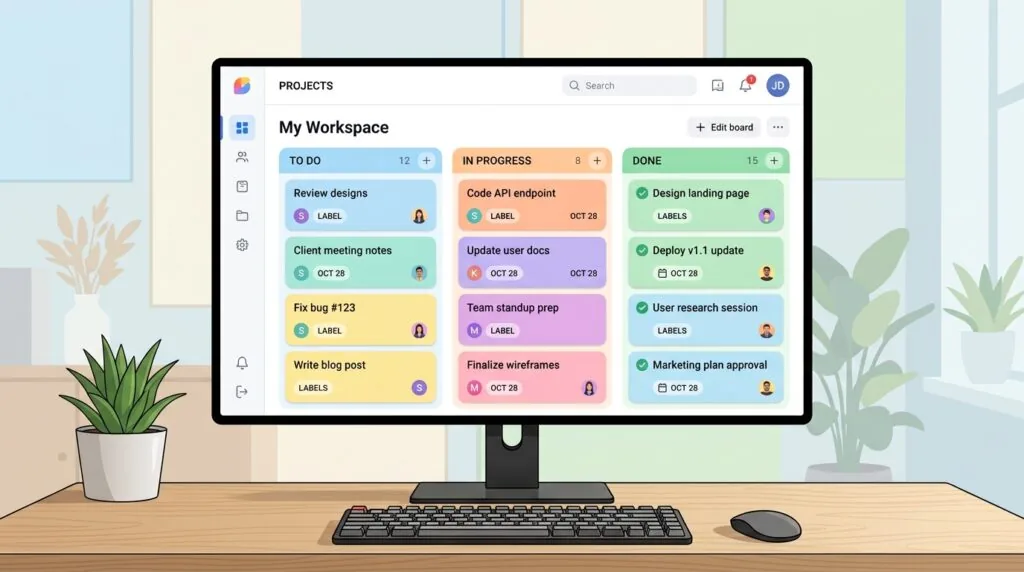
Monday.com works well once a team outgrows simple lists and needs custom boards for sales, operations and HR side by side. The free plan covers two seats only, and paid tiers require a minimum of three seats sold in blocks of five, so a seven-person team pays for ten. Basic starts around £6.70 per seat monthly on annual billing; Standard, which most SMEs actually need for automations and integrations, runs closer to £8.90. Automation and integration actions are capped by tier, and a busy team can burn through the Basic plan’s monthly quota within days.
2. ClickUp – Best All-in-One Platform with High Feature Density
ClickUp packs documents, goals, chat, whiteboards and time tracking into one workspace, which suits owners who want to retire several separate subscriptions. The free plan is genuinely usable long-term for a small team. The Unlimited paid tier costs around £5.20 per user monthly, rising to roughly £8.90 for Business, which adds private docs and deeper reporting. The trade-off is a steeper setup curve: teams new to ClickUp often need a full week to configure statuses and views before the tool feels intuitive rather than overwhelming. Read more on how ClickUp fits UK small business budgets if this is your shortlist leader.
3. Trello – Best for Simple, Visual Kanban-Style Tracking
Trello remains the fastest tool to set up from scratch. A small team can build a working board in under ten minutes. The free plan supports unlimited users and boards, just with a workspace-wide automation cap. Standard costs around £3.70 per user monthly on annual billing and removes the board limit; Premium, at roughly £7.40, adds calendar and timeline views. Trello suits a five-person team running a simple content or client pipeline, but it lacks the native reporting and dependency tracking that larger, more complex operations need. See our full guide to using Trello for UK small business projects for setup tips.
4. Asana – Best for Collaboration and Task Dependencies
Asana is built around task dependencies, meaning one task can’t start until another finishes, which matters for agencies running multi-stage client work. The free Personal plan covers only two users, so most small teams land on Starter at around £8.15 per user monthly. Advanced, at roughly £18.50, adds portfolio views and goal tracking, but few teams under 20 people need it. Asana’s automation cap of 250 actions monthly is workspace-wide, and busy teams report hitting it faster than expected.
5. Todoist – Best for Solopreneurs and Lightweight Team Checklists
Todoist is the simplest tool on this list, and that’s the point. It’s a personal task manager first, with light team features layered on top. The free plan caps out at five active projects, which is genuinely restrictive. Pro removes that cap for around £3.70 a month flat, not per seat, and Business adds shared team projects for roughly £5.95 per user monthly. It has no dependency tracking, no Gantt view and no native time tracking, so it’s a poor fit once a business needs to coordinate more than a handful of overlapping projects. If Todoist feels too basic, our list of free productivity apps worth testing alongside it covers lightweight alternatives.
6. Workiro – Best for Client Document Management and Actionable Tasks
Workiro is a UK-built platform combining task management, unlimited file storage and e-signing in one workspace, aimed squarely at professional services firms that live in documents as much as tasks. It bills natively in GBP at around £23 per user monthly, the only tool here that avoids a dollar-to-pound conversion entirely. There’s no free tier, only a trial, and the per-seat price sits well above Trello or Todoist. It earns its place for accountants, consultants and legal-adjacent small businesses that need client-facing document trails alongside task tracking, not for a five-person team that just needs a shared to-do list.
UK SME Quick Comparison Matrix
| App | Free Tier Limit | Paid Entry Point | Billed In | Best Team Size |
|---|---|---|---|---|
| monday.com | 2 seats, 3 boards | ~£6.70/user/mo | USD (converted) | 10–30 |
| ClickUp | Generous, most features | ~£5.20/user/mo | USD (converted) | 5–50 |
| Trello | Unlimited users, capped automations | ~£3.70/user/mo | USD (converted) | 1–15 |
| Asana | 2 users | ~£8.15/user/mo | USD (converted) | 5–30 |
| Todoist | 5 projects | ~£3.70/mo flat | USD (converted) | 1–5 |
| Workiro | Trial only | £23/user/mo | GBP (native) | 3–25 |
Key Factors UK Small Businesses Must Consider Before Buying
UK GDPR & Data Hosting Locations
This is the area most competitor guides skip entirely, and it matters. The UK’s data adequacy agreement with the EU was renewed in December 2025 and now runs to 27 December 2031, so personal data can keep flowing freely between the UK and EEA under current terms. That doesn’t mean every task management tool stores UK customer data the way you’d assume.
Monday.com hosts data in the US by default, with an EU region option in Germany; only Enterprise accounts get full region-locked residency, while Standard and Pro EU-hosted accounts can still have data processed in the US under Standard Contractual Clauses. ClickUp offers EU hosting through an Ireland data centre, but only on its Enterprise plan. Asana’s EU residency, hosted in Frankfurt, is an Enterprise or Enterprise Plus add-on reached only by contacting sales, and its free Personal plan carries no Data Processing Agreement at all. Workiro, being UK-headquartered, sidesteps most of this question by design.
Practically, this means a small business on a mid-tier plan handling client personal data should request a Data Processing Agreement from any vendor before rollout, and confirm it in writing rather than assuming compliance from a badge on the pricing page. For a broader checklist beyond task tools, see our guide to GDPR compliance tools for UK small businesses.
App Integrations (Xero, Slack, Google Workspace, MS 365)
All six tools connect to Slack, Google Workspace and Microsoft 365 at some tier, though deeper integrations like Xero sync or Salesforce connections are usually gated behind mid-to-upper plans. If your task tool needs to talk to your CRM, check our comparison of HubSpot vs Salesforce for UK small business before assuming compatibility. Teams already relying on Zapier to bridge gaps between apps should also read how to automate small business tasks with Zapier, which works with every tool on this list.
Time to Value (Learning Curve and Setup Friction)
Setup time varies more than most pricing pages admit. Todoist and Trello are usable within an hour with no training. Asana and monday.com typically take a half-day to configure properly for a team of five to ten. ClickUp is the most powerful and the slowest to onboard, often needing several days before a team stops feeling lost in its own workspace. Workiro sits in the middle, since most of the setup time goes into organising document folders rather than learning the task interface itself. If setup speed is your top priority, weight that more heavily than feature count.
Frequently Asked Questions (FAQs)
What is the best free task management app for small teams?
Trello offers the most usable free plan for small teams, with unlimited users and boards, capped only by monthly automation runs. ClickUp’s free plan is close behind and includes more built-in views. Both work well before you need dependency tracking or advanced reporting.
Can these tools help manage remote/hybrid UK staff?
Yes. All six apps include mobile apps, cloud sync and shared visibility across locations, which covers the basics of managing a remote or hybrid UK team. For structured guidance beyond the software itself, see our tips on improving team communication in a UK small business.
Do these apps offer pricing in British Pounds (GBP)?
Only Workiro bills UK customers natively in pounds. Monday.com, ClickUp, Trello, Asana and Todoist publish pricing in US dollars, so your actual monthly charge will move slightly with the exchange rate and may include a card provider’s foreign transaction fee. Always check the checkout screen for your exact GBP total before committing to annual billing.