

Stripe charges UK businesses 1.5% + 20p on domestic card payments. PayPal charges 2.9% + 30p. That gap looks small on paper, but it widens fast once international cards, currency conversion, and disputes enter the picture.
The right choice isn’t just about the lowest headline rate. It depends on how much technical help you have, where your customers are based, and whether a recognisable checkout button is worth paying more for. This guide works through the real UK numbers, using pounds and pence rather than the US-based figures most comparison articles rely on.
At a Glance: The Direct Comparison
Stripe is the cheaper, more customisable option for businesses with some technical capacity. PayPal costs more per transaction but brings instant brand trust and a checkout button shoppers already recognise.
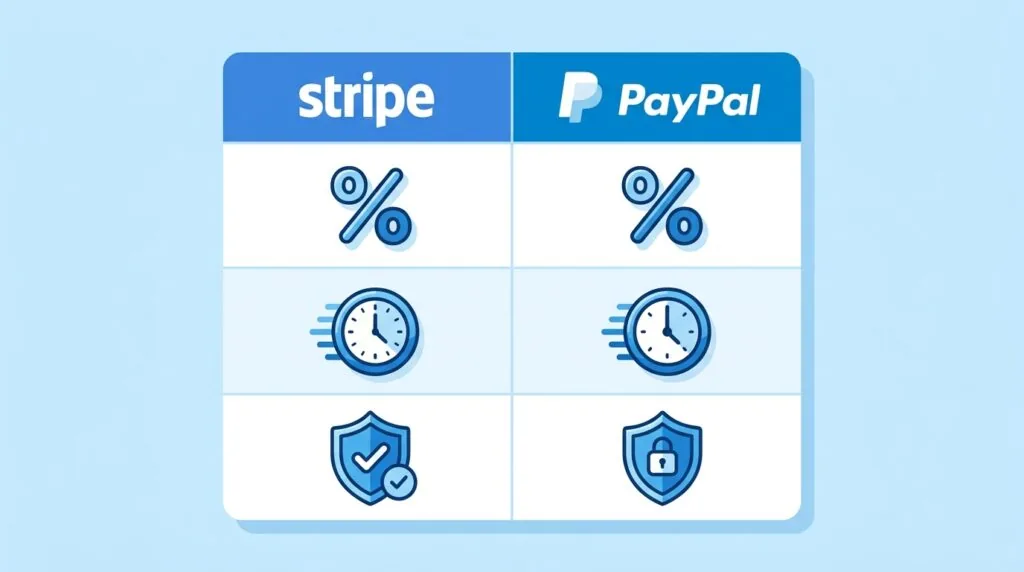
Key Metrics Summary Table
| Metric | Stripe | PayPal |
|---|---|---|
| UK domestic card rate | 1.5% + 20p | 2.9% + 30p |
| EEA card rate | 2.5% + 20p | +1.29% surcharge on domestic rate |
| Non-EEA international rate | 3.25% + 20p | +1.99% surcharge on domestic rate |
| Currency conversion fee | ~2% above mid-market rate | ~3–4% above mid-market rate |
| Payout speed | 2 business days (standard) | Instant to PayPal balance; ~1 day to bank |
| Setup type | No-code Payment Links or developer API | No-code buttons and plugins; SDK for developers |
| Dispute fee | Roughly £15–£20 per chargeback | Roughly £14 per dispute |
| FCA status | Authorised e-money institution (FRN 900461) | Authorised e-money institution (FRN 994790) |
UK Fee Structure: The Real Cost of Transactions
Both processors quote a percentage plus a fixed fee. The percentage matters more as your basket size grows; the fixed fee matters more on small transactions.
Stripe UK Standard & International Fees
Stripe’s standard UK domestic card rate is 1.5% + 20p. Cards issued in the EEA are charged as international since Brexit, at 2.5% + 20p. Cards issued outside the UK and EEA cost 3.25% + 20p. If Stripe handles the currency conversion, it adds roughly 2% on top of whichever rate applies. For recurring UK invoicing, Bacs Direct Debit is a cheaper alternative at 1%, capped at £4 regardless of transaction size.
PayPal UK Standard & International Fees
PayPal’s standard commercial rate for domestic Goods and Services payments is 2.9% + 30p. When the buyer is registered outside the UK, an international surcharge is added on top: roughly 1.29% for EEA cards and 1.99% for non-EEA cards. Currency conversion, when PayPal performs it, typically adds 3–4% above the mid-market exchange rate. Businesses processing high volumes of sub-£5 transactions can apply for PayPal’s micropayment rate, which drops to around 5% + 5p per transaction.
The Hidden Surcharges: Currency Conversion and Fee Stacking
Most comparison guides quote currency conversion as a flat percentage and stop there. In practice, these fees stack. A non-EEA card paying in GBP through PayPal doesn’t just pay the international surcharge — it also pays the domestic rate and, if conversion is involved, the FX spread on top of both. That can push the effective cost above 8% on a single transaction, far higher than the 2.9% headline rate most people remember.
Stripe’s fees are also subject to 20% UK VAT. VAT-registered businesses can reclaim this as input tax, but sole traders below the VAT registration threshold absorb the full cost, which is worth factoring into your margin calculations.
UK Scenario Math: £15 Basket vs. £150 Invoice
| Scenario | Stripe fee | Stripe effective rate | PayPal fee | PayPal effective rate |
|---|---|---|---|---|
| £15 domestic card sale | £0.43 | 2.8% | £0.74 | 4.9% |
| £150 domestic invoice | £2.45 | 1.6% | £4.65 | 3.1% |
| £150 non-EEA card, converted | ~£8.08 | 5.4% | ~£12.89 | 8.6% |
The fixed fee hurts small baskets more on PayPal because its 30p flat charge is higher than Stripe’s 20p. On larger invoices, the percentage difference dominates. On international, converted transactions, the stacked surcharges make PayPal’s real cost nearly double what the headline 2.9% rate suggests.
Checkout Conversion: Seamless UI vs. Trusted Brand Button
Stripe Elements & Native Customization
Stripe Elements and Stripe Checkout let you build a payment form that matches your site’s design exactly, with no redirect to an external page. Apple Pay and Google Pay slot in as digital wallets alongside standard card fields. This white-label experience tends to suit stores that already have design-conscious branding and some development support.
The PayPal Express Button and Customer Friction
The PayPal button is one of the most recognisable elements on the web, and that recognition genuinely increases buyer confidence, particularly for newer stores without an established reputation. The trade-off is friction: shoppers without a PayPal account are pushed through guest checkout, and buyers with an account may be redirected off-site before returning to confirm the order.
Ease of Setup and Technical Complexity
Out-of-the-Box Integrations (Shopify, WooCommerce, Xero)
Both processors offer plugin integration requiring minimal technical knowledge. Stripe connects natively as Shopify Payments, has a dedicated WooCommerce extension, and syncs with accounting packages like Xero and QuickBooks. PayPal Standard offers equivalent one-click buttons for Shopify, WooCommerce, Squarespace, and Magento. If you haven’t settled on a platform yet, it’s worth comparing options in our guide to choosing an ecommerce platform for your UK business before locking in a payment processor, since not every platform supports both equally well.
Developer Resources and API Control
Stripe’s API documentation, webhooks, and SDKs give developers full control over a custom checkout flow, subscription billing, and marketplace-style payouts through Stripe Connect. PayPal’s Checkout SDK covers similar ground but most small UK businesses use the hosted, no-code version rather than building a custom integration.
Behind the Scenes: Operations, Payouts, and Risk
Payout Speeds and Cash Flow Management
Stripe’s standard payout cycle to a UK bank account is two business days on a rolling basis. PayPal makes funds available in your account balance almost instantly, though moving that balance to your actual bank account typically takes around one business day. If cash flow timing is a concern, it’s worth reading our cash flow tips for UK small businesses alongside whichever business bank account you pair with your processor.
Account Stability and the “Frozen Account” Threat
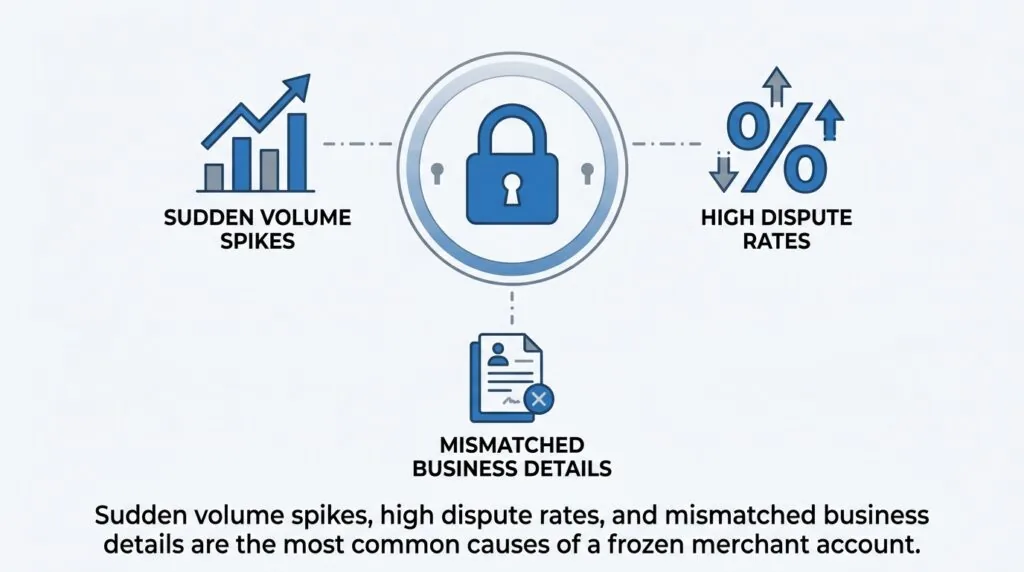
Both platforms use automated risk engines that can hold or freeze funds, but the triggers are rarely explained clearly. In practice, three patterns cause most freezes: a sudden spike in transaction volume that doesn’t match your account history, a chargeback-to-sales ratio that climbs above a low threshold, and a business description that doesn’t match what you’re actually selling.
You can reduce this risk with a few practical steps:
- Submit business verification documents proactively, before you’re asked.
- Keep your dispute rate low, ideally under 1% of transactions.
- Warn your provider ahead of planned volume spikes, such as a product launch or seasonal sale.
- Keep your account’s stated business activity accurate and up to date.
Because both Stripe and PayPal UK Ltd are authorised e-money institutions under the Electronic Money Regulations, customer funds must be safeguarded separately from the companies’ own operating funds. This ring-fencing protects merchant balances even if either company faced financial difficulty, though it doesn’t prevent a temporary account hold during a fraud review.
Dispute Resolution and Chargeback Costs
Stripe disputes go through the card network’s chargeback process, supported by Stripe Radar’s automated fraud detection and 3D Secure 2 authentication, which is required under UK Strong Customer Authentication rules. PayPal disputes typically start in its internal Resolution Centre before escalating to a formal chargeback if unresolved. Either way, keeping clear records, following GDPR-compliant data handling, and maintaining solid cybersecurity practices all reduce your exposure to fraud-driven disputes.
In-Person Payments: Stripe Reader vs. PayPal Zettle
Stripe Reader plugs into the same dashboard as your online account, so in-person and online sales appear in one unified report. PayPal Zettle, a PayPal-owned point of sale product, offers standalone card reader hardware and a till app well suited to market stalls, pop-ups, and small physical retail spaces that also take payments through a PayPal account online.
The Hybrid Approach: Why Many UK Businesses Use Both
A growing number of UK stores run Stripe as the primary checkout for lower fees, while still offering the PayPal Express button as an option for shoppers who trust it more. This captures Stripe’s better margins on most transactions without losing the conversion boost PayPal provides for hesitant buyers. The main downside is reconciliation: two providers mean two sets of transaction records to match against your bookkeeping, which is easier to manage if you’re already set up for digital record keeping under Making Tax Digital.
Final Verdict: Which is Best for Your UK Business?
Neither processor is universally “better.” The right pick depends on your business model, technical resources, and how much you value margin over brand recognition at checkout.
Choose Stripe If…
- You run a SaaS or subscription business needing recurring billing and API control.
- You have developer resources, even part-time or freelance, to customise your checkout.
- Your customer base is mostly UK-based, keeping international surcharges low.
- Profit margin per transaction matters more than checkout brand recognition.
Choose PayPal If…
- You’re a low-volume service business or new store still building trust with buyers.
- Most of your sales are one-off, low-frequency transactions rather than subscriptions.
- You want a no-code setup with zero developer involvement.
- Checkout familiarity and buyer confidence outweigh the higher percentage fee.
Frequently Asked Questions
Is Stripe cheaper than PayPal in the UK?
Yes, for standard domestic card transactions. Stripe charges 1.5% + 20p versus PayPal’s 2.9% + 30p, and the gap widens further on international and converted payments.
How long does it take Stripe to pay out to a UK bank account?
Stripe’s standard payout schedule is two business days on a rolling basis, though this can vary slightly based on your account history and risk profile.
Can I use Stripe and PayPal together on my website?
Yes. Many UK stores run Stripe as the primary checkout and add the PayPal Express button as a secondary option, though this does mean reconciling two sets of transaction records.
Why are PayPal fees higher for UK businesses?
PayPal’s domestic rate carries a higher percentage and a higher fixed fee than Stripe’s, and its international surcharges and currency conversion spread stack on top rather than replacing the domestic rate.
Do I need FCA authorisation to accept card payments?
No. Stripe and PayPal UK Ltd hold their own FCA authorisation as e-money institutions. You use their regulated infrastructure rather than needing your own licence.