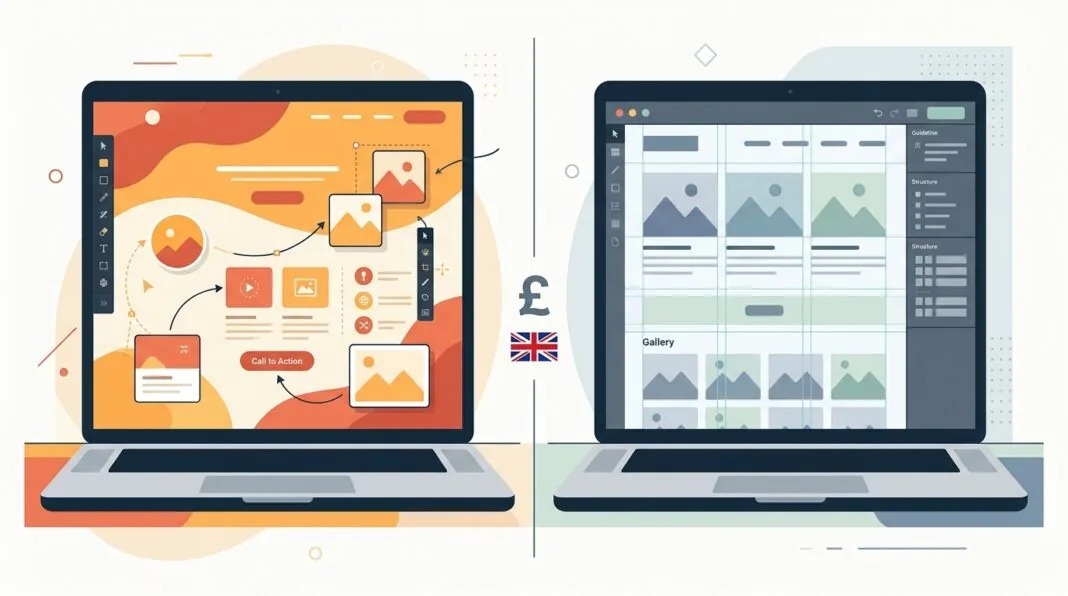


Most UK founders don’t want a features tour. They want to know what this really costs once the free trial ends, and who’s fixing it when something breaks. Shopify and WooCommerce answer that in almost opposite ways, and the right ecommerce platform for you depends on your budget, your appetite for admin, and how well it handles UK delivery and VAT from day one.
The Quick Verdict: Which Platform Fits Your UK Business?
| Factor | Shopify | WooCommerce |
|---|---|---|
| Best for | Owners who want speed, support and one bill | Owners who want control and lower long-term costs |
| Starting monthly cost | £5–£25 (Starter/Basic) | £0 software + roughly £5–£30 hosting |
| Card processing (own gateway) | 2.0%–1.5% + 25p, improves as you upgrade | 1.5%–2.9% + 20–30p via Stripe or PayPal, no platform cut |
| Hosting and security patches | Included | Bought and managed separately |
| Typical launch time | Hours to a few days | A week or more, longer with custom design |
| Who fixes it when it breaks | Shopify support | You, your host, or a developer you hire |
| Native UK VAT/MTD tools | Via App Store integrations | Via free and paid plugins |
Is WooCommerce cheaper than Shopify in the UK? For a store turning over under roughly £5,000 a month, WooCommerce is usually cheaper once you add hosting, a theme and a couple of plugins — often £20 to £50 a month against Shopify’s £19 to £65 plan fee plus a higher card rate. Add developer time for fixing plugin conflicts, though, and the gap narrows fast for anyone who isn’t comfortable with WordPress.
Ease of Use & Day-to-Day Management: SaaS vs. Open Source
The core difference isn’t features. It’s who’s responsible when something goes wrong.
The Shopify Experience: The “No-Code” Sandbox
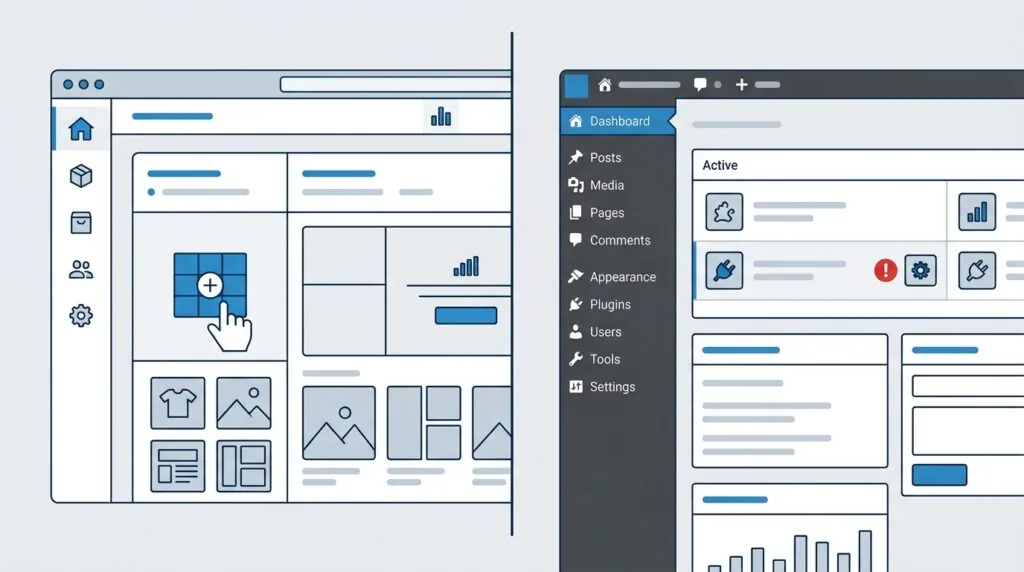
Shopify is hosted software: you rent space in its system rather than owning a server. Security patches, uptime, PCI compliance and backups happen automatically. You build with a drag-and-drop editor, pick a theme, and add features through the App Store rather than editing code.
It’s the same appeal as most hosted website builders: fewer moving parts, one support line when something looks wrong. The trade-off is you’re working inside Shopify’s rules — you can’t touch server settings, and some structural choices, like the fixed `/products/` and `/collections/` URL paths, aren’t yours to change.
The WooCommerce Experience: Complete Creative Control (With a Catch)
WooCommerce is a free plugin that turns a WordPress site into a shop. Nothing is hidden: you choose the host, the theme, the plugins, and you own every byte of data. For anyone already comfortable building a small business website on WordPress, that’s the whole appeal.
The catch is maintenance. WordPress core, WooCommerce, your theme and every plugin update on separate schedules, and they don’t always agree. A clash can trigger what the WordPress community calls the “white screen of death” — a blank page caused by a fatal PHP error, usually fixed by disabling the conflicting plugin. It’s rarely serious, but someone has to notice and fix it. That someone is you, unless you’ve budgeted for developer support.
True Cost Comparison: Pricing in Pounds Sterling (£)
Sticker prices rarely match what lands on the invoice. Here’s what each platform actually costs a UK store once the basics are covered, which matters for your overall start-up budget as much as the ongoing bill.
Shopify Costs: Predictable Subscriptions & App Creep
Shopify runs five UK plans:
- Starter — £5/month: sells through social links and messaging apps only; no full storefront.
- Basic — around £19–£25/month depending on annual or monthly billing: the entry point for a real online store.
- Grow — around £49–£65/month: lower card fees, better reporting.
- Advanced — around £259–£344/month: the lowest standard card rate and advanced shipping tools.
- Plus — from roughly £1,800/month on a three-year term: enterprise-grade, negotiated pricing.
VAT-registered merchants aren’t charged VAT on the subscription itself, thanks to the reverse-charge mechanism; without a VAT number, 20% UK VAT is added to the invoice.
The subscription is rarely the final bill. Most growing stores add £50–£300 a month in apps for reviews, upselling, email marketing and inventory sync once the free-trial optimism wears off — costs that are rarely optional in practice, just not shown on the pricing page.
WooCommerce Costs: Low Entry Barrier, High Maintenance Tail
The WooCommerce plugin itself costs nothing. The true cost of WooCommerce isn’t free — it’s spread across everything the plugin doesn’t include:
- Hosting: shared hosting from about £5–£15/month is workable for a small catalogue; managed WordPress/WooCommerce hosting built to handle traffic spikes runs £20–£100+/month.
- Domain name: roughly £10–£15/year for a `.co.uk`.
- SSL certificate: usually free through the host.
- Premium theme: a one-off £50–£200, though free themes exist.
- Essential plugins (backups, security, SEO, shipping calculators): commonly £100–£800/year combined once you add two or three paid extensions.
That gives a realistic DIY range of roughly £20–£70 a month for a small, low-traffic store. Scale up, add a developer for troubleshooting, and that figure climbs quickly — the “maintenance tail” competitors rarely quantify.
The Hidden Killer: UK Transaction Fees & Payment Gateways
This is the section most comparisons skip, and it’s where the real money moves.
Shopify Payments vs. Third-Party Gateway Penalties
Shopify’s own processor charges, per online card transaction: Basic 2.0% + 25p, Grow 1.7% + 25p, Advanced 1.5% + 25p. Choose a different UK payment gateway instead — Stripe or Opayo, say — and Shopify adds an extra fee on top: roughly 2% on Basic, tapering down on higher plans, waived entirely on Plus if Shopify Payments stays primary.
Here’s the maths competitors mention but rarely run. Take a UK store doing £5,000 a month at a £50 average order — 100 orders.
- Shopify Basic + Shopify Payments: (£5,000 × 2.0%) + (100 × £0.25) = £125 in card fees, on top of roughly £25 a month for the plan. Total: around £150/month.
- Shopify Basic + a third-party gateway: Stripe’s own UK card rate (roughly 1.5% + 20p) charges £95, then Shopify’s third-party penalty adds another 2% (£100). Total gateway-side cost: around £195/month — worse, not better.
The lesson: unless you’ve negotiated custom rates elsewhere, staying on Shopify Payments is almost always cheaper than bringing your own gateway to a Shopify store.
WooCommerce Flexibility: Direct Integrations (Stripe, Klarna, PayPal)
WooCommerce charges no platform-level transaction fee at all. Connect Stripe, PayPal, Klarna or Clearpay directly and you pay only that provider’s processing rate — how Stripe and PayPal fees compare is worth checking before you pick one.
Run the same £5,000/month, 100-order scenario through Stripe direct: £75 + £20 = £95 in card fees, with no extra platform cut. Add £20–£30 for hosting and the total lands around £115–£125 a month — similar to, or slightly below, Shopify Basic once its plan fee is included. Klarna and Clearpay buy-now-pay-later checkouts are available on both platforms and typically carry a somewhat higher effective rate than standard cards, since the provider absorbs the credit risk.
UK Shipping, VAT Compliance & GDPR
Handling Royal Mail, Evri, and DPD
Both platforms connect to the UK’s main couriers, just through different routes. Shopify stores typically use the Royal Mail or multi-carrier apps from the App Store, or the built-in label tools on Advanced and Plus plans, to buy discounted labels and sync tracking automatically. WooCommerce stores usually add one dedicated shipping plugin — a Royal Mail Click & Drop integration or a multi-carrier extension covering Evri and DPD — for the same result. Neither needs manual courier booking once it’s set up properly.
Automating UK VAT & Making Tax Digital (MTD)
The UK VAT registration threshold sits at £90,000 in taxable turnover on a rolling 12-month basis for 2026/27. Cross it, or expect to, and you must register — though many stores register voluntarily earlier, ahead of the current VAT registration threshold, to reclaim VAT on business costs.
Making Tax Digital for VAT already applies to every VAT-registered business. The bigger shift is Making Tax Digital for Income Tax, starting 6 April 2026 for sole traders and landlords with qualifying income above £50,000, dropping to £30,000 in April 2027 and £20,000 in April 2028. Limited companies aren’t included yet — no MTD date has been set for corporation tax.
Both platforms connect to MTD-compatible software: Shopify has an official Xero integration in its App Store, and WooCommerce uses free Xero and QuickBooks sync plugins. Neither files your VAT return for you — that’s still the accounting software’s job.
Most online stores handling UK customer data also need to pay the ICO data protection fee and run a compliant cookie banner under GDPR and PECR. Shopify handles baseline PCI-DSS compliance automatically; on WooCommerce, that sits with your host and SSL setup.
Search Engine Optimization (SEO): Ranking in UK Search Results
Both platforms can rank well; the practical differences are in flexibility. WooCommerce runs on WordPress, giving you a wider choice of SEO plugins, fully editable URL structures, and a blog and shop on one CMS — useful for local SEO content targeting UK towns and postcodes. Shopify’s SEO has improved — editable meta tags, automatic sitemaps, fast page speed by default — but its `/products/` and `/collections/` URL structure is fixed, and blogging tools are more basic.
For most small UK stores, the platform matters less than having a real ecommerce marketing plan behind it: a `.co.uk` domain, a claimed Google Business Profile, and content that answers what UK shoppers are actually searching for.
The Final Verdict: How to Choose
Before you touch either platform, sort your business structure — it affects your VAT position and payment processing registration.
Choose Shopify if…
- You want to launch in days, not weeks, without touching code.
- You’d rather pay a predictable monthly fee than hire a developer.
- You’re selling heavily through Instagram, TikTok or WhatsApp alongside a storefront.
- You want hosting, security and PCI compliance handled for you.
- You plan to scale to multiple staff accounts or locations without building your own infrastructure.
Choose WooCommerce if…
- You’re comfortable with WordPress, or you’ve budgeted for a developer.
- Full ownership of your data, design and hosting matters to you.
- You publish a lot of content and want your blog and shop on one system.
- You want to avoid a rising platform fee as revenue grows.
- You’re disciplined about updates, backups and basic cybersecurity practices — or you’ll pay someone else to be.
Quick Answers
Do I need a developer for WooCommerce? Not to launch a basic store — but most owners bring one in within the first year to resolve plugin conflicts or add features Shopify includes by default.
Is Shopify or WooCommerce cheaper in the UK? WooCommerce is usually cheaper at low sales volumes. Shopify tends to become more predictable, and sometimes cheaper overall, once you factor in a developer’s hourly rate for WooCommerce fixes.
What are Shopify’s transaction fees if I don’t use Shopify Payments? Shopify adds an extra fee — roughly 2% on the Basic plan, less on higher tiers — on top of your own gateway’s processing rate. It’s waived if Shopify Payments stays your primary gateway.
There’s no universally “better” platform here — only the one that matches your budget, your tolerance for admin, and how much of the maintenance you want to own yourself.