
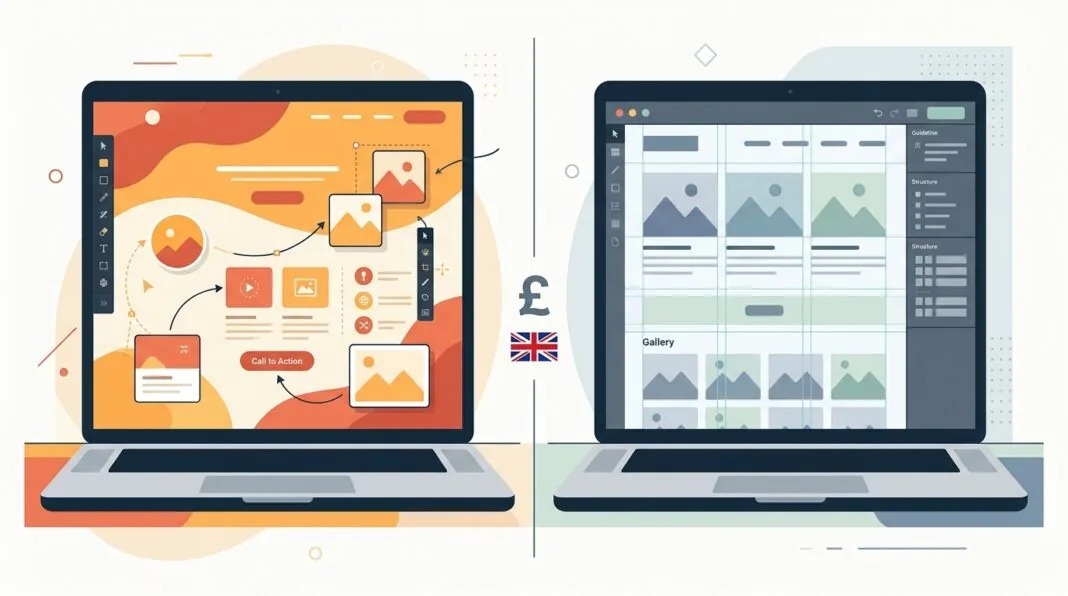

Wix and Squarespace both let you build a professional website without touching code, but they solve different problems. Wix gives you more control over layout and a deeper toolkit for bookings and services. Squarespace gives you a faster route to a polished, visually consistent site. The right choice depends on what your business actually needs to do day to day — not which platform has the flashier homepage.
Wix vs Squarespace: The Core Difference at a Glance
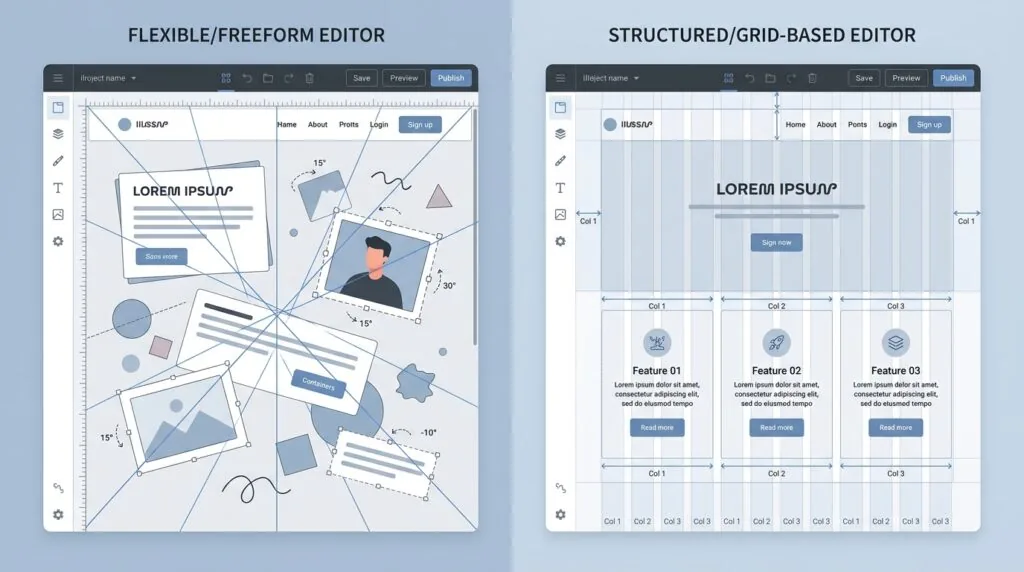
Wix is built around freedom. You place elements anywhere on the page, and the platform’s Aria AI agent (part of the newer Wix Harmony builder) can generate a full site from a written prompt. Squarespace is built around structure. Its Fluid Engine locks your design to a responsive grid, so pages tend to look sharp on every device with less manual tweaking.
If you need a booking system with staff calendars and deposits, Wix has the deeper native tools. If you need a visually striking portfolio or shop with minimal fuss, Squarespace usually gets there faster.
Quick Comparison Table (UK Edition)
| Feature | Wix | Squarespace |
|---|---|---|
| Entry-level price (annual) | £9/month | £12/month |
| Cheapest plan with online selling | £16/month (Core) | £17/month (Core) |
| Built-in transaction fee | 0% platform fee (payment processor fee applies) | 3% on Core; 0% on Plus and Advanced |
| Free domain | Yes, on paid plans | Yes, on paid plans |
| AI website builder | Aria / Wix Harmony | Blueprint AI |
| Native booking system | Wix Bookings | Acuity Scheduling |
| Design approach | Free-form, pixel-level | Fixed grid (Fluid Engine) |
| Best suited to | Local service businesses, bookings, flexible layouts | Creative portfolios, brand-led online stores |
Design & Editor Philosophy: Drag-and-Drop vs. Structured Grid
Wix’s Free-Form Editor: Total Creative Freedom (With a Catch)
Wix lets you drop text, images and buttons anywhere on the canvas using absolute positioning. That freedom is genuinely useful if you have a specific layout in mind. The catch: because elements are placed by exact coordinates rather than within a flowing grid, layouts built carelessly can overlap or misalign on unusual screen sizes — an older laptop resolution, a tablet in landscape, a budget Android phone. Wix’s newer editors have largely fixed this, but it’s still worth previewing every page on mobile before you publish, not just trusting the desktop view.
Squarespace’s Fluid Engine: Guardrails for Beautiful Design
Squarespace’s Fluid Engine builds pages on a CSS grid, so content reflows automatically as screen size changes. You get less pixel-level control, but far more consistency without extra checking. For a solo business owner without design experience, that trade-off usually saves time.
Templates & Mobile Responsiveness
Both platforms offer hundreds of templates and mobile-responsive themes by default. Squarespace’s template library is generally regarded as more visually cohesive out of the box; Wix’s is larger and more varied, which suits businesses wanting a distinctive look rather than a refined, editorial one.
UK Pricing & True Cost of Ownership (GBP)
Wix UK Pricing Plans
On annual billing, Wix’s Classic plans run: Light at £9/month (no online selling), Core at £16/month (the minimum plan for taking payments), Business at £25/month, and Business Elite at £119/month for high-volume stores. Wix Studio, aimed at agencies and design-led teams, sits at similar price points. Promotional discounts often appear at checkout, but they apply to your first term only — budget for the renewal price, not the offer.
Squarespace UK Pricing Plans
Squarespace’s UK tiers, billed annually, are Basic at £12/month, Core at £17/month, Plus at £29/month, and Advanced at £79/month. Squarespace displays UK prices inclusive of the standard 20% VAT rate, so the figure at checkout is what you actually pay. Basic doesn’t support a proper product store — you’ll need Core or above to sell physical goods.
Hidden Fees: Transaction Costs & App Subscriptions
The plan price is rarely the full bill. Watch for four extras: domain renewal after the free first year (roughly £10–£25), a professional email address (Google Workspace typically runs £5–£7 per user, per month), paid apps from Wix’s App Market or Squarespace’s Extensions marketplace, and payment processing fees on every sale. If you’re weighing this against other e-commerce platforms available to UK sellers, factor all four into your comparison, not just the headline subscription. It’s also worth reviewing your setup with a UK business bank account built for online sellers, since currency handling and card fees affect your margins as much as platform pricing does.
E-Commerce & UK Business Integrations
Payment Gateways (Stripe UK, SumUp, PayPal, Barclays)
Both platforms support Stripe and PayPal directly. Wix adds its own processor, Wix Payments, charging around 2.1% + 20p per UK card transaction with no additional platform commission. Squarespace Payments is now live for UK sellers too, including Google Pay support. Neither platform has a native Barclays or SumUp checkout integration, but both can connect SumUp card readers for in-person sales through their respective app marketplaces — useful if you also sell at UK markets or pop-ups. For a fuller breakdown of processor fees, see our guide to the best payment gateway options for UK small businesses, or our direct Stripe vs PayPal comparison.
UK Shipping & VAT Setup (Royal Mail, Evri)
Neither Wix nor Squarespace has a deep, purpose-built Royal Mail or Evri integration baked into the core platform. Instead, both connect to carrier and label-printing apps through their marketplaces, or let you export orders to third-party shipping tools. For VAT, Squarespace can auto-calculate and apply VAT at checkout based on customer location; Wix requires manual tax rule setup or a tax automation app. Either way, if your UK taxable turnover is approaching the £90,000 VAT registration threshold, get your VAT settings right before you cross it — see our guide on registering for VAT for the full process.
Client Bookings & Scheduling Tools
This is where the platforms diverge most. Wix Bookings is native: staff calendars, deposits, packages, and automated reminders, all inside the same dashboard as your website. Squarespace relies on Acuity Scheduling, which Squarespace owns but which still feels like a separate product with its own login and interface. For a plumber in Birmingham juggling call-out slots and deposits, Wix Bookings is the more integrated option. If bookings are central to your business model, it’s worth comparing both against dedicated scheduling software built for UK businesses as well.
Search Engine Optimization (SEO) for UK Markets
Local SEO and Google Business Profile Integration
Both platforms generate an XML sitemap automatically, let you edit meta titles and descriptions, and support alt text on images — the basics needed to rank on Google UK. Squarespace has added AI tools that suggest SEO copy automatically; Wix has a built-in SEO setup checklist that walks you through the essentials page by page. Neither replaces the groundwork of setting up a Google Business Profile and building genuine local SEO for UK small businesses — the website is only one part of ranking locally.
Page Speed, Core Web Vitals, and UK CDN Performance
Both platforms host on a global CDN, which helps UK visitors load pages quickly regardless of where the servers sit. In practice, Squarespace sites often load slightly faster out of the box because they carry less third-party script weight; Wix sites can slow down if you install many apps, so it’s worth auditing your app list periodically. Either way, Core Web Vitals (loading speed, interactivity, and visual stability) affect both your Google ranking and your conversion rate, so don’t treat page speed as a one-off setup task.
Customer Support & Learning Curve
Wix offers 24/7 support with callback options on paid plans, plus a large community forum and App Market ecosystem. Squarespace’s support runs on email and chat, with no phone line for most tiers, but its help centre and guided workshops are thorough. For day-to-day learning curve: Wix’s flexibility means more decisions to make early on; Squarespace’s structure means fewer decisions but less room to deviate later. If responsiveness to customer queries matters to your own website visitors, both platforms support third-party live chat software if you want more than a contact form.
Verdict: Which Website Builder Wins for Your Business Type?
Choose Wix If…
You run a local service business that takes bookings — a plumber, hairdresser, personal trainer, or clinic. Wix Bookings, flexible layouts, and a lower e-commerce entry point (Core at £16/month with 0% platform fee) make it the stronger fit when your website needs to function as a working booking tool, not just a brochure.
Choose Squarespace If…
You’re a creative professional selling a visual product or service — a graphic designer in Bristol, a photographer, an interior stylist. Squarespace’s template quality and Fluid Engine deliver a polished result with less manual design work, which matters when your website is effectively your portfolio.
Is WordPress or a Custom Build Better for You?
If you need functionality neither platform offers natively — complex membership tiers, bespoke booking logic, or deep third-party integrations — WordPress with dedicated plugins or a custom build may serve you better long-term, at the cost of more setup time and technical maintenance. For most UK small businesses starting out, though, Wix or Squarespace will cover the requirement without that overhead. Either way, it’s worth mapping your full toolkit early, including a CRM for UK small businesses if you’ll be managing client relationships beyond the website itself.
Frequently Asked Questions (FAQ)
Is Wix better than Squarespace for UK small businesses?
Neither is universally better. Wix suits businesses needing bookings and layout flexibility; Squarespace suits businesses prioritising visual polish with less manual design work.
What are Squarespace’s transaction fees in the UK?
Squarespace’s Basic and Core plans carry a transaction fee (around 3% on Core) on top of payment processing costs. The Plus and Advanced plans remove the platform transaction fee on physical product sales.
Can I run a local service business booking system on Wix?
Yes. Wix Bookings is built into the platform and supports staff calendars, deposits, packages, and automated reminders without a third-party plugin.
Do Wix and Squarespace include free domains?
Both include a free custom domain for the first year on paid plans. After that, renewal typically costs £10–£25 per year, separate from your subscription.
Which platform is cheaper overall for a UK business?
Wix is cheaper at entry level (£9 vs £12) and at the e-commerce tier once you factor in its 0% platform transaction fee. Squarespace can work out cheaper if you’re on a higher tier already, since Plus and Advanced also drop to 0% on physical goods.
Is Wix or Squarespace better for SEO?
Both cover the technical basics — sitemaps, meta tags, alt text, mobile responsiveness. Neither has a structural SEO advantage; results depend more on your content and local SEO setup than the platform choice.