


Quick answer: A convertible loan note (CLN) is a short-term loan a UK startup takes from an investor, which converts into shares instead of being repaid in cash — usually at the next priced funding round, at a discount to what new investors pay. It lets founders raise money fast without agreeing a company valuation upfront.
CLNs solve a real problem. Agreeing a valuation for a young company is slow and often unrealistic — there isn’t enough trading history to justify a number both sides believe in. A CLN sidesteps that argument. The investor lends cash today. The value gets fixed later, when a proper priced round sets the price for everyone.
That said, CLNs are not the default choice for UK seed rounds anymore. HMRC’s tax rules push many founders toward Advance Subscription Agreements (ASAs) or SeedFAST-style agreements instead, and the reasons why matter more than most guides explain. This article covers the mechanics, the terminology, the tax trap, and a worked example of exactly how much a CLN can dilute your cap table.
Core Mechanics: How a Convertible Loan Note Works
A CLN starts life as debt and ends life as equity — but only if a qualifying event happens before the note matures. Until then, the company owes the noteholder money, with interest, just like any other loan.
The Bridge Financing Function (Debt to Equity)
Founders use CLNs as a bridge: cash to cover payroll, product development, or runway between a seed round and a larger raise, without forcing a valuation conversation months before the company is ready for one. The lender accepts more risk than a bank would, so in exchange they get the right to convert their loan into shares later, usually at better terms than a new investor gets.
This structure works because both sides get something they want. The founder avoids a premature valuation. The investor avoids overpaying for a company that’s still proving itself, while keeping the option to become a shareholder once there’s real traction to price against.
The Conversion Trigger Events (Priced Rounds, Sale, Maturity)
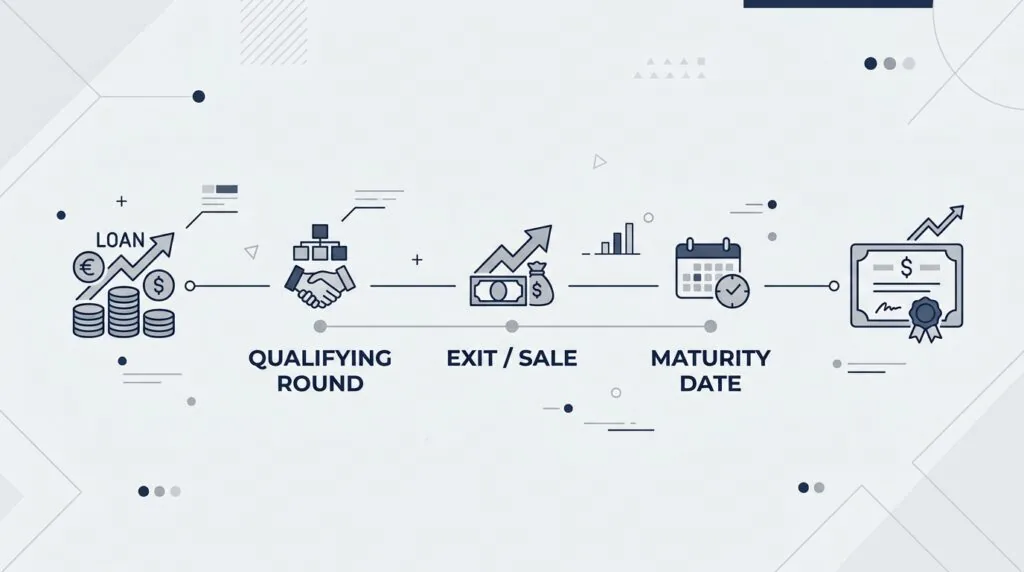
A CLN converts, is repaid, or is renegotiated when one of these events happens:
- A qualifying priced round — the company raises equity funding above an agreed threshold (commonly £500,000+), and the note converts into the same share class at a discount.
- An exit or sale — if the company is acquired before conversion, the instrument usually has separate terms setting out how noteholders get paid, often with a multiple on their original loan.
- Maturity date — if neither of the above happens by the deadline (typically 12–24 months), the note either converts at a pre-agreed fallback price, gets repaid in cash, or is extended by mutual agreement.
Each of these triggers is written into the loan note instrument itself, so vague drafting here is one of the most common sources of founder-investor disputes later.
Key Terminology & Anatomic Parameters of a CLN
Every CLN is built from the same handful of parameters. Getting these wrong — or not understanding what they do to your cap table — is the single biggest risk in a note negotiation.
Valuation Caps & Conversion Discounts
The discount rate gives the noteholder a lower price per share than new investors pay at conversion, typically 10% to 25%, with 15–20% most common in UK seed deals. The valuation cap sets a maximum company valuation the note can convert against, protecting early investors if the company’s value jumps sharply before the priced round.
Here’s how the two interact in practice:
- A startup raises £150,000 on a CLN with a 20% discount and a £4,000,000 valuation cap.
- The company has 1,000,000 shares in issue before the priced round.
- The Series A prices shares at £6.00 each (a £6m pre-money valuation).
- Discount price: £6.00 × 0.80 = £4.80 per share → £150,000 ÷ £4.80 = 31,250 shares.
- Cap price: £4,000,000 ÷ 1,000,000 shares = £4.00 per share → £150,000 ÷ £4.00 = 37,500 shares.
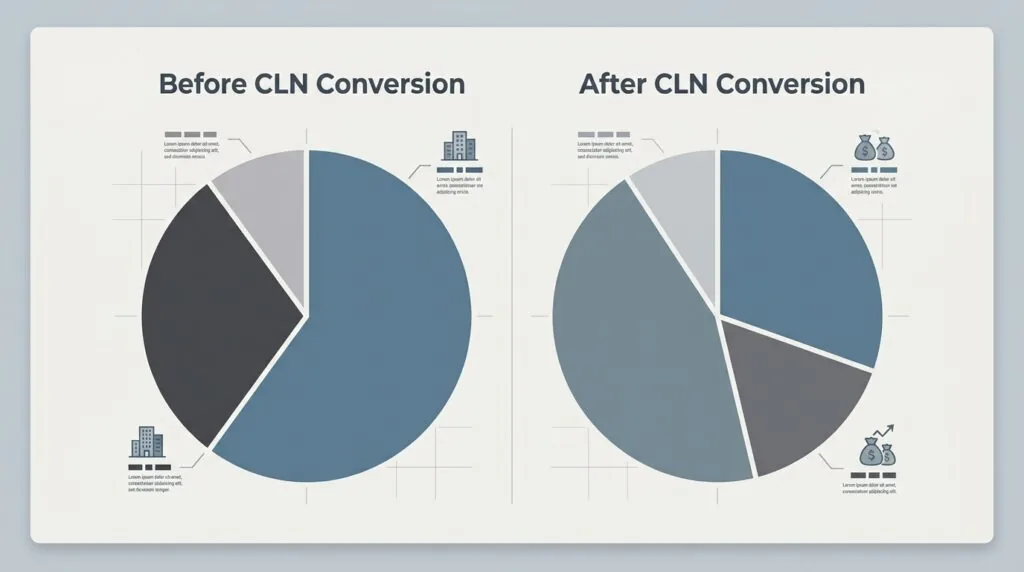
Because the cap produces a lower share price, the noteholder converts under the cap — 37,500 shares instead of the 25,000 shares they’d get paying the round price outright. That’s an extra 12,500 shares handed to one early investor, and it comes straight out of the founders’ and other shareholders’ percentage ownership. Whichever mechanism is more generous to the investor — the discount or the cap — is the one that applies at conversion.
Interest Rates (PIK vs. Cash) & Maturity Dates
UK CLNs typically carry an interest rate of 5% to 10% a year, calculated on the loan amount. Most seed-stage notes use PIK (payment-in-kind) interest — it accrues and converts into extra shares alongside the principal, rather than being paid out in cash the company doesn’t have. Cash interest is rarer at this stage, since it drains the very runway the loan was meant to extend.
The maturity date — usually 12 to 24 months from issue — is the deadline by which a trigger event needs to happen. Shorter maturities push founders toward fundraising faster; longer ones give more breathing room but leave the note as a liability on the balance sheet for longer.
Redemption Rights & Liquidation Preference
Redemption rights let the noteholder demand cash repayment instead of converting, usually only if maturity passes with no qualifying round. Liquidation preference, where included, means noteholders get their money back (sometimes with a multiple) before ordinary shareholders in a sale or wind-down.
This is where the competitor guides usually go quiet: what actually happens if the company hasn’t raised or sold by maturity? In practice, one of three things occurs. The parties extend the maturity date by mutual agreement, which is the most common outcome for startups still trading but not yet ready for a priced round. The note converts at a pre-agreed fallback valuation written into the instrument. Or, if the company genuinely can’t pay and no extension is agreed, the noteholder becomes an unsecured creditor — meaning they queue behind secured lenders, HMRC, and employees if the company is wound up. This is a real risk for investors and a real reason founders should never treat a CLN’s maturity date as a formality.
Convertible Loan Notes vs. ASAs & SAFEs (The UK Tax Dilemma)
CLNs and Advance Subscription Agreements look similar on paper — both let a startup take money before a priced round — but only one of them is compatible with SEIS and EIS relief, and that difference decides which one most UK seed rounds actually use.
Why Standard CLNs Invalidate SEIS & EIS Tax Reliefs
SEIS and EIS relief require an investor to subscribe for new shares in cash, with no right to get their capital back and no debt-like features attached. A CLN fails this test on its face: it is a loan, and HMRC treats the noteholder’s right to redemption — even one they never intend to use — as a disqualifying feature. That’s true even if the note converts into shares in the end; the debt period beforehand is what breaks eligibility.
An Advance Subscription Agreement avoids this because it isn’t a loan at all. The investor prepays for shares that will definitely be issued — there’s no repayment right, no interest, and no redemption. HMRC has confirmed ASAs can qualify for SEIS/EIS, but only if strict conditions are met: no longer than a 6-month longstop date before shares must be issued, and no arrangement that lets the investor get cash back instead. This is why most SEIS/EIS-focused UK seed rounds now use ASAs or SeedFAST-style agreements rather than CLNs.
Founders raising SEIS-eligible money should read our guide to the SEIS scheme in the UK before choosing an instrument, since picking a CLN by default can quietly cost investors their tax relief.
Structural Comparison Table: CLN vs ASA vs SeedFAST/SAFE
| Feature | Convertible Loan Note (CLN) | Advance Subscription Agreement (ASA) | SeedFAST / SAFE-style |
|---|---|---|---|
| Legal nature | Debt instrument | Prepayment for future shares | Prepayment for future shares |
| SEIS/EIS eligible | No | Yes, if longstop ≤ 6 months | Yes, if structured correctly |
| Interest charged | Usually yes (5–10%) | No | No |
| Repayment right | Yes, until conversion | No | No |
| Typical use case | Non-SEIS bridge, larger cheques | SEIS/EIS-focused seed rounds | Fast, simple seed rounds |
| Investor protection | Cap, discount, interest | Cap, discount | Cap, discount |
Strategic Pros & Cons for UK Founders and Lenders
A CLN is a trade-off, not a free option — it moves risk and reward between founders and investors depending on how the terms are set.
Founder Advantages & Cap Table Risks
Founders get speed: a CLN can close in days, with far less negotiation than a priced round, and it delays the valuation conversation until there’s more evidence to support a good number. The risk sits on the other side of that same coin. Every discount and cap point conceded now becomes real dilution later, often calculated at a moment when the founder has the least leverage — mid-negotiation on a Series A, with a maturity deadline looming. Stacking several CLNs from different investors, each with its own cap and discount, can also produce dilution nobody modelled properly until the cap table is built.
Investor Benefits & Downside Mitigations
Investors get downside protection a straight equity purchase doesn’t offer: if the company fails before conversion, they rank as creditors rather than shareholders, giving them a claim ahead of ordinary shareholders. The discount and cap reward them for taking on early risk with less information than a Series A investor will have. The trade-off is the lost SEIS/EIS relief, which for many angel investors is worth more than the discount itself — a reason experienced UK angels often push founders toward an ASA instead.
Founders comparing sources of early capital may also want to look at how to find angel investors in the UK and how to find venture capital in the UK before deciding which instrument fits their next raise.
Step-by-Step: Negotiating & Executing a CLN in the UK
Executing a CLN properly involves legal drafting, board approval, and cap table modelling — skipping any of these steps is where most disputes start.
- Agree commercial terms — amount, discount, cap, interest rate, and maturity date, ideally benchmarked against current UK seed-stage norms.
- Draft the loan note instrument — a formal legal document, not a side letter, setting out every trigger event and what happens at maturity.
- Pass a board resolution — directors must formally approve issuing the instrument; get advice on company director responsibilities before signing.
- Execute and fund — the investor transfers funds against the signed instrument.
- File at Companies House if required — most CLNs don’t need filing, but check if the instrument creates a registrable charge.
- Model the dilution — run the cap and discount scenarios (as above) before the priced round, not after.
- Convert or redeem at the trigger event — issue shares, update the cap table, and update the share register.
Essential Legal Documentation (Instrument vs. Agreement)
A CLN is documented through a loan note instrument — a unilateral legal document the company issues, rather than a bilateral contract both parties negotiate line by line the way a founders’ agreement is. It should be read alongside the company’s existing shareholder agreement, since conversion terms can conflict with pre-emption rights or share class provisions already in place if the two documents aren’t checked against each other.
Post-Execution & Cap Table Dilution Modeling
Once a CLN is signed, model its effect on the cap table under a range of round sizes and valuations — not just the one you expect. A note that looks harmless at a £5m valuation can look very different at £3m if the round underperforms. Founders raising multiple notes from different investors should keep a running model showing combined dilution across every outstanding instrument, since caps and discounts compound rather than average out. Anyone weighing a CLN against other early-stage debt should also compare it with startup business loans in the UK, which don’t dilute equity at all but come with different repayment obligations.
Frequently Asked Questions
Does a CLN qualify for SEIS or EIS relief?
No. HMRC treats the loan and redemption rights in a standard CLN as disqualifying features, even though it eventually converts into shares. Use an ASA if SEIS/EIS eligibility is the priority.
What happens if a startup fails before the CLN matures?
The noteholder becomes an unsecured creditor. They queue behind secured lenders, HMRC, and employees for repayment, and often recover little or nothing if the company has no assets left.
What’s the difference between a CLN and an ASA in the UK?
A CLN is debt with interest and a repayment right; an ASA is a prepayment for shares with no repayment right and no interest. Only the ASA can qualify for SEIS/EIS relief, provided shares are issued within six months.
What’s a standard discount rate for a UK convertible loan note?
Most UK seed-stage CLNs use a discount between 10% and 25%, with 15–20% the most common range, alongside a valuation cap in most institutional deals.
Deciding whether a CLN, ASA, or straight equity round fits your business is easier once you understand your own funding position — our guide on how to pitch to investors in the UK covers how to frame that conversation before terms are even discussed.