

A UK business grant is money awarded to a business that doesn’t need to be repaid, as long as you meet the conditions attached to it. That’s the appealing part. The part most guides skip is that grants are rarely “free money” in the way people imagine — most require you to fund a share of the project yourself, spend the money on a specific purpose, and report back on exactly how you used it.
What is a Business Grant in the UK? (The 2026 Reality Check)
A business grant is non-repayable funding, provided by central government, devolved administrations, public bodies such as UK Research and Innovation, or local authorities, given to support a specific business activity or project. Unlike a loan, you don’t pay it back if you meet the terms. Unlike investment, you don’t give up any equity or ownership.
The catch is that grants are almost always restricted. They fund a defined project — new equipment, a research phase, an export push — rather than your day-to-day running costs like rent or existing salaries. Most schemes also require match funding, meaning you contribute a percentage of the total project cost from your own resources. On Innovate UK’s collaborative research and development competitions, for example, small businesses typically need to fund 30% or more of eligible project costs themselves, with the exact share depending on the size of your business and how close the project is to market.
If you’re still deciding on a business structure before you apply, it’s worth reading our guide on choosing between a sole trader and limited company first, since most competitive grants favour limited companies with clean, audited accounts.
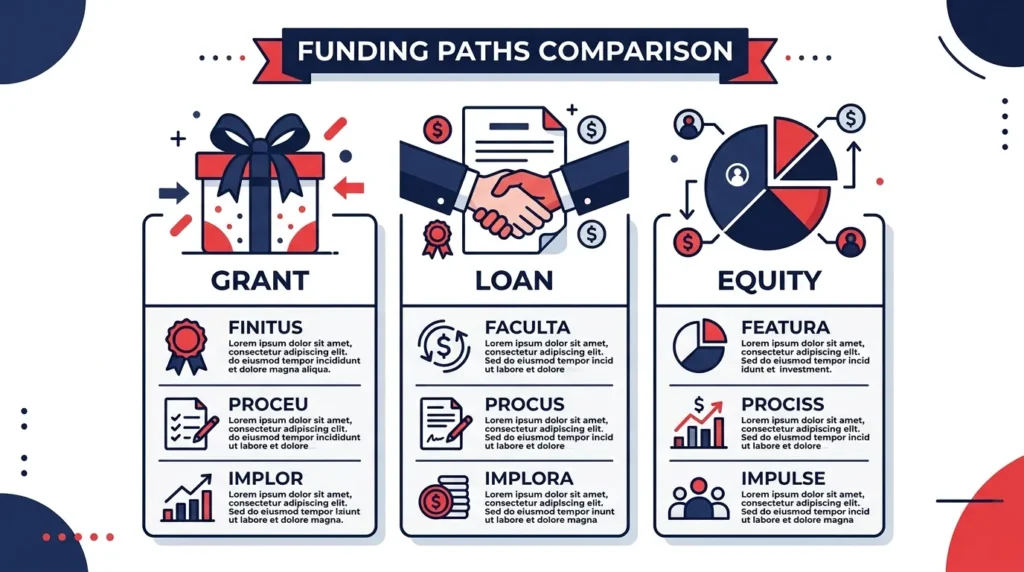
Grants vs. Loans vs. Equity: Key Distinctions
| Feature | Grant | Government-Backed Loan | Equity Investment |
|---|---|---|---|
| Repayable? | No, if terms are met | Yes, with interest | No, but you give up ownership |
| Typical use | Specific project or activity | Any legitimate business purpose | Growth and scaling |
| Application speed | Weeks to months, often competitive | Days to weeks | Months |
| Ownership impact | None | None | Dilutes founder equity |
| Example | Innovate UK competition, King’s Trust Start Up Grant | Start Up Loans, Growth Guarantee Scheme | Angel or VC funding |
Main Categories of UK Business Grants
Most 2026 schemes fall into four broad categories, and knowing which one fits your business narrows your search considerably.
1. Innovation and R&D Grants (Innovate UK & UKRI)
These fund businesses developing genuinely new products, processes or services with commercial potential. They’re delivered through UK Research and Innovation (UKRI) and its innovation agency, Innovate UK, and typically require you to demonstrate technical novelty and a credible route to market. If R&D is part of your plan, it’s worth reading alongside our guide on how to claim R&D tax relief, since grant funding and R&D tax credits interact and can reduce your eligible claim if not tracked correctly.
2. Regional and Local Growth Hub Grants
Delivered through local authorities and Growth Hubs, these target job creation and investment in specific areas of the UK. Funding levels and eligibility vary enormously by postcode, so location matters as much as business size.
3. Startup and Young Entrepreneur Grants (Ages 18–30)
Aimed at first-time founders, these combine small non-repayable grants with mentoring and low-interest loans, most notably through The King’s Trust.
4. Green and Environmental Sustainability Grants
Covering decarbonisation, EV charge points and energy efficiency, these grants support businesses investing in lower-emission operations, often alongside wider business rates relief options for green upgrades.
Top UK National & Regional Grant Schemes Open in 2026
Innovate UK Competitions
Innovate UK funds feasibility studies, industrial research and late-stage innovation projects, with grant sizes ranging from tens of thousands to tens of millions of pounds depending on the competition. One important 2026 update: Innovate UK’s general-purpose Smart Grants programme, previously open to any sector on a rolling basis, was paused in January 2025 and has had no open rounds through the 2025/26 financial year while Innovate UK redesigns its offer. In its place, funding now runs through themed and challenge-led competitions in areas such as AI, quantum technology, robotics and clean energy, most of which favour collaborative projects between SMEs, larger companies and research organisations. Always check the live competition list on the Innovation Funding Service before assuming an old Smart Grants deadline still applies.
Local Growth Hubs and the New Local Growth Fund
The UK Shared Prosperity Fund, which many councils used to run small business grant pots, closed on 31 March 2026. From April 2026 it has been replaced by two successor programmes: the Local Growth Fund, administered through Mayoral Strategic Authorities in England, and the Pride in Place Programme, a longer-term neighbourhood investment fund that isn’t a direct business grant scheme. If your local council previously ran a UKSPF-funded grant, check with your Growth Hub or Combined Authority directly, since availability and criteria now vary significantly by region.
The King’s Trust Enterprise Programme
Open to people aged 18 to 30 who are unemployed or working fewer than 16 hours a week and want to start a business. The free programme includes a £500 Test My Business Idea grant to validate a concept, followed by a start-up package of up to £5,000 in non-repayable grant funding plus a loan of £500 to £25,000, for a combined package of up to £30,000. No funding is guaranteed and it depends on eligibility, viability and affordability checks.
UnLtd Awards for Social Entrepreneurs
UnLtd funds social entrepreneurs aged 16 and over. Its Starting Up award offers a few thousand pounds toward essential start-up costs, and its Scaling Up award offers up to £18,000 to support wages and living costs for ventures that have been trading for one to four years. At least 50% of awards are ring-fenced for Black, Asian and minority ethnic, and/or disabled social entrepreneurs.
Evolving SME Funding Alternatives in 2026
Grants aren’t the only non-dilutive route, and for many businesses a government-backed loan is faster and less competitive.
The Growth Guarantee Scheme (GGS)
The Growth Guarantee Scheme, run by the British Business Bank, gives lenders a 70% government-backed guarantee on facilities of up to £2 million, which helps businesses that lenders wouldn’t otherwise consider on commercial terms alone. You, the borrower, remain 100% liable for the full debt — the guarantee only protects the lender if the loan defaults after normal recovery action. It’s open to businesses with turnover up to £45 million and was extended in the 2025 Spending Review to run until at least 31 March 2030.
British Business Bank Start Up Loans
For newer or pre-revenue businesses, Start Up Loans offer £500 to £25,000 at a fixed interest rate of around 6%, alongside up to 12 months of free mentoring. It’s a personal loan model rather than a business grant, so it’s repayable regardless of how the business performs. If you’re weighing this against other early-stage options, our guide to starting costs for a UK business is a useful companion read.
How to Apply for a UK Business Grant: A Step-by-Step Roadmap
- Target the right Technology Readiness Level (TRL). Innovation grants are pitched at specific stages of development, from early feasibility studies through to near-market experimental development. Applying at the wrong TRL is one of the most common reasons applications are rejected before assessment even begins.
- Organise your financial records. Assessors typically request recent accounts, cash flow forecasts and proof of trading. Businesses using Making Tax Digital-compliant record keeping tend to produce these far faster than those reconstructing figures from spreadsheets.
- Build a business case with numeric outcomes. Vague ambition doesn’t score well. Assessors want specific numbers: jobs created, revenue projected, carbon saved, market size addressed.
- Prepare for match funding. Work out your own contribution before you apply, not after you’re offered the grant. A clear, documented business plan makes this far easier to evidence.
Important Tax & Compliance Rules: HMRC’s Evolving Role in 2026
Are Business Grants Taxable in the UK?
Generally, yes. HMRC treats most grants that meet revenue costs — day-to-day project spending like salaries, materials or marketing — as taxable trading income, reportable through your Self Assessment return or Corporation Tax computation. Grants that fund capital expenditure, such as buying equipment, are typically not taxed directly as income, but they reduce the amount you can claim through capital allowances on that asset. Restricted grants tied to a specific unfinished project can sometimes be deferred as accrued income until the related spending occurs, which is a decision best made with an accountant rather than guessed at.
There’s also a funding ceiling to be aware of: under the Subsidy Control Act 2022, most small grants fall under “Minimal Financial Assistance,” capped at £315,000 per business over a rolling three-year period. If you’re combining multiple grants, this cumulative limit — not the size of any single award — is often what catches businesses out.
The Spring 2026 Targeted Advance Assurance Pilot
HMRC launched a new targeted Advance Assurance pilot for R&D tax relief on 18 May 2026, running for an initial 12 months. It lets eligible SMEs ask HMRC in advance for its view on up to two specific, higher-risk areas of a planned R&D claim — such as whether a project meets the definition of R&D, or how overseas costs should be treated — before the claim is filed. It’s free and voluntary, but there’s no right of appeal if HMRC refuses, and it doesn’t replace the normal claim process through your Company Tax Return. It sits alongside, rather than replaces, R&D tax credits as a separate relief from grant funding.
Eligibility checklist for most 2026 grants:
- Registered with Companies House or HMRC, and trading in the UK
- Able to evidence at least 50% of income from genuine trading activity
- Under any relevant Minimal Financial Assistance or subsidy limits
- Can demonstrate the project needs public funding to proceed (not fundable through normal commercial routes)
- Has accounts, forecasts and a written business plan ready to submit
- Can cover its share of match funding without over-leveraging the business
Frequently Asked Questions About UK Business Grants
How do I get a business grant in the UK?
Start with the government’s Find a Grant service, filter by industry, location and business size, then cross-check with your local Growth Hub and sector-specific bodies like Innovate UK or UnLtd.
Are startup grants really free money?
Only partly. Most require match funding, restrict how the money can be spent, and count as taxable income, so treat them as subsidised capital rather than a windfall.
Do you have to pay back government grants?
No, provided you meet the conditions of the award. If you breach the terms — spend outside the agreed budget, for instance — the funder can claw the money back.
Can I get a grant to start a business in the UK?
Yes, particularly if you’re aged 18–30 through The King’s Trust, or running a social venture through UnLtd. Pre-revenue tech and R&D founders should also check Innovate UK’s current themed competitions rather than assuming Smart Grants are open.