


A Limited Liability Partnership (LLP) is a UK business structure that combines the flexibility of a traditional partnership with the limited liability protection of a company. Created under the Limited Liability Partnerships Act 2000, an LLP is a separate legal entity from its members, who are usually taxed as self-employed individuals.
LLPs are common among solicitors, accountants, architects, and financial consultants — professions where several people work together but don’t want to answer personally for each other’s mistakes. They’re also used by hedge funds and investment partnerships. Below is what an LLP actually involves, where the risks sit, and how it compares to going limited or staying in a traditional partnership.
What is a Limited Liability Partnership (LLP)?
An LLP is a hybrid. It’s taxed broadly like a partnership but structured legally like a company.
The Legal Definition: A Separate Legal Entity
Once registered at Companies House, an LLP becomes a corporate body with its own legal personality, distinct from the people who own and run it. It can own property, enter contracts, sue, and be sued in its own name. This is the same principle that gives a limited company its separation from its shareholders — see our guide to what a limited company actually is for the equivalent explanation on the company side. Because the LLP itself carries the legal and financial risk, a member’s personal assets are generally protected if the business runs into debt or is sued, aside from a few important exceptions covered below.
The History: The Limited Liability Partnerships Act 2000
LLPs have existed in the UK since 6 April 2001, when the Limited Liability Partnerships Act 2000 came into force. The structure was created largely in response to lobbying from large accountancy firms after a string of negligence claims exposed partners in traditional partnerships to unlimited personal liability for the mistakes of colleagues they may never have met. The Limited Liability Partnerships Regulations 2001 followed shortly after, filling in the operational detail the Act itself left out — detail that matters a great deal, as the next section explains.
How Does a UK LLP Work? Key Features
An LLP runs day-to-day much like a traditional partnership, but liability, membership, and statutory duties work differently underneath.
The Concept of Limited Liability
Members are not personally liable for the LLP’s debts beyond whatever they’ve agreed to invest. But limited liability isn’t absolute. A member can still be personally liable for their own negligent acts or professional misconduct, and if the LLP is later wound up insolvent, a court can order a member to repay withdrawals taken shortly before insolvency if those withdrawals left the LLP unable to pay its debts (a wrongful trading-style provision borrowed from company law).
There’s also a lesser-known trap: an LLP must have at least two members at all times. If membership falls to one person — say, through a death or resignation — and stays that way for more than six months, the remaining member becomes personally liable, jointly with the LLP, for debts incurred after that six-month point. It’s a narrow scenario, but one that catches small LLPs off guard when a partner leaves and no replacement is lined up.
Members vs. Partners: Who Can Join?
LLP owners are called “members,” not partners, and any legal person can be one — an individual, a company, or even another LLP. There’s no upper limit on membership numbers, and members can be added or removed at any time with the consent of existing members (filed at Companies House on Form LL AP01 or LL TM01).
Designated Members vs. Ordinary Members
Every LLP needs at least two designated members. If an LLP only has two members in total, both automatically count as designated members by default. Designated members carry extra statutory responsibilities that ordinary members don’t:
- Appointing an auditor, where one is required
- Signing off and filing the annual accounts
- Filing the annual confirmation statement
- Notifying Companies House of changes to membership, registered office, or LLP name
- Acting on the LLP’s behalf if it’s wound up
Ordinary members can still take part in management and share in profits — designated status is about statutory compliance duties, not seniority or control.

Why the LLP Agreement is Crucial (and the Default Rules Trap)
There’s no legal requirement to have a written LLP agreement. This is exactly why so many LLPs end up in dispute.
What Happens If You Don’t Have an LLP Agreement?
Most guides describe an LLP agreement as a nice-to-have. It isn’t. Without one — or where one is silent on a particular point — the Limited Liability Partnerships Regulations 2001 impose default rules automatically, and they’re rarely what a growing business actually wants:
- All members share profits and capital equally, regardless of how much money, time, or client work each person actually put in
- Every member can take part in management, with no distinction between active and passive members
- No member can be expelled, even for serious misconduct, unless an express power to expel has been agreed in writing
- Unanimous consent is required to bring in a new member or to change the nature of the LLP’s business
Picture three people incorporating an LLP together: one invests £50,000 and works full-time, the other two invest nothing and work part-time. With no agreement in place, all three are legally entitled to an equal one-third share of profits. A UK court confirmed exactly this outcome in Eaton v Caulfield (2011), where a departing member successfully claimed an equal share of capital purely because the default rules applied. Drafting even a short LLP agreement that expressly disapplies these defaults — and replaces them with a sensible profit-sharing and exit process — avoids the problem entirely. It’s worth pairing this with a proper shareholder agreement if any members also hold interests in a related limited company.
How is an LLP Taxed in the UK?
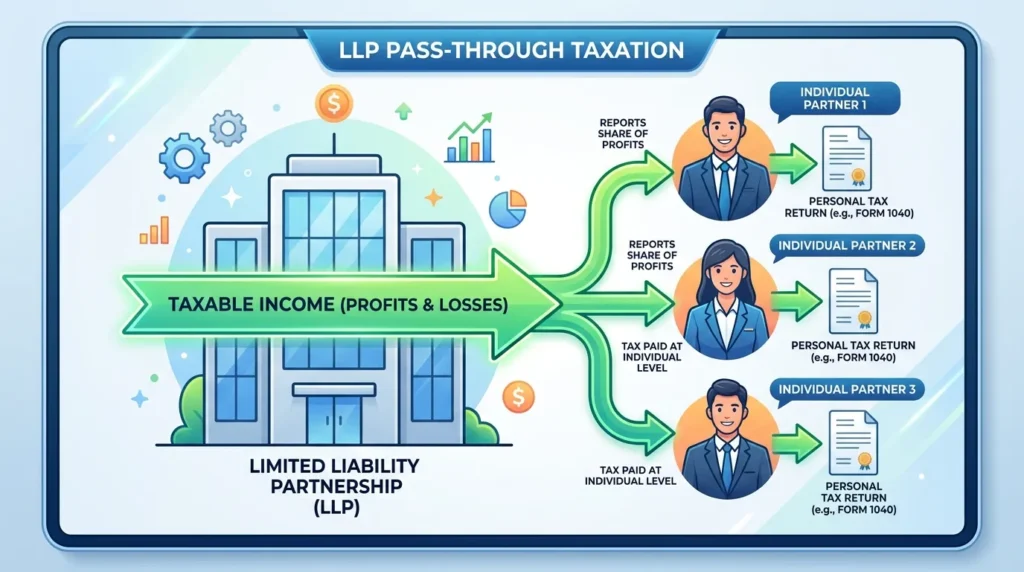
An LLP does not pay Corporation Tax. Instead, each member is taxed individually on their share of the profits, as if they were self-employed.
The Principle of Tax Transparency
This is called tax transparency, or pass-through taxation. The LLP calculates its total profit and allocates it between members according to the LLP agreement (or equally, under the default rules). Each member then declares their own share on a personal Self Assessment return and pays Income Tax and National Insurance on it directly — the LLP itself is skipped over for tax purposes, even though it still files a Partnership Tax Return (Form SA800) reporting the total profit and how it was split.
Here’s what that looks like in practice. Say a three-member LLP makes £150,000 profit in a year, split 40%/35%/25% under the agreement. Member one declares £60,000, member two £52,500, and member three £37,500 — each on their own Self Assessment, taxed at their own marginal Income Tax rate, exactly as a sole trader would be. Compare that with a limited company, where the company pays Corporation Tax first, and members then pay further tax on whatever they draw out as salary or dividends — see our breakdown of current dividend tax rates for how that second layer works.
HMRC Self-Assessment and National Insurance (NICs)
Members pay Class 4 National Insurance on their profit share — 6% on profits between £12,570 and £50,270, and 2% above that for 2026/27 — through Self Assessment, the same as any self-employed individual. Compulsory Class 2 NI was abolished from April 2024; members with profits above £12,570 build State Pension entitlement automatically through Class 4, and those below that threshold can pay a voluntary £3.65 a week to protect their record. Filing deadlines and penalties for missing them are the same as for any Self Assessment return — check our guide to late filing penalties if a deadline is close.
The HMRC “Salaried Member” Rules
This is where most beginner-level guides stop, and it’s the single biggest compliance risk in modern LLP structures. HMRC introduced the Salaried Member Rules in 2014 to stop firms disguising what are effectively employees as self-employed LLP members purely to avoid paying employer National Insurance.
A member is treated as an employee for tax purposes — taxed under PAYE, with employer NI due — unless they fail at least one of three conditions:
- Condition A: At least 80% of the member’s pay is a fixed or variable salary that doesn’t move with the LLP’s overall profits or losses
- Condition B: The member has significant influence over the LLP’s affairs
- Condition C: The member’s capital contribution is at least 25% of their expected “disguised salary” for the year
If all three conditions are met (i.e. the member fails to escape any of them), HMRC treats that person as a salaried member and taxes them as an employee. This matters enormously for law firms, accountancy practices, and investment LLPs that bring in junior members with modest capital contributions and little real say in the business.
The rules have been tested hard in the courts recently. In the long-running HMRC v BlueCrest Capital Management case, the Court of Appeal narrowed what counts as “significant influence” under Condition B in January 2025, and the Supreme Court unanimously upheld that narrower interpretation in 2026 — confirming that influence only counts if it comes from the LLP’s own agreement or legal framework, not from a member’s day-to-day trading or client relationships. HMRC has also tightened its guidance on Condition C, applying anti-avoidance rules even to genuine capital contributions if the main purpose was passing the test. Firms admitting new members onto reduced capital, or restructuring existing arrangements, should treat this as an area to review annually rather than set and forget.
LLP vs Limited Company (Ltd) vs Traditional Partnership
The right structure depends on how much you value privacy, tax efficiency, and protection from a co-owner’s mistakes — no single structure wins on all three.
Side-by-Side Comparison Matrix
| LLP | Limited Company | Traditional Partnership | |
|---|---|---|---|
| Liability | Limited to capital agreed, with narrow exceptions | Limited to share capital | Unlimited, and joint and several between partners |
| Tax treatment | Tax transparent — members pay Income Tax and Class 4 NI | Corporation Tax on profit, then tax on dividends/salary | Income Tax and Class 4 NI on each partner’s share |
| Minimum owners | Two members | One director/shareholder | Two partners |
| Public accounts | Yes, filed at Companies House | Yes, filed at Companies House | No public filing requirement |
| Governing document | LLP agreement (optional but essential) | Articles of Association (required) | Partnership agreement (optional) |
| Best suited to | Professional practices, joint ventures, investment vehicles | Most trading businesses seeking tax efficiency and credibility | Very small, low-risk partnerships between trusted parties |
Key Deciding Factors: When to Choose an LLP
An LLP tends to suit professional practices where several people bring in business independently but want protection from each other’s negligence — the classic case being a law or accountancy firm. It also suits joint ventures and investment structures where profit-sharing needs to be flexible and taxed once, not twice.
It’s a weaker fit if privacy matters to you, since LLP accounts are public in the same way as a limited company’s — unlike a traditional partnership, which files nothing publicly. It’s also a weaker fit for a single founder, since two members are a legal minimum. If you’re weighing this up from a sole trader starting point rather than a partnership, our sole trader vs limited company comparison covers that more common decision in detail.
Advantages and Disadvantages of a UK LLP
The Benefits of Forming an LLP
- Limited liability protects personal assets from the LLP’s debts and from negligence by other members
- Tax transparency avoids the double layer of Corporation Tax plus dividend tax that limited companies carry
- Flexible profit-sharing and management structure, once a proper agreement is in place
- No minimum capital requirement to get started
- Separate legal personality gives the same contracting and credibility benefits as a company
The Drawbacks and Compliance Obligations
- Annual accounts and a confirmation statement are filed publicly at Companies House, so there’s no financial privacy advantage over a traditional partnership
- At least two members are required at all times, with personal liability risk if that drops to one for over six months
- Members generally can’t access the same profit-extraction flexibility (like dividend timing) that limited company directors use for tax planning
- Ongoing salaried member testing adds an annual compliance task most small LLPs underestimate
- Without a proper LLP agreement, default statutory rules can produce outcomes no one intended
How to Set Up an LLP with Companies House
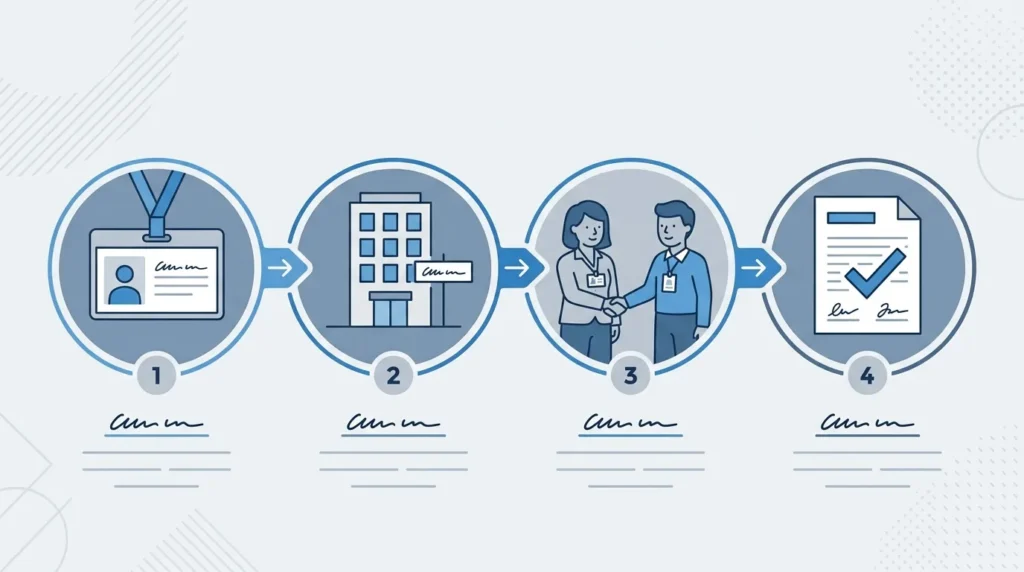
Setting up an LLP takes four core steps, and can complete within 24 hours if filed digitally.
Step 1: Choose a Legal Name
The name must be unique on the Companies House register and end in “LLP” or “Limited Liability Partnership.” It can’t be identical or too similar to an existing name, and it shouldn’t clash with a registered trade mark — run a quick check before filing, and see our guide on trademarking a business name if you plan to protect it formally later.
Step 2: Establish a Registered Office Address
Every LLP needs a UK registered office address, which becomes part of the public record. Many members use a registered office address service rather than list a home address.
Step 3: Appoint at Least Two Designated Members
Decide who will hold designated member responsibilities from the outset — this needs to be agreed and recorded before submission, ideally alongside drafting (or at least outlining) the LLP agreement itself.
Step 4: Submit Form LL IN01 and Register
File Form LL IN01 with Companies House, either online or by post. As of 2026, the digital incorporation fee is £100 (£124 by paper). Since November 2025, all new members are also required to complete identity verification at the point of appointment. Once approved, Companies House issues a certificate of incorporation, and the LLP appears on the public register.
Ongoing compliance doesn’t stop there: every LLP must file an annual confirmation statement (£50 digitally) confirming its registered details and membership, alongside its annual accounts. If you’re weighing LLP against forming a standard company instead, our step-by-step guide to setting up a limited company runs through that equivalent process.
Frequently Asked Questions (FAQs)
What is the difference between an LLP and a limited company? An LLP is tax transparent, with members taxed individually on their profit share, while a limited company pays Corporation Tax first and members are taxed again on what they draw out. Both offer limited liability and both file public accounts.
Do LLPs pay Corporation Tax? No. An LLP itself doesn’t pay Corporation Tax on trading profits. Profits pass straight through to members, who pay Income Tax and Class 4 National Insurance on their share via Self Assessment.
Can an LLP have only one member? No, an LLP needs at least two members at all times. If membership falls to one person for more than six months, that person becomes personally liable for debts incurred from that point on.
What are the disadvantages of an LLP? The main drawbacks are the loss of financial privacy (accounts are public), the two-member minimum, the annual burden of testing HMRC’s salaried member rules, and the risk of unwanted default rules applying if there’s no written LLP agreement.
How does an LLP pay tax in the UK? The LLP files a Partnership Tax Return (SA800) showing total profit and how it was divided. Each member then reports their own share on a personal Self Assessment return and pays Income Tax and Class 4 NI on it directly.
Final Thoughts
An LLP earns its keep when several people are working together, sharing risk unevenly, and want a tax profile closer to self-employment than to running a limited company. The legal shell is straightforward to set up. What actually protects members — and avoids disputes down the line — is the LLP agreement, and increasingly, an honest annual look at whether any member could be caught by the salaried member rules. Treat both as compliance essentials, not optional extras, and the structure does exactly what it was designed to do.