

A management buyout (MBO) is a transaction where a company’s existing managers buy the business from its current owners, taking on both control and equity. It’s one of the most common exit routes for UK business owners who want the company to stay in familiar hands rather than going to a stranger or a competitor.
What is a Management Buyout (MBO)?
A management buyout is when a company’s directors or senior managers buy the business they currently run, instead of it being sold to an outside party. The management team becomes the new owner, usually backed by external lenders or investors, because very few managers have enough personal savings to buy the business outright.
MBOs tend to happen in the UK when:
- A founder is retiring and wants a clean succession plan rather than an open-market sale
- A larger group wants to divest a subsidiary or a division that no longer fits its strategy
- A private equity firm is exiting a portfolio company and the existing managers want to keep running it
If a founder isn’t sure an MBO is the right route, it’s worth comparing it against selling the business on the open market first, since a trade sale often achieves a higher price but takes the business out of the team’s hands entirely.
The Fundamental Difference: MBO vs. MBI vs. BIMBO
These three terms get mixed up constantly, but the distinction is simple: it comes down to who is doing the buying.
| Deal Type | Who Buys the Business | Typical Scenario |
|---|---|---|
| MBO (Management Buyout) | The company’s existing management team | Founder retires; internal team takes over |
| MBI (Management Buy-In) | An external management team, new to the company | Investors bring in fresh leadership to run an underperforming business |
| BIMBO (Buy-In Management Buyout) | A mix of existing managers and incoming external managers | Existing team lacks a skill (e.g. sales or operations), so an outside director joins the buying group |
An MBI generally carries more risk for lenders, since the incoming team has no track record inside that specific business. That usually means MBIs are priced with a higher cost of debt than MBOs.
How Does a Management Buyout Work in the UK? (The Step-by-Step Process)
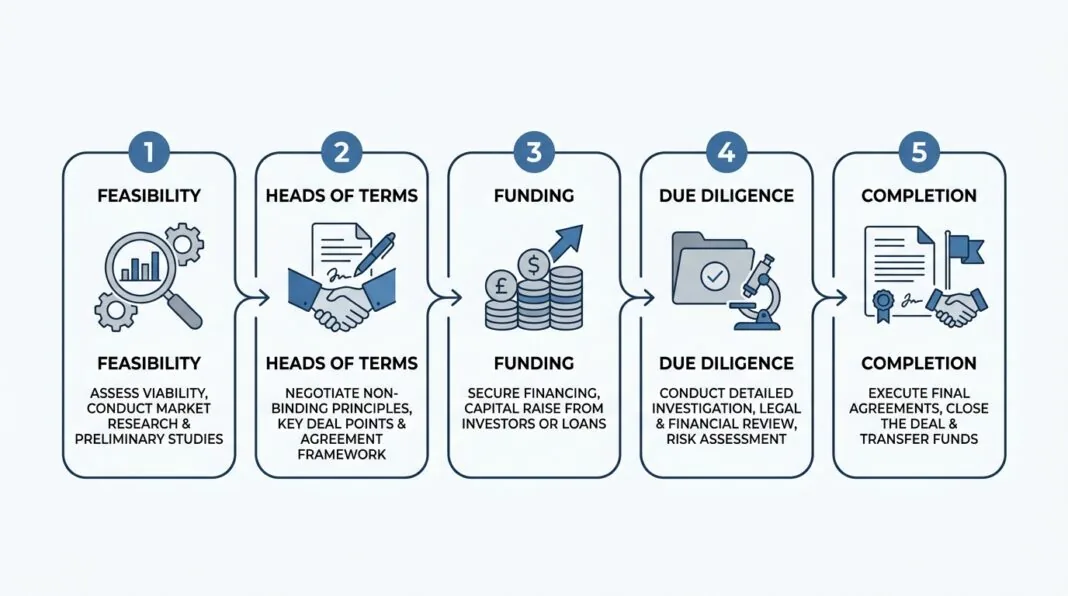
A UK management buyout typically takes six to nine months from first conversation to legal completion, and moves through five core stages: feasibility and valuation, heads of terms, securing the funding stack, due diligence and HMRC clearance, and final legal completion.
| Stage | Typical Duration | What Happens |
|---|---|---|
| 1. Feasibility & valuation | 4–6 weeks | Informal valuation, initial affordability check |
| 2. Heads of Terms | 2–4 weeks | Price and structure agreed in principle |
| 3. Funding stack | 6–10 weeks | Lenders and investors confirm terms |
| 4. Due diligence & HMRC clearance | 6–8 weeks | Legal, financial and tax checks run in parallel |
| 5. Legal completion | 2–4 weeks | SPA signed, funds released, deal closes |
Step 1: Feasibility and Early Valuations
The management team starts by getting a realistic valuation of the business — usually based on a multiple of EBITDA — and testing whether the numbers can support the debt the deal will need. This is also the point to check personal appetite: an MBO only works if every key manager is genuinely willing to take on financial risk, not just enthusiasm.
A common mistake here is skipping a proper valuation and anchoring to a number the owner has in their head. Get an independent corporate finance adviser involved early, even informally, before any figures are put to the vendor.
Step 2: Pitching the Deal & Draft Heads of Terms (HoT)
Once the numbers stack up, the management team formally approaches the owner with a proposal. If both sides agree in principle, they sign Heads of Terms — a non-binding document setting out price, structure and timeline. This is functionally similar to a letter of intent for a business purchase, and it’s the point where confidentiality agreements should already be in place.
Step 3: Securing the Funding Stack
With Heads of Terms agreed, the team approaches lenders, vendor finance, and possibly private equity to build the capital structure. This is usually the longest and hardest stage, and it’s covered in full detail below.
Step 4: Due Diligence and HMRC Clearance
Lenders and any equity investors will run financial, legal and commercial due diligence to verify the numbers behind the deal. In parallel, the seller’s advisers should submit an HMRC clearance application (see the tax section below) — this needs to happen before completion, not after.
Step 5: Draft the Share Purchase Agreement (SPA) and Complete
The lawyers draft the Share Purchase Agreement, which sets out warranties, indemnities, and the exact mechanics of how funds move on completion day. The incoming management team should also put a shareholder agreement in place at this stage, governing how they’ll make decisions and split profits between themselves once they’re co-owners.
How is a UK Management Buyout Funded? (The Capital Stack)
Most UK MBOs are funded through a combination of management equity, senior bank debt or asset-based lending, vendor loan notes from the seller, and — for larger deals — private equity or mezzanine finance. No single source usually covers the whole price.
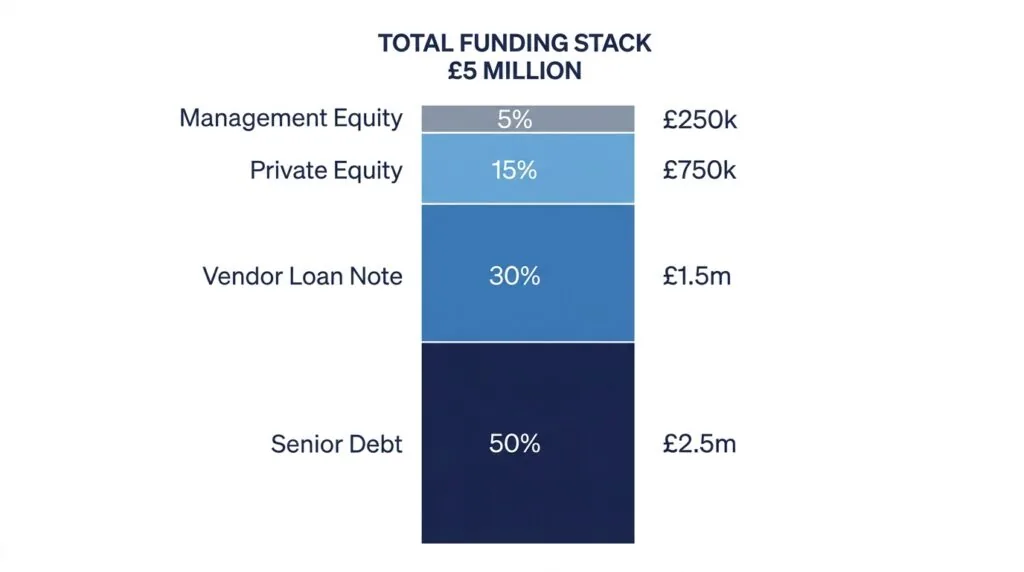
Here’s what that looks like in practice, using a hypothetical £5 million UK business MBO:
| Funding Source | % of Deal | Amount | Notes |
|---|---|---|---|
| Management equity | 5% | £250,000 | Split between the buying directors, often remortgaged or from savings |
| Senior bank debt / ABL | 50% | £2,500,000 | Secured against assets and cash flow, repaid over 5–7 years |
| Vendor loan note | 30% | £1,500,000 | Seller effectively lends part of their own sale price back to the buyers |
| Private equity / mezzanine | 15% | £750,000 | Higher-cost capital that fills the gap between debt and equity |
1. Management Equity Contribution (Skin in the Game)
Lenders want to see the management team has personal money at risk — typically 5–15% of the deal value. This doesn’t have to mean remortgaging a family home to the limit; it’s often a mix of savings, a modest secured loan, and sometimes a smaller cash contribution from more junior managers in exchange for a smaller equity slice.
2. Senior Debt & Asset-Based Lending (ABL)
Senior debt, usually from a bank or specialist lender, is normally the largest single piece of the stack. It’s secured against the company’s assets — property, equipment, receivables — and repaid from future trading profits. This is different from a standard start-up business loan, since lenders are assessing an established business with a trading history rather than a new venture.
3. Vendor Loan Notes (VLN) / Seller Debt
A vendor loan note is where the seller agrees to receive part of the sale price later, effectively lending the buyers a portion of the purchase price. This reduces how much the management team needs to raise externally, and it also signals confidence — a seller willing to leave money in the deal believes the business will keep performing.
4. Private Equity (PE) Sponsors & Mezzanine Finance
On larger deals, a private equity firm may fund the equity gap in exchange for a minority (sometimes majority) stake, alongside mezzanine finance — a hybrid of debt and equity that sits between senior debt and equity in repayment priority. If the team is approaching investors for the first time, it’s worth reading up on pitching to investors before the first meeting, since PE due diligence on the management team itself can be as thorough as the diligence on the business.
Common funding mistakes to avoid:
- Over-leveraging the business so debt repayments strip out all working capital in year one
- Agreeing a vendor loan note interest rate without independent advice
- Assuming a bank will lend on the same terms as it would to an established owner-operator
- Not stress-testing the funding structure against a slower-than-expected first 12 months
UK Tax Implications of an MBO
The two tax issues that decide whether an MBO runs smoothly are Business Asset Disposal Relief for the seller and HMRC clearance for the transaction structure.
Business Asset Disposal Relief (BADR) for Sellers
Business Asset Disposal Relief — the current name for what used to be called Entrepreneurs’ Relief — lets a qualifying seller pay a reduced 10% rate of Capital Gains Tax on the sale, instead of the standard rate, up to a lifetime limit of £1 million in gains. To qualify, the seller generally needs to have held at least 5% of shares and voting rights, been a director or employee, and owned the shares for at least two years before the sale.
This matters directly to the buying management team too, because a seller who understands their BADR position is far more likely to accept a structure involving a vendor loan note, since deferred payments can still usually qualify for the relief if structured correctly. For the wider picture on how gains on the sale of a business are taxed, see this guide to capital gains tax on business assets.
HMRC Clearance (Section 138)
Before an MBO completes, it’s standard practice for advisers to submit a clearance application to HMRC under Section 138 of the Taxation of Chargeable Gains Act (often still referred to by its old Corporation Tax Act reference). This asks HMRC to confirm the share reorganisation involved in the deal — particularly where a new holding company (Newco) is set up to buy the target business — won’t be treated as a tax avoidance arrangement.
Skipping this step, or applying too late, is one of the most common and costly mistakes in UK MBOs. Without clearance, HMRC could later challenge the transaction structure, potentially triggering an unexpected tax bill for the seller well after completion. Clearance applications should go in as soon as the deal structure is fixed — ideally alongside due diligence, not after. It’s also worth understanding how the new company will be taxed going forward once management take over, covered in this guide to the UK corporation tax rate.
Pros and Cons of a Management Buyout
| For the Departing Owner | For the Management Team | |
|---|---|---|
| Pros | Confidential, faster process than an open sale; business legacy protected; team already trusted | Control over the business they know; upside if the company grows; no need to build a business from scratch |
| Cons | Often a lower price than a trade sale to a strategic buyer; deferred consideration carries some risk if the buyers underperform | Personal financial risk; heavy debt burden in early years; team must learn to be owners, not just operators |
For the incoming owners, it’s worth revisiting what changes practically once they’re directors and shareholders rather than employees — including the shift in company director responsibilities that comes with personal liability for decisions they may previously have escalated upward.
Frequently Asked Questions
How much personal money do I need for an MBO?
Most UK lenders expect the management team to contribute 5–15% of the total deal value from personal funds. On a £5 million deal, that’s typically £250,000–£750,000 split across the buying directors, not one person alone.
How long does a management buyout take in the UK?
A typical UK MBO takes six to nine months from initial feasibility work to legal completion, though complex deals involving private equity can take longer.
What are the main tax implications of an MBO in the UK?
The seller’s Capital Gains Tax position, particularly whether they qualify for Business Asset Disposal Relief at 10% up to a £1 million lifetime limit, and HMRC clearance under Section 138 for the transaction structure.
How is a business valued for a management buyout?
Most UK MBOs are valued using an EBITDA multiple appropriate to the sector, adjusted for the company’s specific risk profile, growth trajectory and reliance on the departing owner.
Can a management buyout fail after Heads of Terms are signed?
Yes — the most common reason is the funding stack falling apart during due diligence, often because lenders assess affordability more conservatively than the management team expected.