
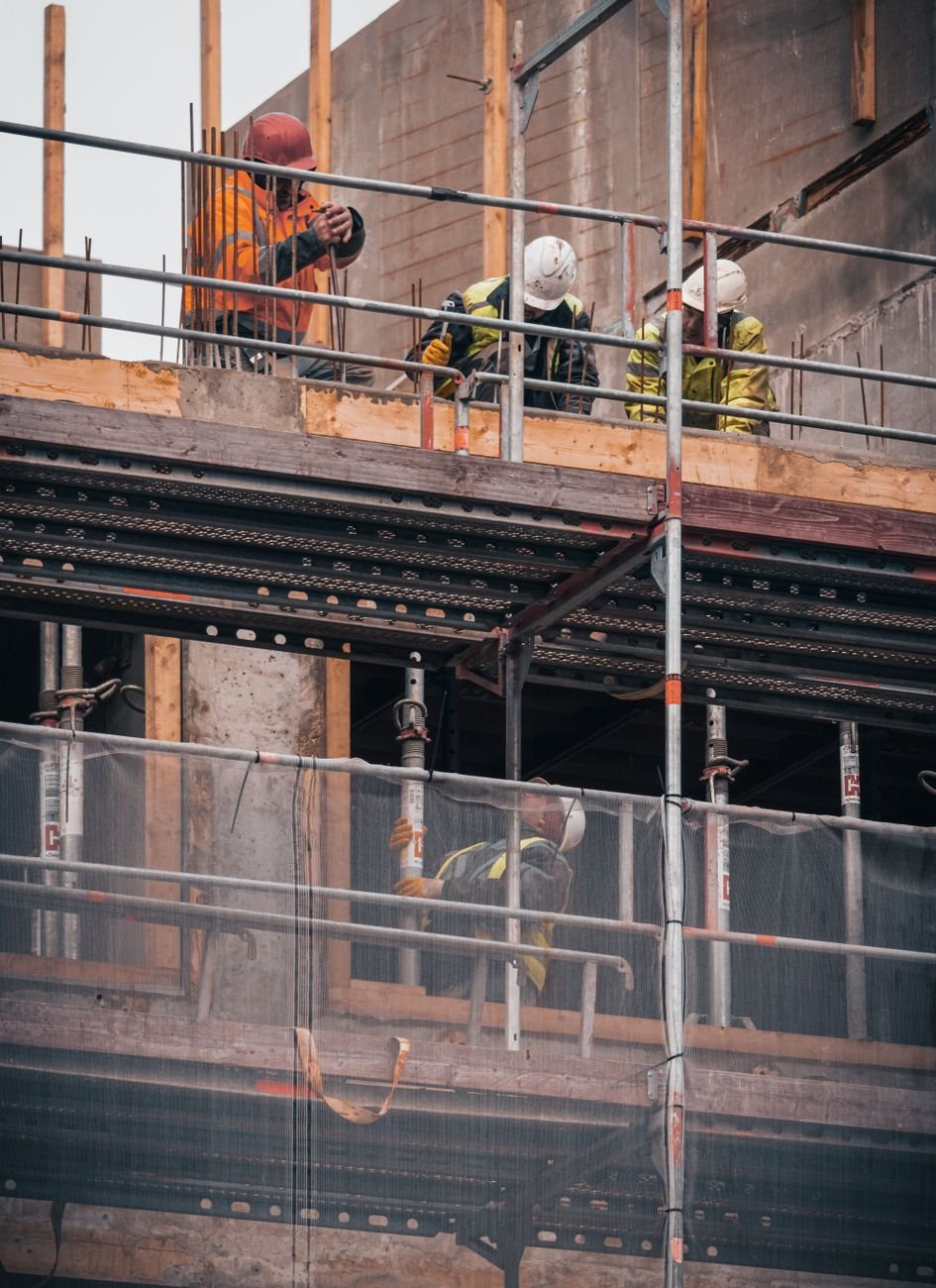

You can start a construction company in the UK without a general licence. You choose a structure, register with HMRC (and Companies House if you form a limited company), sort out CIS and insurance, and follow health and safety law. The rules changed in 2025 and 2026, so older guides often get them wrong. This guide uses current figures.
Last reviewed: October 2026.
Quick answer: how to start a construction company in the UK
- Pick your type of work and your customers.
- Check which qualifications and cards your trade needs.
- Choose sole trader, limited company or partnership.
- Register with HMRC, plus Companies House for a limited company.
- Register for CIS, and for VAT or PAYE when they apply.
- Take out employers’ liability and public liability insurance.
- Budget your start-up costs and keep two to three months of cash spare.
- Set up your online presence and win your first jobs.
What type of construction company should you start?
Most new firms are a specialist trade business, a general builder or a design-and-build firm.
A specialist trade business does one job well, such as roofing or plastering. Costs and risk stay low. A general builder runs whole projects and hires the trades. That ties up more cash and brings more legal duties. A design-and-build firm handles plans and construction, so it may also need professional indemnity cover.
Then choose your customers. Domestic clients want extensions, lofts and repairs, and often pay in stages. Commercial clients offer bigger jobs, but they pay on longer terms and ask for insurance certificates, references and CSCS cards.

Do you need qualifications, a licence or experience?
No. The UK has no general licence for builders. But some work is restricted, and many sites will not let you in without proof of competence.
- Gas work: you must be on the Gas Safe Register.
- Electrical work: most home electrical work is notifiable under Part P of the Building Regulations. You either join a competent person scheme such as NICEIC or NAPIT, or use building control.
- CSCS card: most commercial sites require one. It shows you have the training and have passed the health and safety test.
- Optional extras: NVQs and Federation of Master Builders (FMB) membership help win trust.
For other licensing questions, see do I need a business licence in the UK.
Can you start with no trade experience? Yes, but it is harder. You would hire skilled people and learn estimating, contracts and site safety fast. A free small business mentor from the trade can save you costly mistakes.
Sole trader vs limited company vs partnership
Most builders start as sole traders and move to a limited company as jobs get bigger. Here is how the three compare.
| Factor | Sole trader | Limited company | Partnership |
|---|---|---|---|
| Liability | Personal and unlimited | Company is liable, not you (with exceptions) | Personal, shared between partners |
| Set-up cost | Free | £100 | Free |
| Tax | Income tax and NI | Corporation tax, plus tax on your pay | Each partner taxed on their share |
| Admin | Light | Heavier: accounts, annual filings | Moderate |
| Credibility | Fine for small domestic work | Often preferred by commercial clients | Moderate |
Corporation tax is 19% on profits up to £50,000 and 25% above £250,000, with marginal relief in between. zitadelleag
A simple way to decide. Go limited if you take on larger or commercial jobs, use subcontractors, or want to keep profit in the business. Stay a sole trader if you do small domestic jobs and want minimal admin.
Edge case: limited liability will not protect you if you break the law or act negligently. Lenders and suppliers also often ask for personal guarantees. When you outgrow sole trader status, see how to move from sole trader to limited company. For shared ownership, read about setting up a business partnership or what an LLP is.
Future change to know about: Making Tax Digital for Income Tax applies from 6 April 2026 to sole traders with income over £50,000, and the threshold falls to £30,000 in April 2027 and £20,000 in April 2028. It counts gross income, not profit. Partnerships are not yet in scope. You can compare free Making Tax Digital software before you need it. gov.uktinytax
How to register your construction business
Sole traders register with HMRC. Limited companies register with Companies House first, then with HMRC.
As a limited company
- Choose a name that is unique on the register and ends in “Limited” or “Ltd”.
- Pick a SIC code. Common ones are 41202 (domestic buildings), 41201 (commercial buildings) and the 43xxx range for specialist trades.
- Add a registered office address. Read about a registered office address, and note that a virtual office address can work if you are often on site.
- List directors, shareholders and people with significant control. Understand your company director responsibilities first.
- Verify your identity. Since 18 November 2025, people who set up, own or control a company must prove who they are. Most people do it online with GOV.UK One Login. carpenterbox
- Pay the fee. Online registration costs £100 from 1 February 2026, up from £50. Approval usually takes about 24 hours. The yearly confirmation statement is now £50. salarytax
- Register for corporation tax with HMRC within three months of starting to trade.
Your to-do list after incorporation is covered in first steps after registering a company.
As a sole trader
Register for Self Assessment with HMRC by 5 October after the tax year you started trading in. HMRC sends you a Unique Taxpayer Reference (UTR). Our guide to registering for Self Assessment walks through it. Then keep proper books. See sole trader record keeping requirements.
CIS, VAT and PAYE: the tax registrations that matter
CIS, VAT and PAYE each apply in different situations. Here is when.
Construction Industry Scheme (CIS)
The Construction Industry Scheme is an HMRC scheme where contractors deduct tax from payments to subcontractors and pass it to HMRC.
- Contractors (anyone paying subcontractors for construction work) must register as contractors and file monthly returns.
- Subcontractors do not have to register, but unregistered subcontractors face a 30% deduction rather than 20% for registered ones. sopherco
- Gross Payment Status (GPS) means no deduction. You must pass HMRC’s tests.
Worked example. You invoice £1,000 for labour and £400 for materials. Deductions apply to labour only.
| Status | Deduction | You receive |
|---|---|---|
| Registered | £200 (20%) | £1,200 |
| Not registered | £300 (30%) | £1,100 |
Registered subcontractors usually reclaim the deductions through their tax return. Until then, you carry the cash gap.
April 2026 changes. Nil returns are now mandatory, HMRC can remove gross payment status immediately, and local authorities are exempt from CIS. In fraud-linked cases HMRC can also charge a penalty of up to 30% of the tax lost and block reapplication for five years. If you pay subcontractors, check their status with HMRC before every payment. Paying at the wrong rate can leave you liable for the shortfall. protaxtide
VAT
You must register for VAT when your taxable turnover passes £90,000 in 12 months. Register within 30 days of crossing the line. zitadelleag
Voluntary registration lets you reclaim VAT on materials. But homeowners cannot reclaim it, so charging VAT makes your domestic prices 20% higher unless you absorb it. Some work, such as new-build homes, is zero-rated, so check the rate before you quote.
If you work for another VAT-registered, CIS-registered contractor, the domestic reverse charge usually applies. You do not charge VAT on that work. Your customer accounts for it. It does not apply to homeowners.
PAYE and hiring
Before your first payday, register as an employer, set up PAYE, check right-to-work documents and arrange a workplace pension. Use a proper employment contract template. Apprentices can cut costs. See apprenticeship funding in the UK.
Be careful with “self-employed” labourers. HMRC looks at how they really work, not what the contract says. Read about taking on a contractor before you rely on that label.
Insurance, health and safety and compliance
You legally need employers’ liability insurance as soon as you employ anyone. Public liability is not a legal requirement, but most clients insist on it.
- Employers’ liability: the legal minimum cover is £5 million. Fines can reach £2,500 for every day you go without it.
- Public liability: covers injury or damage to third parties. Limits of £1 million to £5 million are common. See the public liability insurance guide.
- Tools and plant cover: covers theft from your van or site.
- Contract works insurance: covers the job itself while you build.
- Professional indemnity: needed if you give design advice. See the professional indemnity guide.
For the full list, read what business insurance you need in the UK.
Health and safety. The Construction (Design and Management) Regulations 2015 (CDM) apply to nearly every job, including domestic ones. On domestic projects, duties often pass to the contractor unless a written agreement says otherwise. Write risk assessments and method statements, train for asbestos awareness (vital in pre-2000 buildings) and supply the right PPE. Larger jobs may need to be notified to the HSE.
Waste and building control. In England, you generally need to register as a waste carrier with the Environment Agency to carry your own construction waste. Scotland, Wales and Northern Ireland have their own regulators. For Building Regulations sign-off, use building control or a competent person scheme.
How much does it cost to start a construction company?
Most new UK builders need roughly £5,000 to £30,000 or more, depending on whether they need a van and a full tool kit. Treat these as planning ranges, not quotes.

| Cost | Typical range |
|---|---|
| Company registration | £0 (sole trader) or £100 (Ltd) |
| Insurance (liability and tools) | About £400 to £1,500 a year |
| CSCS test and card | Roughly £55 to £60 |
| Starter tools | £1,500 to £5,000 |
| Van (used, or lease deposit) | £3,000 to £15,000 |
| Accountant | £600 to £1,800 a year |
| Accounting software | £0 to £30 a month |
| Signage, website, Google profile | £200 to £1,000 |
| Cash buffer (2–3 months) | £3,000 to £10,000 |
Compare FreeAgent and Xero or try free accounting software to keep software costs down. Running admin from home saves rent. See running a business from home in the UK. For general costs beyond construction, read how much it costs to start a business in the UK.
Funding and cash flow
Cash flow is the main reason new builders get into trouble. Work costs money before it earns any.
Example: a £10,000 extension needs £3,500 of materials upfront and £4,800 of wages over three weeks. You have paid out about £8,300 before the client pays you, perhaps 30 days after completion.
How to reduce the gap:
- Agree stage payments and a deposit for materials in writing.
- Quote with clear payment terms, and invoice the day work finishes. Free invoicing software helps.
- Know your rights. Between businesses, the Late Payment of Commercial Debts Act 1998 allows statutory interest and fixed compensation. On commercial construction contracts, the Construction Act adds payment notices and adjudication. Neither covers homeowners.
If you need finance, compare invoice financing, asset finance and British Business Bank loans.
Winning your first customers
Local trust wins first jobs. Start free.
- Claim your Google Business Profile with your area and services.
- Photograph every job, before and after.
- Ask each client for a review the week you finish.
- List your firm on trusted trade directories and schemes, such as Checkatrade, TrustMark or the FMB.
- Tell merchants, estate agents and past employers you are open for work.
Common mistakes new builders make
- Pricing from memory instead of working out labour, materials, overheads and profit.
- Mixing personal and business money.
- Waiting to register for CIS and paying 30% on every invoice.
- Starting work with no written quote or contract.
- Forgetting the £90,000 VAT limit until you have passed it.
- Skipping insurance “until the first big job”.
- Ignoring Making Tax Digital until the deadline.
FAQs
Do I need CIS registration as a new builder?
Contractors who pay subcontractors must register. Subcontractors do not have to, but unregistered ones face a 30% deduction instead of 20%.
At what turnover do I need to register for VAT?
You must register when your taxable turnover goes above £90,000 in any 12-month period. You can register earlier voluntarily.
Can I start a construction company with no experience?
Yes, but you would need skilled staff or partners, strong estimating and a small first project. Experience in the trade makes everything easier.
Do I need employers’ liability insurance?
Yes, if you employ anyone, even part-time. The minimum cover is £5 million. Public liability is optional by law but widely required by clients.
How long does it take to set up a limited company?
Online registration is usually approved within 24 hours. Allow extra time for identity verification and for opening a business bank account.
Your next steps
- This week: choose your structure and register.
- Within 30 days: arrange insurance, CIS, a business bank account and your CSCS card.
- Before your first big job: set payment terms and put your costs in a spreadsheet.
When work builds up, read how to scale a small business in the UK.