

Website terms and conditions set the rules for anyone who uses your site. Done properly, they protect your business from disputes, limit your liability, and keep you on the right side of UK consumer law. Done badly — or copied from someone else’s site — they can be unenforceable, or worse, land you in legal trouble.
This guide walks through exactly what UK terms and conditions need to contain, how to make them legally binding, and where most small business owners go wrong.
What Are Website Terms and Conditions?
Website terms and conditions (also called terms of use or terms of service) are a legally binding agreement between you and anyone who visits or uses your website. They set out the rules of engagement: what users can and can’t do, what you’re liable for, and what happens if something goes wrong.
If you’re still building your small business website, it’s worth drafting your terms alongside it rather than bolting them on afterwards, since some clauses (like account rules or checkout processes) depend on how the site actually works.
Terms and Conditions vs Privacy Policy: What’s the Difference?
Terms and conditions and privacy policies are often confused, but they cover different legal ground.
| Terms and Conditions | Privacy Policy | |
|---|---|---|
| Purpose | Governs how users can use your site and services | Explains how you collect and use personal data |
| Legal basis | Contract law | UK GDPR and the Data Protection Act 2018 |
| Legally required? | Not always, but strongly recommended | Required if you collect any personal data |
| Covers | User conduct, liability, IP, payments, disputes | Cookies, data storage, third-party sharing, user rights |
If your site collects any personal data — even just names and email addresses through a contact form — you need a privacy policy regardless of whether you have terms and conditions. Most UK businesses handling personal data also need to register with the ICO and pay the data protection fee.
Are Terms and Conditions Legally Required for UK Websites?
No, UK law does not require every website to have terms and conditions — but for e-commerce sites, businesses handling user accounts, or anyone offering paid services, they’re effectively essential. Without them, you have no agreed rules governing your relationship with users, no protection against liability claims, and no legal basis to remove abusive users or reject fraudulent orders.
The exception is your privacy policy, which UK GDPR does make mandatory if you process personal data. T&Cs sit alongside this as a separate, optional-but-recommended document. If you’re unsure what else applies to your business, it’s worth reviewing the broader legal requirements for UK small businesses before you launch.
Key Clauses to Include in Your UK Website Terms and Conditions
Every set of UK website terms should cover these five core areas, regardless of what the site does.
1. Governing Law and Jurisdiction
State which country’s laws apply and which courts will hear any dispute. In the UK, this usually means specifying England and Wales, Scotland, or Northern Ireland, since each has its own legal system. A typical clause reads: “These terms shall be governed by and construed in accordance with the laws of England and Wales, and any disputes shall be subject to the exclusive jurisdiction of the courts of England and Wales.”
If you sell to consumers outside the UK, note that mandatory consumer protections in the buyer’s own country may still apply, regardless of what your governing law clause says.
2. Limitation of Liability and Disclaimers
This clause limits what you’re responsible for if something goes wrong — website downtime, third-party content, or losses arising from use of your site. UK law puts hard limits on this: you cannot exclude liability for death or personal injury caused by negligence, and for consumer contracts, exclusions must pass a fairness test under the Consumer Rights Act 2015.
A common approach: “To the maximum extent permitted by applicable law, we exclude all representations, warranties, and conditions relating to our website and its contents.” Directors should also understand how liability clauses interact with their responsibilities as a company director, since a poorly drafted clause won’t shield personal liability in cases of fraud or wrongful trading.
3. Intellectual Property (IP) Protection
State clearly that your site’s content, logos, images, and design belong to you (or your licensors), and that users can’t copy, reproduce, or repurpose them without permission. This is also the point to reference trademarking your business name if you’ve registered one, since it strengthens your legal position against copycats.
4. Acceptable Use Policy (User Conduct)
Set out what users are and aren’t allowed to do on your site: no uploading malicious code, no scraping content, no fraudulent transactions, no harassment of other users. This clause gives you grounds to suspend or block bad actors. It works well alongside practical cybersecurity measures for your small business, since the legal clause and the technical safeguards reinforce each other.
5. Account Termination and Suspension
If your site has user accounts, explain when and how you can suspend or terminate them — for breach of the acceptable use policy, non-payment, or suspected fraud. Include what happens to any data or content the user has stored on your platform.
Additional Clauses Required for UK E-commerce Sites
If you sell goods or services directly through your site, you need several clauses beyond the core five above. These are the areas competitors most often get wrong by defaulting to generic, US-focused templates.
Payment, Pricing, and Taxes (VAT)
State your accepted payment methods, when payment is taken, and whether prices include VAT. If you’re VAT-registered, this must be clear before checkout — hiding VAT or other charges until the final step can now count as an unfair commercial practice under UK law (more on this below). If you haven’t yet sorted your VAT position, our guide to registering for VAT in the UK covers the thresholds and process.
Delivery, Cancellations, and Returns (Consumer Contracts Regulations 2013)
Under the Consumer Contracts (Information, Cancellation and Additional Charges) Regulations 2013, most consumers buying online have a 14-day cooling-off period to cancel their order without giving a reason, starting from the day after delivery for goods. There are exceptions — personalised items, perishable goods, and digital content once download has started, for example — but you must state these exceptions clearly, or the standard cooling-off period will apply by default.
Statutory Rights & The Consumer Rights Act 2015
The Consumer Rights Act 2015 gives UK consumers automatic rights that your terms cannot remove or weaken: goods must be of satisfactory quality, fit for purpose, and as described. Consumers get a short-term right to reject faulty goods (usually 30 days), followed by rights to repair, replacement, or refund. Your terms should acknowledge these rights explicitly rather than trying to override them — attempting to exclude statutory rights is itself an unfair term and won’t hold up in a dispute. If you’re comparing platforms to run your store, this is worth checking against your UK ecommerce platform choice, since some make returns and cancellation workflows easier to manage than others.
How to Make Your Website Terms and Conditions Legally Binding
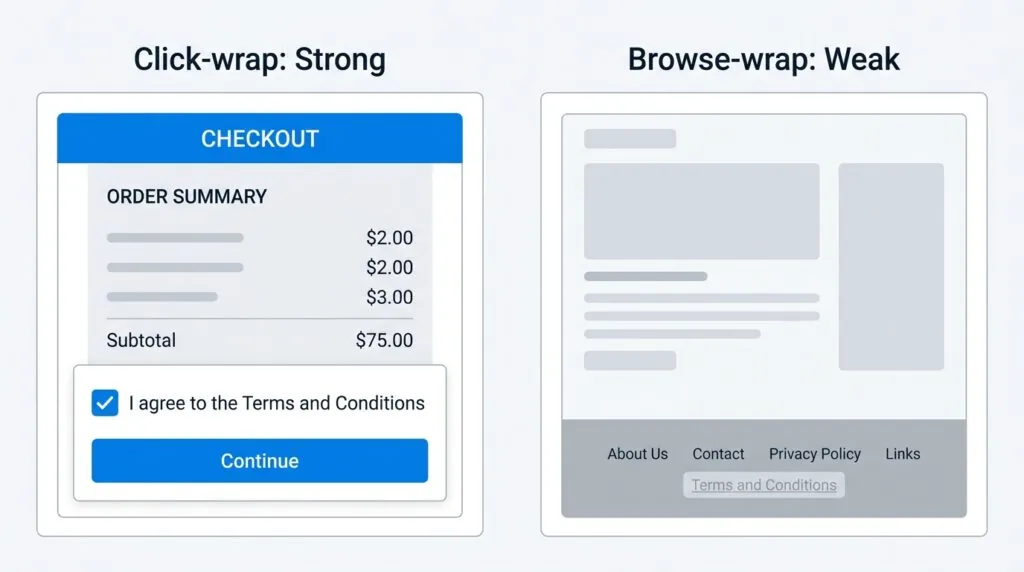
Writing the right clauses only gets you halfway there. UK courts have consistently held that terms are only enforceable if the user had a genuine opportunity to see and agree to them before using the site — simply linking to them in the footer often isn’t enough.
Browse-wrap vs Click-wrap Agreements
| Click-wrap | Browse-wrap | |
|---|---|---|
| How it works | User must actively tick a box or click “I agree” before proceeding | Terms are linked (e.g. in the footer) with no required action |
| User awareness | High — agreement is unmissable | Low — user may never see the link |
| UK enforceability | Strong — courts see this as clear evidence of consent | Weak — courts are often reluctant to bind users who took no active step |
| Best used for | Checkout flows, account sign-up, paid services | Informational pages with lower legal risk |
If your site takes payments or creates user accounts, click-wrap is the safer route every time.
Best Practices for Obtaining Active Consent
- Place an unticked checkbox next to a link to your terms at checkout or sign-up.
- Don’t let users proceed until the box is ticked.
- Keep a timestamped record of when each user agreed, and to which version of the terms.
- Update the “last modified” date whenever you revise your terms, and consider re-prompting existing users to accept material changes.
Avoiding “Unfair Contract Terms” under UK Law
A term can be perfectly clear and still be unenforceable if it’s unfair. Under the Consumer Rights Act 2015, a term is unfair if it creates a significant imbalance between you and the consumer, to the consumer’s detriment, contrary to good faith. Unfair terms simply don’t bind the consumer — even if they clicked “I agree.”
Common examples of terms that UK courts and regulators treat as unfair include:
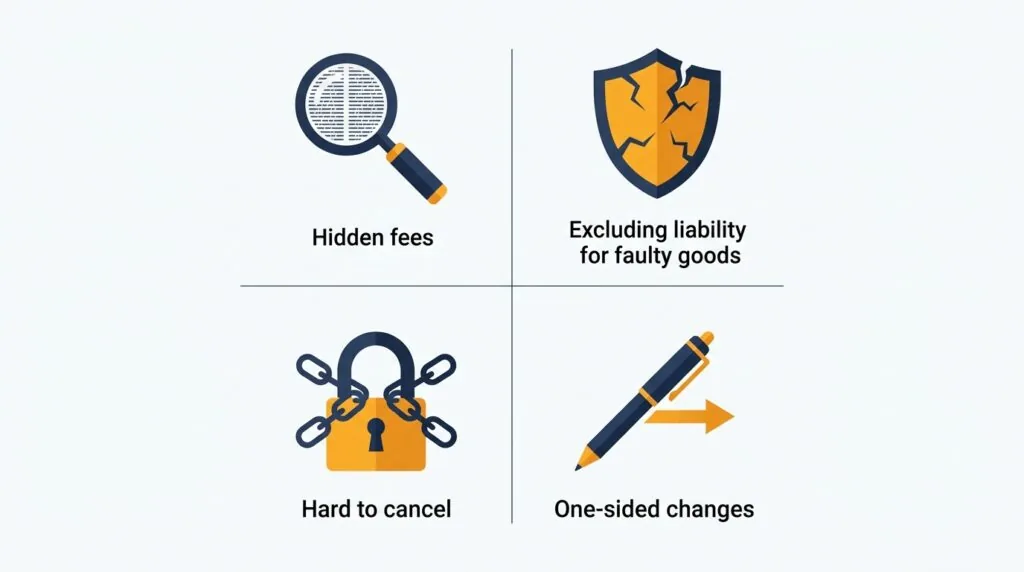
- Excluding liability for faulty or unsafe goods.
- Charging cancellation fees that are disproportionate to your actual loss.
- Burying mandatory charges (like booking fees or VAT) in small print instead of the headline price.
- Giving yourself the right to change the contract terms unilaterally, with no notice to the consumer.
- Requiring consumers to jump through unreasonable hoops to cancel a service they signed up to easily.
This area has become more, not less, strict. The Digital Markets, Competition and Consumers Act 2024, which took effect for most consumer protection provisions on 6 April 2025, replaced the older Consumer Protection from Unfair Trading Regulations 2008 and gave the Competition and Markets Authority (CMA) the power to fine businesses directly — up to 10% of global turnover — without needing a court order first. It also added specific bans on drip pricing (revealing mandatory fees late in the checkout process) and fake reviews. Separate rules tightening requirements around subscription contracts and auto-renewals are expected to follow, though implementation has been repeatedly pushed back and is not expected before 2027.
If your business handles any personal data alongside these terms, pairing your legal drafting with proper GDPR compliance tools for small UK businesses reduces the risk of falling foul of both regimes at once.
How to Write Your T&Cs: Templates, Generators, or Solicitors?
You have three realistic options for producing UK-compliant terms and conditions, and the right one depends on your budget, risk exposure, and how unusual your business model is.
| Option | Cost | Best for | Main risk |
|---|---|---|---|
| DIY / free generator | Free–low cost | Simple, low-risk informational sites | Generic clauses that miss UK-specific requirements |
| Paid template | £20–£150 | Standard e-commerce or service sites | Still needs tailoring to your actual business |
| UK solicitor | £300–£1,500+ | Complex products, high transaction volumes, regulated sectors | Cost — but lowest legal risk |
A free generator can work for a low-risk brochure site. Once you’re taking payments, storing customer data, or operating in a regulated space, the cost of a solicitor is usually far lower than the cost of an unenforceable contract or a CMA enforcement action.
The Risks of Copy-Pasting Competitors’ Terms
Copying another business’s terms and conditions is common — and risky in two separate ways.
First, it’s a copyright issue. Website terms and conditions are original written work, and copying them without permission is copyright infringement, regardless of the fact that they’re publicly visible on a website. Businesses have received cease-and-desist letters, and in some cases formal legal claims, for lifting a competitor’s terms wholesale.
Second, and often overlooked, copied terms don’t fit your business. You inherit clauses written for a different product, a different jurisdiction, or an outdated version of the law — including references to regulations that no longer apply, or protections your actual business doesn’t offer. That gap between what your terms say and what your business actually does is exactly what gets exposed in a dispute.
Summary Checklist for UK Website Terms and Conditions
- Define who you are, what your site does, and how users accept the terms.
- Specify governing law and jurisdiction (England and Wales, Scotland, or Northern Ireland).
- Include a liability and disclaimer clause that respects UK statutory limits.
- Protect your intellectual property and reference any trademarks.
- Set out acceptable use rules and grounds for account suspension.
- For e-commerce: cover payment, VAT, delivery, cancellation, and statutory consumer rights.
- Use click-wrap consent at checkout or sign-up, not just a footer link.
- Check every clause against the Consumer Rights Act 2015 fairness test.
- Keep a separate, UK GDPR-compliant privacy policy.
- Review and update your terms whenever your business model, pricing, or the law changes.
Frequently Asked Questions
Are website terms and conditions legally binding in the UK?
Yes, if a user has clearly agreed to them — typically by ticking a box or clicking “I agree” — and the terms themselves don’t contain unfair clauses under the Consumer Rights Act 2015. A link in the footer that no one has to interact with offers much weaker protection.
Do I need a lawyer to write terms and conditions?
Not always. A well-researched template can work for a simple, low-risk website. But if you handle payments, personal data, or a regulated product or service, a UK solicitor’s review reduces your legal exposure significantly.
Can I copy and paste terms and conditions from another website?
No. Terms and conditions are protected by copyright, and copying them can lead to a legal claim from the original business. Copied terms also rarely match your actual business, which creates its own compliance risk.
How do I write website terms and conditions for e-commerce?
Start with the core clauses (liability, IP, governing law, acceptable use), then add e-commerce-specific sections covering payment and VAT, delivery, the 14-day cancellation right under the Consumer Contracts Regulations 2013, and statutory rights under the Consumer Rights Act 2015.