

Most lists of UK startup incubators are out of date the day they’re published. They mix up incubators and accelerators, they still feature Tech Nation as if it runs government-funded cohorts, and they rarely tell you what a programme actually costs you in equity. This guide fixes that. It covers what’s genuinely active right now, what each one takes in exchange for support, and the legal and tax details that decide whether a deal is actually good for you.
Incubator vs. Accelerator: What’s the Real Difference?
An incubator supports founders at the idea or early-product stage over a flexible period, often six months to two years, and usually takes no equity. An accelerator runs a fixed, intensive cohort programme — typically three to six months — in exchange for equity, ending in a demo day in front of investors.
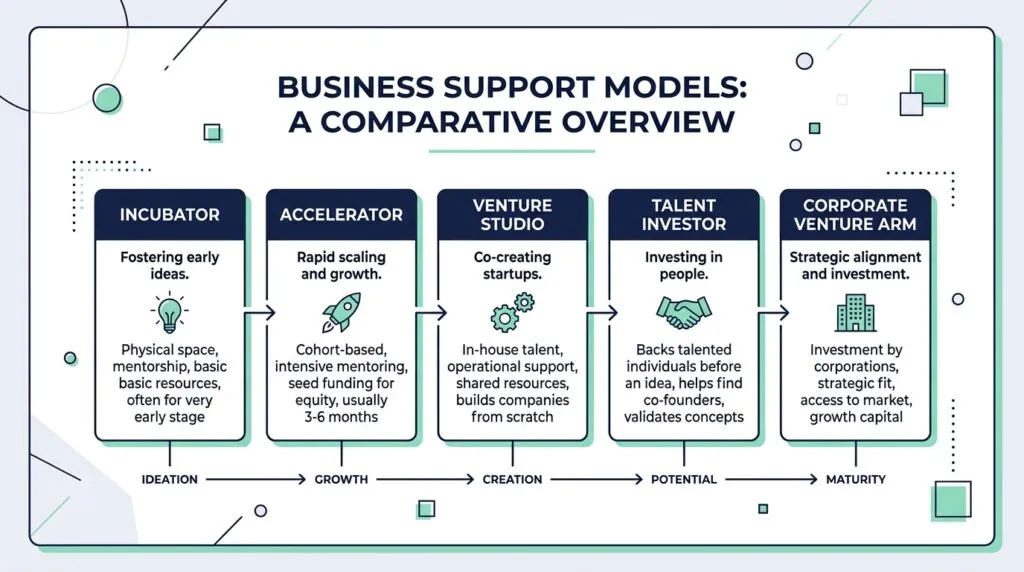
That two-way split is how most articles frame it, and it’s part of the problem. In practice, UK founders will run into at least five different models.
| Model | Typical length | Equity taken | What you get | Best fit |
|---|---|---|---|---|
| Incubator | 6–24 months, flexible | Usually none | Workspace, mentoring, grant funding | Idea-to-MVP stage |
| Accelerator | 3–6 months, fixed cohort | Roughly 4–10% | Cash investment, structured curriculum, demo day | Working product with early traction |
| Venture studio | 6–18 months, hands-on | 10%+ (co-founding stake) | The studio helps build the company with you, from scratch | Idea-stage founders without a team yet |
| Talent investor | ~12 weeks to build a company, then a launch phase | Around 8% | Equity-free grant while you find a co-founder, then an equity investment | Individuals with no co-founder or idea yet |
| Corporate venture arm | Ongoing, no fixed cohort | Negotiated case-by-case | Investment plus a route into a large corporate’s customer base | Startups with product-market fit who want a big commercial partner |
Startup Incubators (Ideation & Validation)
Incubators exist to de-risk an idea before it needs serious capital. You get desk space, mentoring, and access to a founder community, and in return the incubator asks for very little — sometimes nothing at all. University-affiliated incubators fall almost entirely into this camp.
Startup Accelerators (Growth & Scaling)
Accelerators are built for speed. You join a cohort, follow a set curriculum, and pitch to investors on a fixed date. The equity you give up buys you a compressed, high-pressure runway toward your next raise.
Venture Studios (Co-creation & Heavy Equity)
A venture studio doesn’t wait for you to bring an idea — it co-founds the company with you, contributing product, design and operational resource from day one. Because the studio is effectively a co-founder, its equity stake is much higher than a typical accelerator’s.
Why Join a UK Startup Incubator or Accelerator?
The workspace and the cheque are the visible benefits. The real value is usually what they unlock afterwards.
Non-Dilutive Funding and SEIS/EIS Alignment
Not every programme takes equity. Geovation and SETsquared, for example, provide funding or business support without touching your cap table, which matters if you’re already stretched thin on dilution. Where a programme does take equity, check that its investment structure won’t interfere with your ability to raise later using the SEIS scheme or UK small business grants — some early paperwork mistakes here are expensive to undo.
Mentorship and Warm Introductions to UK Venture Capital
A good programme’s mentor network and demo day can save you months of cold outreach. If you’re building your own investor list in parallel, it’s worth learning how to find angel investors in the UK so you’re not solely reliant on one programme’s contacts.
Technical Infrastructure and University IP Pipelines
University-linked incubators — often working through a Technology Transfer Office — give academic spin-outs lab access, equipment and a route to commercialising research that would otherwise sit in a filing cabinet.
Top Startup Incubator and Accelerator Programmes in the UK
Terms change between cohorts, so treat the figures below as a starting point and confirm current terms directly with each programme before you apply.
| Programme | Location | Duration | Equity | Funding | Best for |
|---|---|---|---|---|---|
| Techstars London | London | 13 weeks | Roughly 5–6% | Around $20k, plus an optional convertible note historically up to $100k–$200k | Sector-agnostic pre-seed and seed tech |
| Entrepreneur First | London, then San Francisco | ~12 weeks to form a company, then a launch phase | Around 8% | Equity-free grant while forming, then up to $250k investment | Individuals without a co-founder or idea yet |
| Founders Factory | London | ~6 months, flexible | 4–6% | Around £30k | Founders who want a named corporate distribution partner |
| Bethnal Green Ventures | London | Several months, hybrid | 7% | £60k | Tech-for-good startups tackling social or environmental problems |
| Geovation | London | 6 months intensive + 6 months light-touch | Equity-free | Up to £20k | Geospatial, property, energy and land-data startups |
| Wayra UK | London | Rolling, no fixed cohort | Negotiated | Up to £250k | Startups with existing traction wanting Telefónica or O2 pilots |
| SETsquared | Bath, Bristol, Cardiff, Exeter, Southampton, Surrey | Flexible, long-term | Equity-free | Business support and investor introductions, not cash | Deep tech and university spin-outs across the “Silicon Gorge” region |
| Bruntwood SciTech | Manchester, Birmingham, Leeds, Liverpool, Cheshire, Cambridge, Glasgow | ~6 months | Equity-free (property-led model) | Lab and office space, business support | Regional science and tech founders outside London |
1. Sector-Agnostic & High-Growth Giants
Techstars London and Entrepreneur First anchor this category. Techstars runs a classic 13-week accelerator sprint toward a demo day, while Entrepreneur First works differently: it invests in ambitious individuals before they have a co-founder or even an idea, then pairs them up during the programme.
2. Tech, DeepTech & FinTech Specialists
Geovation, backed by Ordnance Survey and HM Land Registry, is the clearest example of a specialist, data-driven programme — you don’t need to already be a “geospatial company” to apply, only a product that could benefit from location, land or property data. Wayra UK sits at the corporate end: it’s Telefónica and Virgin Media O2’s venture arm, better suited to startups that already have paying customers and want a route into a large telecoms business.
3. Social Impact & Sustainable Tech Hubs
Bethnal Green Ventures pioneered the UK’s “tech for good” category and continues to focus exclusively on ventures tackling social or environmental problems, backed by a fund that includes the British Business Bank.
4. Regional Ecosystem Leaders (Outside London)
Most incubator guides skew heavily toward London. SETsquared — a partnership across six universities in Bath, Bristol, Cardiff, Exeter, Southampton and Surrey — has been ranked among the world’s top university business incubators and takes no equity. Bruntwood SciTech takes a different, property-led approach: it builds innovation campuses across Manchester, Birmingham, Leeds, Liverpool, Cheshire, Cambridge and Glasgow, layering business support and regional incubation programmes onto office and lab space rather than taking a stake in your company.
5. University & Academic Spin-out Incubators
Programmes attached to Cambridge, Imperial College and London Business School typically don’t take equity through the incubator itself — but if your technology originated from university research, the university’s Technology Transfer Office may hold a separate equity stake in the underlying intellectual property. Always ask this question directly and early, before it becomes a surprise on your cap table.
Key Evaluation Criteria: How to Choose the Right UK Program
Equity Requirements & Dilution Checks
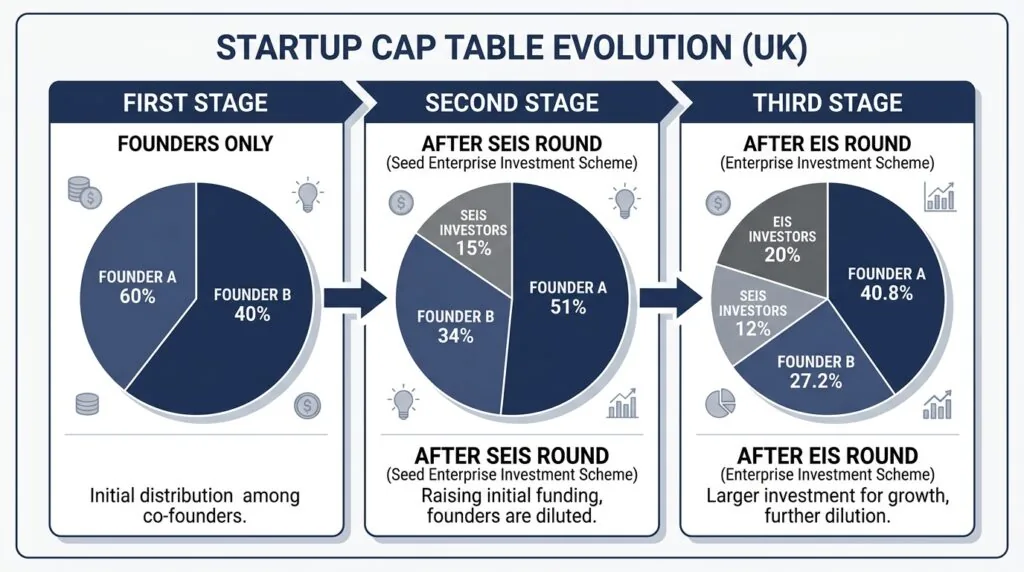
The UK doesn’t technically use the US-style SAFE (Simple Agreement for Future Equity) — most programmes here invest through an Advance Subscription Agreement (ASA) or a Convertible Loan Note instead, which convert into shares under broadly similar logic but sit under UK company and tax law. Before signing, model out what your ownership looks like after the programme’s stake, a follow-on round, and any shareholder agreement terms attached to the deal. A 7% stake sounds small in isolation; stacked with two more funding rounds, it compounds fast.
Geographic Footprint & Cohort Requirements
In-person programmes usually require relocation for the duration of the cohort. If you can’t move to London, Manchester or Bristol for three to six months, a flexible incubator like SETsquared or a regional one like Bruntwood SciTech is a more realistic fit than a fixed-cohort accelerator.
Corporate Partnerships vs. Independent Venture Backing
Corporate-backed programmes such as Founders Factory or Wayra UK give you a fast track to one large customer, but your progress can end up tied to that partner’s internal priorities. Independently VC-backed programmes like Techstars or Entrepreneur First offer more flexibility but less guaranteed commercial access.
The Application Blueprint: How to Secure Your Spot
- Validate before you apply. Most programmes expect at least a working prototype or clear proof of concept — pure idea-stage pitches rarely get through, except at true talent-investor or incubator-only programmes.
- Get your legal basics in order. If you haven’t already, set up your limited company and confirm your registered office address — some programmes won’t issue an offer until incorporation is sorted.
- Prepare a tight business plan and pitch. Reviewers are assessing team and market as much as product, so a clear UK business plan matters as much as the demo.
- Interview and pitch. Expect a panel or investment committee stage. This is effectively a dry run for pitching to investors later.
- Negotiate the offer. Read the investment instrument, the equity percentage, and any board or information rights before you accept — programmes expect founders to ask questions here.
Proof of Concept & MVP Requirements
A working demo, even a rough one, beats a polished deck with no product behind it. Programmes want evidence you can ship, not just plan.
The Core Team Dynamics Check
Interviewers probe how co-founders handle disagreement almost as much as they probe the product. If you’re applying solo, be ready to explain your plan for finding technical or commercial co-founders.
Common Mistakes, Compliance Risks & Edge Cases
Getting the SEIS/EIS sequence wrong. SEIS shares must be issued before any EIS shares in the same accounting period — get this order wrong and you can invalidate relief for investors under both schemes. A company can raise a maximum of £250,000 under SEIS across its lifetime, with investors claiming 50% income tax relief on up to £200,000 invested per year. EIS investors instead get 30% relief, and from April 2026 companies can raise up to £10 million a year and £24 million over their lifetime under EIS — both roughly doubled versus the previous limits. Get R&D tax relief advice alongside this if you’re a deep tech or life sciences founder, since the two reliefs interact.
Assuming any well-known incubator can sponsor your UK visa. This is one of the most common and costly misunderstandings. Since April 2023, only a short list of Home Office-approved organisations can endorse applicants for the Innovator Founder visa — as of 2026 that list is UK Endorsing Services, Innovator International and Envestors Limited, plus the Global Entrepreneurs Programme for founders it has already invited. Most incubators and accelerators, including the well-known names in this guide, are not endorsing bodies themselves. If relocating to the UK is part of your plan, check the current GOV.UK endorsing body list directly rather than assuming a programme covers it.
Treating Tech Nation as a live government programme. Tech Nation, the original publicly funded body, ceased operations in March 2023 when it lost its core government grant. The brand was bought by Founders Forum Group and relaunched later that year with a different structure and remit — it’s no longer the free, government-backed accelerator network many older articles still describe.
Ignoring what happens if the programme doesn’t work out. If you fail to hit milestones or the relationship sours, check your shareholder agreement for buy-back or good-leaver clauses before you sign, not after.
Overlooking non-equity alternatives. If dilution is your main concern, compare the offer against a startup business loan or a straightforward UK startup grant before assuming an equity deal is your only option.
Frequently Asked Questions
What is the difference between a startup incubator and an accelerator?
An incubator supports founders over a flexible, often long-term period and usually takes no equity. An accelerator runs a fixed three-to-six-month cohort in exchange for equity, ending in a demo day.
Are there free startup incubators in the UK?
Yes. SETsquared and Bruntwood SciTech both provide business support without taking equity, and Geovation offers up to £20,000 in equity-free funding.
How much equity do UK incubators take?
It varies by model. True incubators typically take none. Accelerators usually take between 4% and 10%. Venture studios, which effectively co-found the company with you, often take 10% or more.
How does SEIS affect early-stage incubator investment?
SEIS lets a company raise up to £250,000 with investors receiving 50% income tax relief, but SEIS shares must be issued before any EIS shares in the same accounting period, or relief can be invalidated for both.
Can a startup incubator sponsor my UK visa?
Not directly, in almost all cases. Since April 2023, only Home Office-approved endorsing bodies can endorse Innovator Founder visa applicants — a short, specific list that doesn’t include most incubators or accelerators. Check GOV.UK’s current list before assuming any programme covers this.
Is Tech Nation still running incubator programmes?
The original government-funded Tech Nation closed in March 2023. It now operates under Founders Forum Group with a different structure, so treat older references to its accelerator cohorts as outdated.