

Seed funding in the UK is the first meaningful round of equity investment a startup raises after founder or friends-and-family money. It’s typically used to build a working product, hire an initial team, and reach the traction needed for a Series A. Getting there means understanding who invests at this stage, how UK tax incentives change the maths, and what legal steps actually close a round.
This guide walks through all of it, in order: the funding sources available, the SEIS/EIS tax reliefs that make UK angel investing distinctive, realistic equity and valuation ranges, and the exact sequence of steps from data room to share issue.
What Is Seed Funding? (And How It Works in the UK Ecosystem)
Seed funding is early-stage equity capital exchanged for a stake in your company, raised once you have more than an idea — usually a prototype, early users, or initial revenue — but before you have the predictable growth metrics investors expect at Series A.
Unlike a bank loan, seed funding is not repaid. Investors take shares and accept the risk that the company might fail, in exchange for the upside if it succeeds. In the UK, this exchange is shaped heavily by SEIS and EIS, the tax reliefs covered in detail below, which reduce an investor’s effective risk and make early-stage UK companies more attractive than they’d otherwise be.
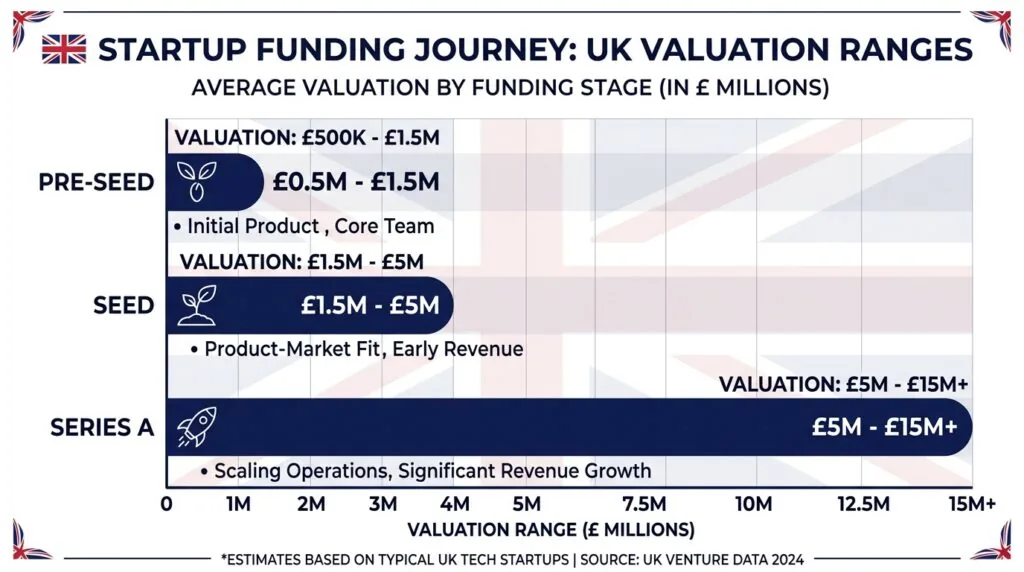
Pre-Seed vs. Seed vs. Series A: Valuations and Check Sizes
Founders often use these terms loosely. Here’s how they actually differ in the UK market.
| Stage | Typical UK Raise | Typical Pre-Money Valuation | Typical Dilution |
|---|---|---|---|
| Pre-Seed | £150k – £500k | £750k – £1.4m (up to £3–4m for strong teams) | 10–20% |
| Seed | £500k – £3m (median around £1.68m) | £3m – £10m (median around £5.6m) | 15–25% |
| Series A | £5m – £15m+ | £20m – £40m | 15–25% |
The seed figures come from the British Business Bank’s most recent Small Business Equity Tracker data. Treat them as a reference point, not a target — sector, team, and traction move the number in either direction.
The UK Seed Landscape: 5 Core Capital Sources
Most UK seed rounds are built from a mix of these five sources, rather than a single cheque.
1. Angel Investors & Angel Syndicates
Individual investors, often former founders or operators, who write cheques of roughly £10k–£100k and frequently invest through syndicates that pool capital and share due diligence. Angels are usually the fastest route to a first close and the most likely to use SEIS. For a practical outreach process, see our guide on finding angel investors in the UK.
2. UK Venture Capital Funds (Seed & Pre-Seed VCs)
Dedicated seed funds write larger cheques, usually take a board observer or director seat, and expect a full data room from day one. They move slower than angels but can anchor a round and signal quality to follow-on investors. Our detailed breakdown on how to find venture capital in the UK covers how to build a target list and get warm introductions.
3. Equity Crowdfunding Platforms
Platforms let you raise from hundreds of smaller investors in a single public campaign, which also doubles as marketing. It suits consumer brands with an existing audience more than deep-tech or B2B software. See our full walkthrough of UK small business crowdfunding before committing marketing budget to a campaign.
4. Non-Dilutive Government Grants & Start Up Loans
Innovate UK grants, sector-specific competitions, and the government-backed Start Up Loans scheme provide capital without giving up equity, though grants come with reporting requirements and slower timelines. These work well alongside, not instead of, equity funding. Compare current options in our guides to UK small business grants and getting a startup business loan in the UK.
5. Startup Accelerators and Incubators
Programmes like Entrepreneur First and Techstars UK offer a small cheque, mentorship, and a demo day in exchange for a small equity stake, typically 6–10%. They’re most valuable for first-time founders who need structure and warm investor access. Our list of UK startup accelerators breaks down what each programme actually offers.
The UK Superpower: Leveraging SEIS and EIS to Attract Investors
SEIS and EIS are HMRC tax relief schemes that let UK investors claim back a large share of what they invest in qualifying early-stage companies. They are the single biggest reason UK angel investing behaves differently from the US market, and most founders under-sell them.
SEIS vs. EIS: Limits, Rules, and Tax Benefits
| Feature | SEIS | EIS |
|---|---|---|
| Company lifetime raise limit | £250,000 | £24m (£40m for Knowledge-Intensive Companies) |
| Company gross assets limit | Under £350,000 | Under £30m (most companies) |
| Company trading age limit | Under 3 years | Under 7 years (10 for KICs) |
| Max employees | Fewer than 25 | Fewer than 250 |
| Investor income tax relief | 50% | 30% |
| Investor annual investment limit | £200,000 | £1m (£2m if partly in KICs) |
| CGT treatment | Full exemption after 3 years, 50% reinvestment relief | Full exemption after 3 years |
| Order of use | Must be used first | Used after SEIS is exhausted |
Under SEIS, a UK startup can raise up to £250,000 while offering investors 50% income tax relief — meaning a £20,000 investment costs an investor as little as £10,000 after relief, before any downside protection from loss relief. Most companies use SEIS for their very first round, then move to EIS once they outgrow SEIS’s £350,000 gross assets threshold. SEIS must always be issued before EIS or VCT investment; once you accept EIS money, you can’t go back and use SEIS. For a deeper dive into eligibility and claiming the relief, read our full SEIS scheme explainer.
Why HMRC Advance Assurance Is Non-Negotiable
Advance Assurance is HMRC’s pre-approval that your planned share issue will qualify for SEIS or EIS relief. Almost no experienced angel or fund will commit money without seeing it, because it removes the risk that HMRC later rejects the claim and clumsily unwinds their tax relief. Applications typically take 6–12 weeks to process, so apply before you start pitching, not after you have a term sheet on the table.
How Much Equity Should You Give Away at the Seed Stage?
Most UK founders give away between 15% and 25% of their company at seed, once you account for both the investor stake and any new option pool carved out for future hires. Pre-seed rounds typically dilute founders 10–20%; by the time a company reaches Series A having raised both rounds, founders commonly retain somewhere in the 50–65% range.
The number that matters isn’t the headline valuation — it’s how much of the company you’ll own after the option pool is created. A pool is usually carved out of the pre-money valuation, which means it dilutes founders specifically, not incoming investors. Always ask whether a quoted valuation is pre-money or post-money, and whether the option pool sits inside or outside it.
Valuing an Early-Stage UK Startup
There’s no formula that reliably prices a pre-revenue company. In practice, UK seed valuations are negotiated around a small set of reference points: comparable recent rounds in your sector, the strength and track record of the founding team, the size of the addressable market, and how much runway the raise needs to buy. A simple sanity check many founders use: divide the amount you want to raise by the percentage of equity you’re willing to sell, and see whether the resulting valuation is defensible against comparable UK deals in your sector.
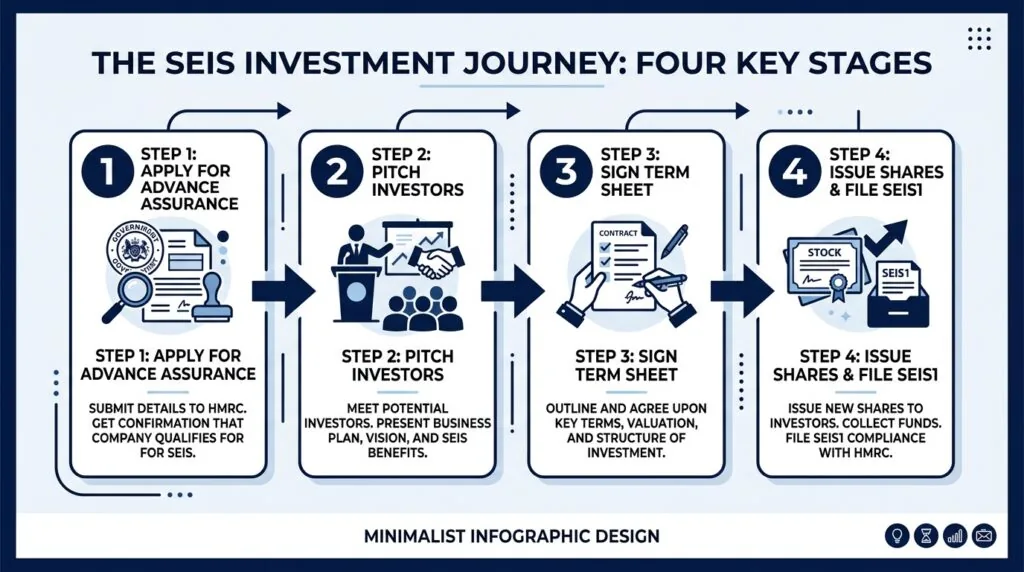
Step-by-Step: How to Prepare and Close Your UK Seed Round
- Build your fundraising data room.
- Secure HMRC Advance Assurance.
- Map and warm-intro your investor pipeline.
- Issue term sheets and negotiate key clauses.
- Draft legal agreements and complete due diligence.
- Issue shares and file compliance forms with HMRC.
Step 1: Build Your Fundraising Data Room
Before contacting a single investor, assemble a complete data room. This is where most vague guides stop at “make a pitch deck” — a real UK data room needs all of the following:
- A 10–15 slide pitch deck covering problem, solution, traction, market, team, and the ask
- A three-to-five-year financial model with clear assumptions
- A current cap table showing all existing shareholders and option holders
- Proof of traction (revenue, users, pilots, or letters of intent)
- A summary of technical architecture or IP position, where relevant
- Your HMRC Advance Assurance letter or confirmation it’s in progress
- A one-page executive summary for cold outreach
Read our companion guide on how to pitch to investors in the UK for a full breakdown of what each of these documents needs to contain, and our UK business plan guide if you’re building the underlying plan from scratch.
Step 2: Secure HMRC Advance Assurance
Submit your Advance Assurance application alongside your data room preparation, not after. You’ll need your business plan, financial forecasts, and details of the shares you intend to issue. Budget 6–12 weeks for a response, and factor that timeline into when you start outreach.
Step 3: Map and Warm-Intro Your Investor Pipeline
Build a list of angels, syndicates, and seed funds active in your sector and stage, prioritised by relevance over prestige. Warm introductions convert dramatically better than cold emails — ask your existing network, advisors, or accelerator connections before resorting to cold outreach.
Step 4: Issue Term Sheets and Negotiate Key Clauses
A term sheet sets out valuation, the amount being raised, board or observer rights, and protective provisions such as anti-dilution and liquidation preference. At seed, a standard UK term sheet uses a straightforward 1x non-participating liquidation preference; anything more aggressive is a red flag worth pushing back on.
Step 5: Draft Legal Agreements and Complete Due Diligence
Once terms are agreed, your solicitor drafts the subscription agreement and updated shareholders’ agreement, while investors run due diligence on your financials, IP, contracts, and cap table. Have a signed founders’ agreement and any NDAs already in order — gaps here are one of the most common causes of delayed closes.
Step 6: Issue Shares and File S1/SEIS1 Forms with HMRC
Once funds land, file the SH01 share allotment form at Companies House, update your cap table, and submit the SEIS1 or EIS1 compliance statement to HMRC. HMRC then issues the reference number your investors need to claim their tax relief through Self Assessment.
Legal Contracts & Closing Instruments
Term Sheets, Advanced Subscription Agreements (ASAs), and SAFE Notes
UK founders frequently confuse US-style SAFE notes with the UK’s Advanced Subscription Agreement, but they aren’t interchangeable under UK law. An ASA is the standard UK instrument for raising quickly ahead of a priced round: investors pay now, and shares are issued later at a discount to the next round’s valuation, structured specifically to preserve SEIS/EIS eligibility. A US SAFE, used unmodified, can jeopardise that tax relief because of how it’s treated for HMRC purposes — most UK advisers recommend an ASA instead, or a carefully adapted SAFE with specialist tax advice. A Convertible Loan Note (CLN) is a third option structured as debt that converts to equity, useful in specific bridge scenarios but rarely SEIS/EIS-compatible. See our dedicated guide to convertible loan notes for UK startups for how CLNs compare to ASAs in practice.
Common Mistakes UK Founders Make
| Mistake | Why It Costs You | Fix |
|---|---|---|
| Pitching before Advance Assurance is filed | Serious investors stall or walk away | Apply for Advance Assurance before outreach begins |
| Using a US SAFE unmodified | Can void SEIS/EIS relief for investors | Use an ASA, or a UK-adapted SAFE with specialist advice |
| Not knowing pre-money vs. post-money | You underestimate real dilution | Confirm the basis of every valuation quoted to you |
| Skipping the data room until asked | Slows momentum and looks unprepared | Build it before first investor contact |
| Accepting non-standard liquidation preferences | Erodes founder and employee upside later | Push back on anything beyond 1x non-participating |
Frequently Asked Questions
How much seed funding can I raise under SEIS in the UK?
A UK company can raise a maximum of £250,000 in total under SEIS, provided its gross assets are under £350,000, it employs fewer than 25 people, and it has been trading for less than three years.
What is the difference between SEIS and EIS?
SEIS is for very early-stage companies and offers investors 50% income tax relief on up to £200,000 a year, capped at a £250,000 lifetime company raise. EIS is for more developed companies, offers 30% income tax relief, and allows companies to raise substantially more — up to £24m over their lifetime.
How do I get Advance Assurance from HMRC?
You apply directly to HMRC with your business plan, financial forecasts, and details of the shares you plan to issue, before approaching investors. Processing typically takes 6–12 weeks.
How much equity do seed investors ask for in the UK?
Most UK seed rounds result in founders giving away 15–25% of the company, once the investor stake and any new option pool are both accounted for.
What documents are needed for a UK seed fundraising round?
At minimum: a pitch deck, financial model, cap table, proof of traction, HMRC Advance Assurance confirmation, and a term sheet, followed by a subscription agreement and updated shareholders’ agreement to close.
Key Takeaways & Actionable Next Steps
Raising seed funding in the UK is a sequence, not a single event: understand where you sit between pre-seed and Series A, build your data room early, file for Advance Assurance before you pitch, and use SEIS or EIS as a genuine selling point rather than an afterthought. Expect to give away 15–25% of your company, insist on standard UK terms, and use an ASA rather than an unmodified US SAFE if you’re raising ahead of a priced round.
Next, if you haven’t already, register your company correctly and get your foundational agreements in place — start with our guides on setting up a limited company in the UK and claiming R&D tax relief, which can extend your runway before you even close the round.