
If you run a small business in the UK, you don’t need to pay a monthly subscription just to keep your books in order. Several accounting platforms offer genuinely free plans that cover invoicing, expense tracking, and even Making Tax Digital (MTD) filing — provided you know their limits before you commit.
Quick answer: the best free accounting software right now
Zoho Books is the best all-round free accounting software for UK small businesses in 2026. It combines MTD for VAT support with a genuinely usable free tier, no cost commitment, and enough features to run a small operation without hitting a wall too quickly.
Two strong alternatives depend on your situation:
- FreeAgent — free for life if you hold a business account with NatWest, Royal Bank of Scotland, Ulster Bank, or Mettle.
- QuickFile — a solid pick for UK-based freelancers and low-volume businesses who want multi-currency invoicing without a subscription.
If none of those quite fit, the comparison table and buyer’s guide below will help you narrow it down by business type and transaction volume.
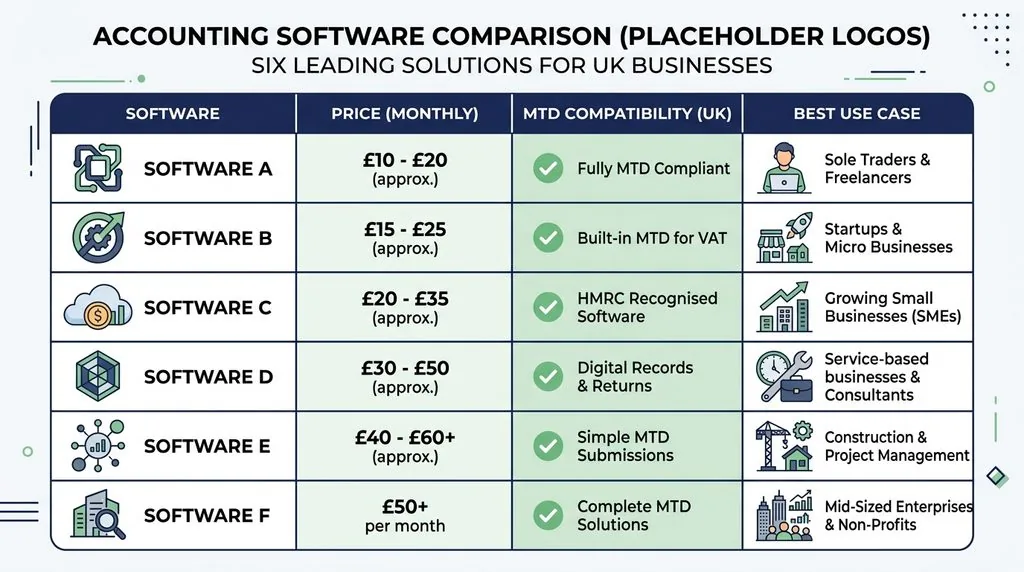
Comparison table: free accounting software at a glance
| Software | Price from | MTD compatible | Best for | Key limitation |
|---|---|---|---|---|
| Zoho Books | Free | VAT filing yes; listed for MTD for Income Tax | Small businesses wanting an easy, scalable free plan | Revenue and invoice caps on the free tier |
| FreeAgent | Free (bank customers) / paid otherwise | Yes, VAT and Income Tax | NatWest, RBS, Ulster Bank or Mettle customers | Only free if you bank with an eligible provider |
| QuickFile | Free | VAT yes; Income Tax on paid tiers | Multi-currency, low-volume UK freelancers | Capped at 1,000 ledger entries a year |
| Clear Books | Free (sole trader plan) | MTD for Income Tax yes | Sole traders and landlords | No invoicing or quotes on the free plan |
| Crunch Free | Free | Roadmap for Income Tax; VAT on paid plans | Sole traders not yet VAT-registered | No VAT filing or automated bank feeds |
| GnuCash | Free (no paid tiers) | No native MTD support | Users comfortable with manual, offline bookkeeping | Desktop only, no cloud sync, no mobile app |
Pricing, caps, and MTD status change fairly often in this market, so it’s worth double-checking directly with the provider before you sign up.
Is free accounting software really free?
Free accounting software is genuinely free to use, but almost every provider limits the free tier in some way — usually through a revenue cap, a transaction limit, or eligibility tied to your bank. There are three common models.
Freemium. The core invoicing and bookkeeping tools are free, but you’ll hit a wall once you cross a certain number of transactions or a set annual revenue. Zoho Books and QuickFile both work this way.
Bank-bundled. The software itself is a paid product, but your bank covers the cost as a perk of holding a business account with them. FreeAgent is the clearest example — free for NatWest, RBS, Ulster Bank, and Mettle customers, and a paid subscription for everyone else.
Open-source or desktop. Tools like GnuCash have no paid tier at all, but they also lack cloud syncing, mobile apps, and — in most cases — native MTD support. They suit people comfortable with manual bookkeeping rather than growing businesses.
None of these are a trick. But it’s worth reading the small print before assuming a “free” badge means unlimited use. If you’re still working out your basic bookkeeping habits before choosing software, our guide to sole trader record keeping requirements is a useful starting point.
Making Tax Digital: what free software needs to handle
Making Tax Digital (MTD) is HMRC’s programme requiring digital record-keeping and returns, submitted directly through approved software rather than manual forms. It applies in two phases: MTD for VAT, already mandatory for most VAT-registered businesses, and MTD for Income Tax, which is rolling out in stages from 2026.
| Phase | Who it affects | Start date |
|---|---|---|
| MTD for VAT | Most VAT-registered businesses | Already mandatory |
| MTD for Income Tax | Self-employed people and landlords earning over £50,000 | From April 2026 |
| MTD for Income Tax (extended) | Self-employed people and landlords earning over £30,000 | From April 2027 |
If you fall into either MTD for Income Tax bracket, you’ll need software that can keep digital records and send quarterly updates to HMRC, followed by an end-of-year finalisation. Not every free plan supports this yet — some, like Crunch Free and GnuCash, only offer it through separate bridging software or a future roadmap. Always check HMRC’s own compatible software list before relying on a free tier long-term.
If you haven’t registered for Self Assessment yet, it’s worth sorting that out before you start comparing software — see our guide on how to register for Self Assessment.
The best free accounting software for UK small businesses
Zoho Books — best overall
Zoho Books is the strongest all-round free option because it pairs an easy learning curve with real MTD functionality, rather than making you choose between the two.
Good for: small businesses and sole traders who want a modern, straightforward tool without a subscription.
Not for: businesses that expect to issue a high volume of invoices quickly, since the free plan is capped.
- MTD for VAT filing included on the free tier
- One connected bank account
- Around 1,000 invoices covered per year
- Mobile app with receipt scanning
- Zoho branding appears on invoices unless you upgrade
FreeAgent — best if you bank with an eligible provider
FreeAgent is a fully featured accounting platform that costs nothing at all if you hold a qualifying business account.
Good for: NatWest, Royal Bank of Scotland, Ulster Bank, or Mettle customers who want a complete package without caps.
Not for: anyone banking elsewhere, since the standard subscription applies to everyone else.
- Full MTD support for VAT and Income Tax
- Cash flow forecasting and tax timeline reminders
- No revenue or invoice cap for eligible users
- Requires at least one transaction a month with Mettle to stay eligible
QuickFile — best for multi-currency and low-volume freelancers
QuickFile was built specifically around UK accounting rules, which shows in how naturally it handles VAT schemes and CIS deductions.
Good for: freelancers and small service businesses with international clients and modest transaction volumes.
Not for: anyone processing a high number of invoices, bills, or bank lines each month.
- Multi-currency invoicing included free
- 1,000 ledger entries per rolling 12 months
- Automated bank feeds cost extra
- No built-in third-party app integrations
If your clients pay you in different currencies, it’s also worth reviewing your setup around exporting goods from the UK, since currency handling and customs paperwork often go hand in hand.
Clear Books — best cheap upgrade path
Clear Books’ Sole Trader Free plan is built for people who need simple, HMRC-approved software for quarterly MTD updates without paying anything.
Good for: sole traders, the self-employed, and landlords who need MTD for Income Tax support.
Not for: anyone who wants to create invoices or quotes, since that’s a paid-tier feature.
- Supports MTD for Income Tax quarterly updates
- Works with the Construction Industry Scheme (CIS)
- No VAT filing on the free plan
- Upgrading to the entry paid tier unlocks invoicing and receipt capture
Crunch Free — best for sole traders not yet VAT-registered
Crunch Free is a practical option if your main need is basic bookkeeping ahead of MTD for Income Tax, rather than full VAT compliance today.
Good for: side hustles and early-stage sole traders under the VAT threshold.
Not for: VAT-registered businesses, since filing is reserved for paid plans.
- Unlimited invoices and transactions
- No revenue cap
- No automated bank feed on the free tier
- VAT filing only available on paid plans
GnuCash — best for manual, offline bookkeeping
GnuCash is open-source desktop software with no subscription at any tier, which makes it appealing if you’re comfortable managing your own records.
Good for: micro-businesses with very few transactions and some comfort with technical software.
Not for: anyone who needs MTD compliance without extra bridging software.
- No cloud storage — data lives on your device
- No native MTD support
- Generates PDF invoices and basic profit and loss reports
- No mobile app beyond a basic Android version
Free vs paid: when you’ll need to upgrade
Free plans work well until your business grows past their limits. The most common triggers are:
- Revenue caps — Zoho Books’ free tier is built around a set annual turnover, and moving past it forces an upgrade.
- Transaction or invoice caps — QuickFile’s 1,000 ledger entries can be used up faster than expected once you include bank lines and bills, not just invoices.
- Feature gaps — no payroll, limited reporting, or missing invoicing (as with Clear Books’ free plan) often push growing businesses toward a paid tier before the revenue cap even matters.
- Bank eligibility changes — if you switch away from NatWest, RBS, Ulster Bank, or Mettle, FreeAgent stops being free.
Most paid entry-level plans in this market sit somewhere between £5 and £15 a month, rising as you add users, payroll, or advanced reporting. Budgeting for that jump early avoids a scramble later, especially around a filing deadline.
If you’re also formalising your business structure as you grow, our guides on moving from sole trader to limited company and first steps after registering a company cover what typically changes at that stage, accounting included.
How to choose the right free accounting software
The right choice depends on three things: your business type, your transaction volume, and whether you already bank with a provider that bundles free software.
By business type:
- Sole trader, no VAT registration: Crunch Free or Clear Books
- Sole trader or landlord needing MTD for Income Tax: Clear Books or Zoho Books
- Limited company: Zoho Books or FreeAgent (if eligible)
- Freelancer with international clients: QuickFile
By transaction volume:
| Monthly transactions | Recommended type |
|---|---|
| Under 50 | QuickFile or Crunch Free |
| 50–150 | Zoho Books |
| 150+ | Consider a paid plan from day one |
By features you actually need: if you rely on bank feeds daily, check whether they’re included free or cost extra (QuickFile charges for this). If you’ll need payroll soon, note that almost no free plan includes it. And if invoicing is central to your workflow, confirm the free tier allows it at all — Clear Books’ free plan notably doesn’t.
Getting your invoicing process running smoothly matters just as much as the software itself — our guide on how to automate invoicing covers the practical side of that. And if you’re weighing up receipt-capture tools to pair with your chosen platform, our comparison of Dext vs Hubdoc is a useful next read.
Limitations to check before you commit
Free plans are genuinely useful, but a few limitations catch people out regularly:
- Branding on invoices. Several free tiers, including Zoho Books, add the provider’s branding unless you upgrade.
- No live support. Free users typically get email-only help, not phone or live chat.
- Add-on costs for bank feeds. QuickFile’s automated feeds sit outside the free plan.
- No payroll. Budget separately if you plan to employ staff.
- Data export limits. Confirm you can export your records if you switch providers later — some platforms make this smoother than others.
Since you’ll be storing financial data in any of these platforms, it’s also worth reviewing basic account security. Our guide to two-factor authentication for small businesses is a quick way to tighten that up.
Frequently asked questions
Which free accounting software is best for a sole trader?
Clear Books and Zoho Books are the strongest options for sole traders needing MTD for Income Tax support, while Crunch Free suits those below the VAT threshold who mainly need basic bookkeeping.
Is free accounting software safe to use?
Yes, provided you choose an established provider with clear security information, two-factor authentication, and UK GDPR-aligned data handling. Review this directly on the provider’s site before signing up.
Do I still need an accountant if I use free software?
Often, yes. Free software handles day-to-day bookkeeping and MTD filing, but it won’t advise on tax planning, business structure, or claiming reliefs — that still requires a professional.
Which free software is HMRC-recognised?
Zoho Books, FreeAgent, and Clear Books all appear on HMRC’s published lists of MTD-compatible software, though specific features vary by plan. Always check the current list directly with HMRC before relying on it.
What happens when I outgrow the free tier?
Most platforms prompt an upgrade once you hit a revenue or transaction cap, and some restrict features until you do. Planning for this ahead of a filing deadline avoids disruption.
Can I use a spreadsheet instead of accounting software?
Yes, if it’s linked to MTD-compatible bridging software for submissions. This can work for very low transaction volumes but becomes harder to manage as your business grows.
Verdict
For most UK small businesses, Zoho Books offers the best balance of features, ease of use, and MTD compliance on a free plan. If you bank with NatWest, RBS, Ulster Bank, or Mettle, FreeAgent is hard to beat — you get a fully-featured platform without the caps that come with most free software. And if you’re a low-volume freelancer working with international clients, QuickFile is worth a closer look.
Whichever you choose, treat the free plan as a starting point rather than a permanent home. Revisit your choice once your transaction volume, VAT status, or team size changes — switching early is far easier than switching under pressure.