

Microsoft reset its commercial pricing worldwide on 1 July 2026, folding a baseline Copilot AI experience into most Microsoft 365 business plans. That change has quietly narrowed — and in places reversed — the price gap with Google Workspace. Most comparison guides still quote pre-July figures in US dollars and skip UK VAT and compliance rules. This one doesn’t.
The Executive Summary: Choosing Your Ecosystem
Google Workspace usually costs less and is simpler to administer. Microsoft 365 usually wins if your team lives in desktop Excel, needs offline file access, or wants built-in device security without buying separate antivirus software.
Neither platform is objectively “better.” It depends on how your team works, how much storage each person genuinely needs, and whether Microsoft’s bundled security tools are worth paying for instead of buying them separately.
| Your priority | Better fit |
|---|---|
| Lowest monthly cost per user | Google Workspace |
| Native desktop Word/Excel and offline editing | Microsoft 365 |
| Simple, predictable storage that won’t run out unexpectedly | Google Workspace (pooled) |
| Built-in endpoint security and device management | Microsoft 365 Business Premium |
| Fastest route to Cyber Essentials certification | Either, if MFA is switched on everywhere |
| Heavy external client meetings via Teams links | Microsoft 365 |
Two-factor authentication for UK small businesses is relevant to almost every row in that table — both platforms now treat it as close to mandatory, which we cover in the compliance section below.
UK Pricing in 2026: The New Cost Landscape
All prices below are per user, per month, in GBP, excluding VAT, on an annual commitment paid yearly — the standard way both vendors quote list prices. UK-registered businesses add 20% VAT on top of every figure.
Google Workspace UK plans and costs
| Plan | Price (ex VAT) | Storage | Meeting size |
|---|---|---|---|
| Business Starter | £5.90/user/month | 30GB pooled | 100 participants |
| Business Standard | £11.80/user/month | 2TB pooled | 150 participants |
| Business Plus | £18.40/user/month | 5TB pooled | 500 participants |
| Enterprise | From £22.60/user/month | 5TB+ pooled | 1,000 participants |
Gemini AI is now included at every paid tier — Starter gets a limited version, Standard and Plus unlock full Gemini access inside Docs, Sheets, Slides, Drive and Meet at no extra cost.
Microsoft 365 UK plans and costs
| Plan | Price (ex VAT) | Storage | Notes |
|---|---|---|---|
| Business Basic | £5.40/user/month | 1TB per user | Web and mobile apps only |
| Apps for Business | £9.80/user/month | 1TB per user | Desktop apps, no hosted email or Teams |
| Business Standard with Copilot | £18.10/user/month | 1TB per user | Desktop apps, Teams, Copilot AI bundled |
| Business Premium with Copilot | £24.60/user/month | 1TB per user | Adds Intune, Defender, Entra ID, Purview |
That “with Copilot” naming isn’t decorative. From 1 July 2026, Microsoft folded its Copilot Chat features into the base packaging of most commercial plans and turned the previously promotional “Standard with Copilot” and “Premium with Copilot” bundles into permanent SKUs. Business Basic and the entry-level Standard tier both rose in price as part of the same update, while Business Premium’s underlying rate held steady. If you don’t want the AI assistant, ask your reseller whether a legacy Standard licence is still available at your renewal — existing subscribers keep their current price until then.
NCE lock-in vs flexible commitments
Microsoft sells licences through the New Commerce Experience (NCE), usually via a Cloud Solution Provider (CSP) partner. An annual commitment paid monthly locks in your rate for 12 months but costs roughly 20% more than paying upfront, and leaving early can trigger a cancellation charge. Google Workspace works the same way in principle — annual billing is 16-20% cheaper than monthly — so the lock-in trade-off isn’t unique to Microsoft, only the CSP terminology is.
The “Storage Tax”: Pooled vs Siloed Data Storage
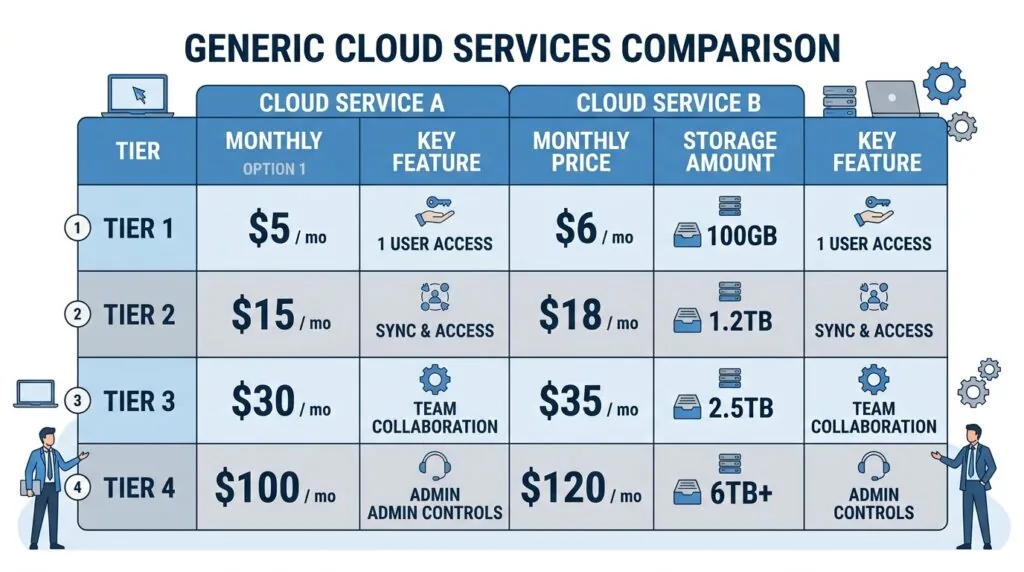
Pooled storage (Google Workspace) shares one storage allowance across your whole organisation. Siloed storage (Microsoft 365) gives each user a fixed, separate allowance that can’t be borrowed from a colleague’s unused space.
That difference matters more than the headline gigabyte number. Google Workspace Business Standard gives you 2TB per user, but it’s pooled — a video editor who needs 6TB and a bookkeeper who uses 20GB simply share the same company-wide pot. Microsoft 365 gives every plan a flat 1TB per user, no matter the tier, and that allowance is siloed: unused space on one account can’t top up another.
A 15-person agency on Google Workspace Business Standard has 30TB to divide however usage falls. The same 15 people on Microsoft 365 have 15TB in total, but strictly 1TB each — if one video editor fills their allowance, you’re buying a per-user storage add-on or moving files to cloud storage built specifically for UK small businesses, even though the company overall is nowhere near its limit. Teams with a few heavy users and many light ones do better under Google’s pooled model; teams with even usage rarely notice the difference.
Application & Workflow Showdown
Document creation: Word/Excel vs Google Docs/Sheets
Microsoft 365 Business Standard and above ship full desktop Word, Excel and PowerPoint that work offline and sync when you reconnect. Google Workspace is web-first — Docs and Sheets run in the browser, or via the Drive desktop sync client — which suits always-online teams but can feel limiting for heavy formula work or complex formatting offline. If your team already lives in Excel for finance modelling, that’s usually the deciding factor on its own.
Collaboration and communication: Teams/Outlook vs Meet/Gmail
Microsoft Teams stays the default for firms whose external clients are already on Microsoft — meeting links and file co-authoring feel native to anyone else on a Microsoft 365 tenant. Google Meet is lighter and opens instantly in a browser, which some clients find easier without an app. Outlook’s calendar handles complex scheduling well; Gmail’s search and labelling suits high-volume inboxes. If external video calls happen daily, compare video conferencing software for UK small businesses before deciding.
Task and workflow tools
Neither platform’s built-in task manager (Microsoft Planner/To Do or Google Tasks) matches a dedicated tool once a team passes roughly ten people. Many UK small businesses layer a proper task management app on top of whichever suite they choose, rather than treating the built-in options as a long-term solution.
Security, GDPR, and Cyber Essentials Compliance
Both platforms can meet UK GDPR and Cyber Essentials requirements. Microsoft 365 Business Premium bundles more of the required tooling into one subscription; Google Workspace generally costs less to reach the same baseline but expects you to configure more settings yourself.
Under UK GDPR, contractual and technical safeguards matter more than exact data location, but both vendors publish UK-specific hosting. Microsoft 365 stores UK tenant data primarily in Azure UK South (London) and Azure UK West (Cardiff). Google’s equivalent data-region controls, which let you pin storage to a specific geography, are an Enterprise-tier feature — Business-tier Workspace customers rely on Google’s standard European infrastructure and contractual commitments rather than a UK-only guarantee.
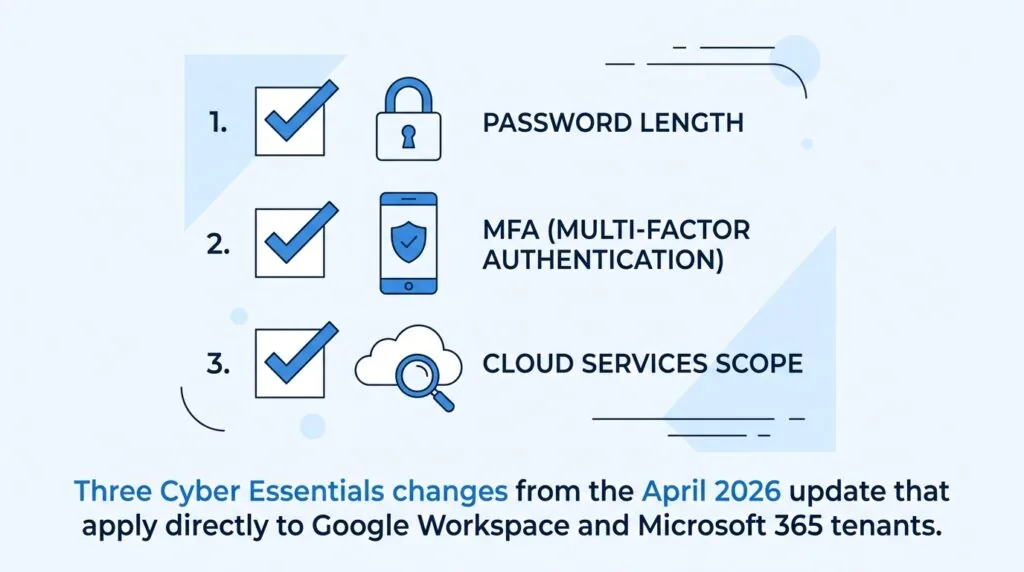
Cyber Essentials, the NCSC-backed certification scheme administered by IASME, updated its Requirements for IT Infrastructure to version 3.3 (the “Danzell” release) on 27 April 2026. Three changes affect any business running either suite:
- Minimum password length rose from 8 to 12 characters, unless MFA or account lockout is enforced instead.
- If a cloud service offers MFA and it isn’t switched on for every user, that’s now an automatic assessment failure — not a minor mark-down.
- Cloud services (including your email and file storage platform) are explicitly in scope, where older versions of the framework focused mainly on on-premise hardware.
Both Google Workspace and Microsoft 365 support enforced MFA at every paid tier, so neither has a structural advantage here — the failure risk is almost always a business that never turned the setting on. Reviewing your two-factor authentication setup before your next Cyber Essentials renewal is the single highest-value five minutes you can spend on this.
Where the platforms genuinely diverge is endpoint security. Microsoft 365 Business Premium bundles Intune (device management), Defender for Business (endpoint protection), Entra ID (identity) and Purview (data loss prevention) into one £24.60/user/month subscription — potentially replacing a separate antivirus purchase. Google Workspace Business Plus includes Vault for eDiscovery, context-aware access, and advanced endpoint management, but no built-in antivirus — most Workspace-only businesses still need a separate cybersecurity tool. For regulated sectors weighing up GDPR compliance tools for small companies, that gap between what’s bundled and what you’ll buy separately often decides the platform more than the sticker price.
AI Integration in 2026: Copilot vs Gemini
Gemini comes included in every paid Google Workspace tier from Standard upward. Microsoft 365 Copilot is now bundled into the Standard and Premium plans by default, but that bundling is exactly why those tiers cost more than they used to.
Google took the include-it-in-the-price route: Standard and Plus customers get Gemini inside Gmail, Docs, Sheets, Slides, Drive and Meet with no separate line item. Microsoft took the opposite path for years — Copilot cost roughly £13.80 to £16.10 per user as an add-on — before folding a version into Business Standard and Premium as part of the July 2026 repricing. The outcome is similar (most UK small businesses now get generative AI without a separate purchase), but Microsoft’s route shows up as a bigger jump in the base price, worth remembering behind any “Microsoft 365 got more expensive” headline. For the full breakdown, see Microsoft 365 Copilot pricing for UK small businesses.
Migration and Long-Term Administration
Moving between ecosystems is rarely instant. Budget for a transition window where email, calendars and files run in parallel, and expect your Making Tax Digital record-keeping obligations to continue uninterrupted — most accounting software works with either platform’s storage. Administration otherwise favours whichever console your IT lead already knows: Google’s Admin console is generally faster for basic user and group management, while the Microsoft 365 admin center offers deeper policy control once Intune or Conditional Access are in play, at the cost of a steeper learning curve. If you’re about to hire your first employee and set up a second account, test both consoles with a free trial before committing to an annual term. For handovers with outside contractors, also compare free file-sharing tools for UK small businesses against each platform’s native sharing links.
The Final Selection Matrix: Operational Questions to Ask Your Team
Ask these before renewing or switching:
- Do a third or more of your team need offline document editing? Microsoft 365’s desktop apps outweigh the price gap.
- Does one or two people use far more storage than everyone else? Google’s pooled model avoids per-user storage add-ons.
- Do you already pay separately for antivirus and device management? Price Business Premium against that combined spend, not against the suite alone.
- Is your Cyber Essentials renewal due after April 2026? Confirm MFA is enforced organisation-wide, whichever platform you pick.
- Is AI a daily requirement or a nice-to-have? If daily, Google’s included Gemini on Standard may undercut Microsoft’s bundled Copilot pricing for a similar outcome.
Quick FAQ
Is Microsoft 365 cheaper than Google Workspace in 2026?
Not at the mid tier. Since 1 July 2026, Business Standard with Copilot (£18.10/user/month) costs more than Google Workspace Business Standard (£11.80/user/month), mainly because Microsoft’s price now bundles its Copilot AI assistant by default.
What’s the difference between pooled and siloed storage?
Pooled (Google Workspace) shares one storage total across every user. Siloed (Microsoft 365) gives each user their own fixed, non-transferable 1TB, regardless of plan.
Which suite is best for a UK startup?
Under ten people with modest storage needs: Google Workspace Business Starter is usually cheaper. Teams needing desktop Excel from day one, or Windows-only software, often start with Microsoft 365.
How do both platforms handle GDPR?
Both offer UK/European hosting and standard contractual clauses. Microsoft publishes specific UK datacentre regions (London, Cardiff) at every business tier; Google’s guaranteed data-region controls are Enterprise-only.