

AI can save a UK small business real time on marketing, admin, and customer support without a big budget or technical team. The tools that matter most are generative AI assistants (ChatGPT, Copilot, Gemini), AI chatbots, and automation apps that plug into software you already use. The catch isn’t the technology. It’s using it in a way that doesn’t breach UK GDPR, waste money on tools you don’t need, or expose customer data to the wrong system.
What Does AI Actually Mean for a UK SME?
For UK small businesses, AI refers to accessible, software-based systems that automate repetitive administrative, marketing, and customer service tasks to save time and cut costs. You don’t need to build anything. Most SMEs use AI simply by subscribing to a tool.
Beyond the Hype: Machine Learning and Generative AI Explained Simply
Two terms get used interchangeably, but they’re different things.
Machine learning (ML) is software that spots patterns in data and improves at a task over time, like a fraud-detection system in your bank account flagging unusual transactions.
Generative AI is software that creates new content on request, like ChatGPT writing a product description or Canva Magic Studio resizing an ad. This is the category most small businesses actually interact with day to day.
You don’t need to understand the underlying mechanics to use either well. You need to know what each tool is good at, and what it shouldn’t be trusted with.
Current AI Adoption Trends in the UK
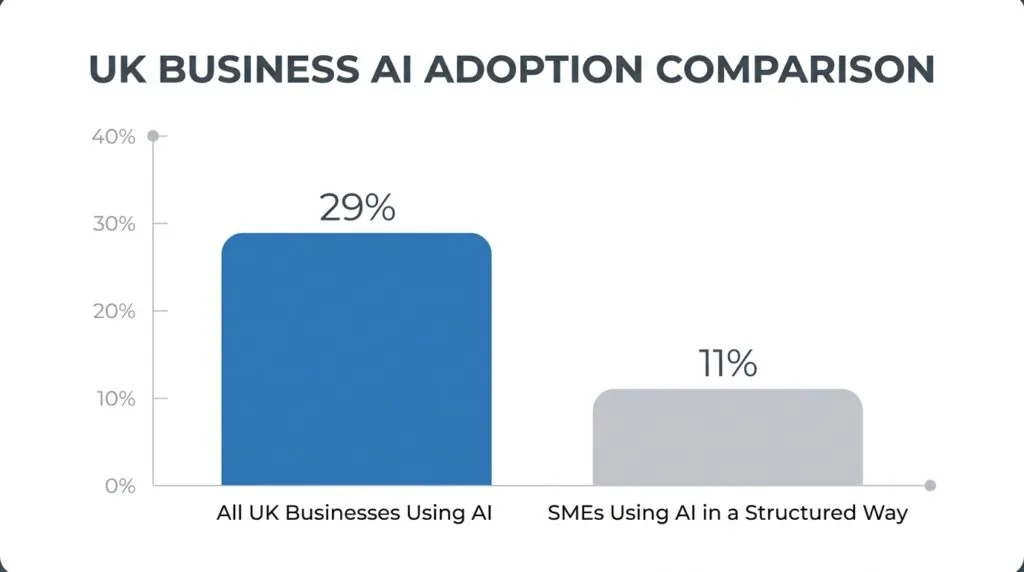
Roughly 29% of UK businesses reported using at least one AI technology as of June 2026, according to the Office for National Statistics’ Business Insights and Conditions Survey, up sharply from around 9% when the ONS first asked the question in September 2023. Adoption is heavily skewed by size: larger firms with 250+ staff report figures closer to half, while research from the British Chambers of Commerce suggests only around 11% of SMEs use AI in a structured way to automate operations, meaning most small businesses are still at the early, experimental stage.
The takeaway: you’re not late. Most of your competitors are still using AI casually, if at all. A small business that adopts a couple of tools properly, with basic compliance in place, is already ahead of the pack.
4 Key Areas Where AI Drives SME Growth and Productivity
AI helps small businesses grow in four practical areas: customer support, marketing, admin and operations, and financial tracking.
1. Customer Support and Engagement (24/7 Coverage)
AI chatbots answer common customer questions outside your opening hours, freeing you or your team from repetitive queries about opening times, returns, or pricing. Tools like Tidio let you set up a chatbot in an afternoon, trained on your own FAQs. If you’re weighing up options for your website, it’s worth comparing dedicated AI chatbot platforms built for UK customer service teams rather than settling for whatever’s bundled with your website builder.
2. Marketing, Copywriting, and Local SEO Automation
Generative AI drastically cuts the time it takes to draft social posts, product descriptions, and email newsletters. It’s genuinely useful for a first draft and for brainstorming angles you wouldn’t have thought of. It’s less reliable for anything requiring precise facts, pricing, or legal claims, which you should always check yourself.
If content output is a bottleneck, it’s worth reviewing dedicated AI writing tools built specifically for business use, and separately, AI social media management tools that can schedule and adapt posts across platforms. Canva’s AI features are also worth a look if design, not just copy, is where you’re losing time — see our breakdown of Canva’s AI tools for UK small businesses.
3. Admin, Operations, and Managing “Meeting Overload”
This is where AI often delivers the fastest, least visible ROI. AI meeting transcription tools like Otter.ai turn a 45-minute call into a written summary with action points in seconds, cutting down on follow-up emails.
Combine that with task management platforms such as Asana and Trello, decent scheduling software to stop the back-and-forth of booking calls, and simple workflow automation to automate repetitive tasks with Zapier, and you can reclaim several hours a week without touching anything technical.
4. Financial Tracking, Cash Flow, and Budget Optimisation
AI-powered features in accounting software now flag unusual spending, forecast cash flow gaps, and reconcile transactions automatically. Tools like LiveFlow build on top of spreadsheets you already use, rather than replacing your accounting system entirely, which makes them a lower-risk starting point than switching platforms outright.
Practical AI Tools for UK Small Businesses (Free and Low-Cost Options)
Most SMEs only need two or three AI tools to start. The table below covers the categories that matter most.
| Tool | Best For | Free Tier? | Typical UK Cost (Monthly) |
|---|---|---|---|
| ChatGPT (OpenAI) | General writing, brainstorming, research | Yes, limited | £0–£20 per user |
| Microsoft Copilot | Word, Excel, Outlook integration | No | See our Microsoft 365 Copilot UK pricing guide |
| Google Gemini | Google Workspace integration | Yes, limited | £0–£20 per user |
| Tidio | Website chatbots, customer support | Yes, limited | £0–£30 |
| Canva Magic Studio | Design, image editing, ad creative | Yes, limited | £0–£12 |
| Fireflies.ai / Otter.ai | Meeting transcription and notes | Yes, limited | £0–£18 |
| Motion | AI-scheduled task planning | No | £19–£34 |
Start with one tool that solves your single biggest time drain, not three tools solving problems you don’t have yet.
The UK Legal and Regulatory Guardrails: Keeping Your Business Safe
AI use doesn’t sit outside UK data protection law. If a tool processes personal data (customer names, emails, support tickets), UK GDPR applies in full.
Data Protection: Compliance with UK GDPR and the ICO
When deploying generative AI tools, compliance with UK GDPR and ICO guidelines is essential to protect customer and business data. In practice, this means three things:
- Know what data goes where. Keep a simple record of which AI tools process personal data and why.
- Have a lawful basis. Most small businesses rely on “legitimate interests” for internal AI use, which should be documented in a short Legitimate Interests Assessment.
- Be transparent with customers. If AI meaningfully affects how you handle a customer (an AI chatbot answering queries, AI-assisted pricing), say so in your privacy notice.
Free consumer versions of tools like ChatGPT carry more compliance risk than paid business or enterprise tiers, which typically include stronger data protection terms. If you’re regularly handling sensitive customer data, it’s worth reviewing dedicated GDPR compliance tools built for smaller teams, alongside basics like two-factor authentication on any account connected to customer data.
The Growing Risk of “Shadow AI” in Small Teams
Shadow AI is the risk of employees pasting confidential company, financial, or customer data into public AI tools that weren’t approved or reviewed by the business. It’s one of the most common and least discussed AI risks for small teams, because it usually happens with good intentions: a staff member pastes a customer complaint into ChatGPT to draft a reply, not realising that data may be stored or used to train the model.
The fix isn’t banning AI. It’s a short written policy: which tools are approved, what data can and can’t be pasted in, and who to ask if unsure. This sits alongside your wider cybersecurity practices rather than replacing them.
Managing Hallucinations and Quality Control
AI tools sometimes generate confident, plausible-sounding answers that are simply wrong, known as “hallucinations.” This is a genuine risk for anything customer-facing or factual: pricing, legal claims, regulatory guidance, technical specifications.
Treat AI output as a draft, not a finished product. Anything published externally or sent to a customer should be checked by a person before it goes out, especially numbers, dates, and claims about your products.
What’s Changing: The ICO’s New AI Code of Practice
UK data protection rules around AI are actively being updated, and it’s worth knowing what’s coming. The Data (Use and Access) Act 2025 reformed the rules on automated decision-making, with key provisions in force since December 2025. It shifts the law from a near-blanket restriction on automated decisions to a system where individuals can request human review of decisions made about them by AI, alongside stronger transparency duties for the business.
The ICO is also finalising a new statutory Code of Practice on AI and automated decision-making, with a public consultation that closed in May 2026 and final guidance expected later in 2026. Separately, the penalty cap under PECR (the rules governing electronic marketing and cookies) is expected to rise substantially to bring it in line with UK GDPR’s maximum fines. None of this is finalised in full yet, so if AI is central to how you handle customer decisions (pricing, credit, recruitment shortlisting), it’s worth checking ico.org.uk directly before you lock in a process, rather than relying on guidance that may be a few months out of date.
Common Mistakes UK Small Businesses Make With AI
A few patterns come up again and again with SMEs adopting AI for the first time:
- Subscribing to too many tools at once. Most businesses only need one or two AI tools to solve their actual bottleneck. Extra subscriptions add cost without adding time savings.
- Using consumer-tier AI for business data. Free, public versions of AI chat tools generally offer weaker data protection than paid business tiers.
- No written AI policy. Without one, staff make their own individual decisions about what’s safe to paste into an AI tool, which is how Shadow AI risk builds up.
- Publishing AI output unchecked. Hallucinated facts, wrong prices, or invented statistics in a blog post or customer email damage trust fast.
- Ignoring the funding available. Many SMEs pay full price for tools or training when grants, loans, or free programmes could have covered part of the cost.
UK Grants, Funding, and Training for AI Adoption
Innovate UK Grants and BridgeAI Support
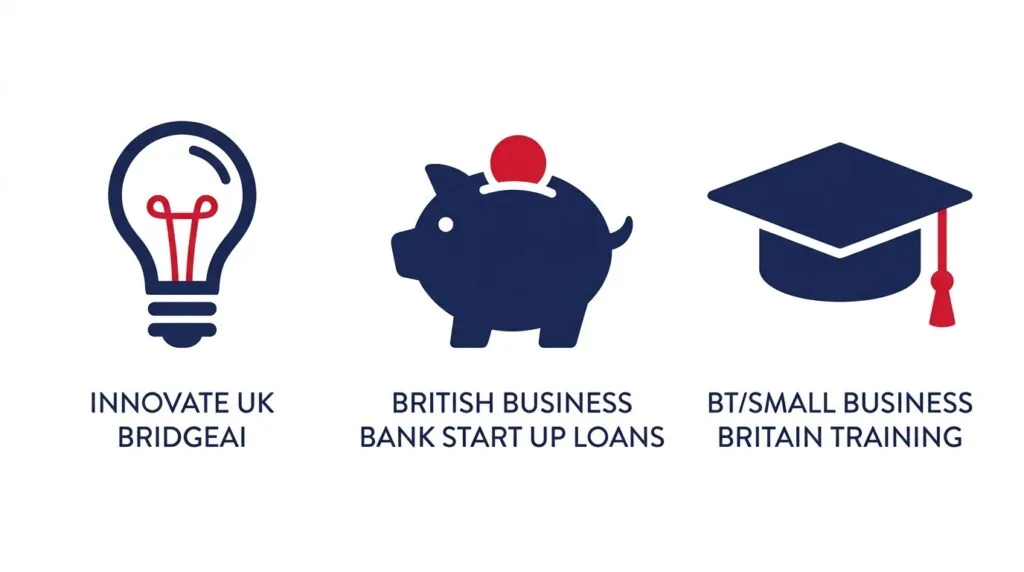
Innovate UK, part of UK Research and Innovation, runs several funding routes relevant to AI. Its BridgeAI programme is the most relevant for typical small businesses: it offers funding, expert support, and training specifically to help SMEs in sectors like construction, agriculture, creative industries, and transport and logistics adopt AI responsibly, rather than build new AI products from scratch.
Innovate UK’s larger competitive grants, like its Frontier AI feasibility funding, are aimed more at businesses developing or commercialising new AI technology, with project costs typically running into six figures. That’s usually a poor fit if you’re simply trying to adopt existing AI tools, so it’s worth checking eligibility carefully before applying, or looking at the wider small business grants available in the UK first.
British Business Bank Start Up Loans for Tech Integration
The government-backed Start Up Loan, delivered by the British Business Bank, is a realistic option for funding AI tool subscriptions, training, or a small automation project. As of April 2026, it offers:
- Unsecured personal loans of £500–£25,000 per founder, up to £100,000 per business
- A fixed interest rate of 7.5% per year, the same for every applicant
- No security or personal guarantee required, though you remain personally liable for repayment
- 12 months of free business mentoring included
- Eligibility recently extended to businesses trading up to five years, up from the previous three-year limit
It’s worth understanding how startup business loans work in the UK more broadly before applying, since the Start Up Loan is one option among several government-backed schemes.
BT and Small Business Britain Training Programmes
Small Business Britain, supported by BT Group, runs a free six-week AI for Small Business programme delivered entirely online, with live weekly sessions, recordings, and access to an AI expert community. It’s aimed squarely at owners with little to no AI experience.
Separately, the government’s AI Skills Boost programme, run by the Department for Science, Innovation and Technology with Skills England, offers free, government-benchmarked AI training aimed at building basic AI confidence across the workforce, part of a wider goal to upskill 10 million UK adults by 2030. For teams looking to formalise AI skills training, it’s also worth checking whether apprenticeship funding could support a more structured training plan.
Summary: Your Step-by-Step AI Implementation Checklist
- Identify your single biggest time drain (support queries, content writing, admin, cash flow tracking).
- Choose one AI tool to solve that specific problem, starting with a free or low-cost tier.
- Check whether the tool’s business or enterprise tier is needed for GDPR-compliant data handling.
- Write a one-page AI policy covering what data staff can and can’t paste into AI tools.
- Review Innovate UK’s BridgeAI programme, a Start Up Loan, or the Small Business Britain/BT course to offset cost or build skills.
- Set a rule that AI output is checked by a person before anything reaches a customer.
- Revisit your approach every few months, since both the tools and the UK regulatory guidance are changing quickly through 2026 and 2027.
Frequently Asked Questions
Is AI safe for my small business under GDPR?
Yes, provided personal data has a lawful basis for processing, you know which tools handle that data, and you’re transparent with customers about meaningful AI use. Free consumer AI tools generally carry more compliance risk than paid business tiers.
Are there government grants for AI in the UK?
Yes. Innovate UK’s BridgeAI programme supports AI adoption in priority sectors, and the British Business Bank’s Start Up Loan can fund tools or training for businesses trading up to five years, at a fixed 7.5% interest rate as of April 2026.
How do I prevent staff using unapproved AI tools?
Write a short, clear policy stating which AI tools are approved and what data can’t be pasted into them. Most “Shadow AI” incidents happen because staff aren’t told where the line is, not because they’re acting carelessly.
What are the best free AI tools for sole traders?
ChatGPT, Google Gemini, Canva Magic Studio, and Tidio all offer usable free tiers. Start with one that solves your most time-consuming task rather than adopting several at once.