


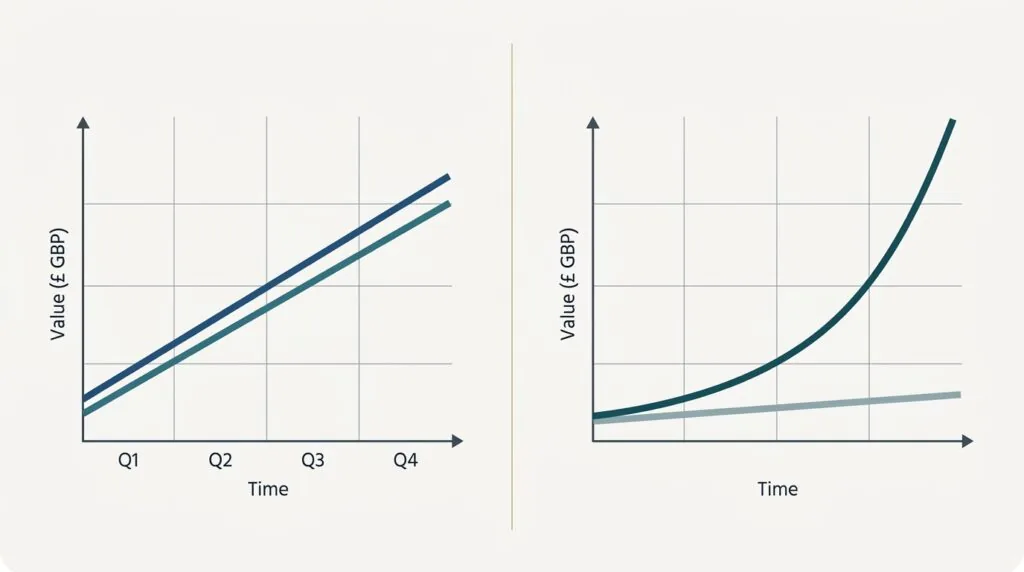
Scaling means increasing revenue faster than you increase costs. Growing means adding revenue and resources at roughly the same rate. That distinction decides whether expansion makes you more profitable or just busier and more exposed.
Most UK small businesses don’t fail because demand dries up. They fail because they scale before their finances, systems, or people can support the extra volume. A business that wins three big new clients in a month can be in worse shape than one that turns clients away — because payroll, stock and supplier invoices land before customer payments do. That gap is where growth becomes dangerous.
This guide sets out a UK-specific process for scaling: how to check you’re actually ready, how to fund the jump without giving away more equity than you need to, how to remove yourself as the bottleneck, and which government schemes are genuinely worth your time in 2026.
The 4 Indicators Your UK SME Is Ready to Scale
You’re ready to scale when you can answer yes to all four of these, not just one or two.
- Validated demand. You have repeat customers or recurring contracts, not a single lucky spike in orders.
- Financial runway. You hold enough cash, or an agreed funding line, to cover at least three to six months of increased costs before extra revenue lands in your bank account.
- Documented processes. Your core delivery work is written down somewhere other than your own head, so someone else could follow it.
- The founder bottleneck test. If you took two weeks off with no phone, would the business keep serving customers at the same standard? If the honest answer is no, you’re not ready to scale — you’re ready to fix that first.
Skipping straight to hiring or marketing spend without these in place is the most common route into what founders call “the growth trap”: more revenue on paper, less cash in the bank, and a business that’s harder to run than it was six months earlier.
Step 1 – Master the Financials & Secure Expansion Capital
Scaling is a cash flow problem before it’s a strategy problem. Wages, stock and rent are usually paid weeks before customers settle their invoices, so every extra pound of revenue you chase first costs you cash you don’t yet have.
Build a 13-week rolling cash flow forecast before you commit to any expansion spend. This is more useful than an annual budget because it shows the exact weeks where the gap between paying suppliers and staff and receiving customer payment is at its widest — that gap is what sinks fast-growing SMEs, not lack of profitability on paper.
As a working benchmark, aim to hold cash runway equal to at least three months of your increased cost base, not your current one, before you scale up headcount or stock. If your gross margin sits below 20%, be especially cautious: thin margins leave almost no buffer to absorb a late-paying customer or an unexpected cost spike.
UK Tax Milestones You’ll Cross While Scaling
| Milestone | Threshold (2026/27) | What Changes |
|---|---|---|
| VAT registration | £90,000 taxable turnover (rolling 12 months) | Must register with HMRC within 30 days of crossing; charge and reclaim VAT from then on |
| VAT deregistration | £88,000 | Can apply to deregister if turnover falls and stays below this |
| Corporation Tax small profits rate | Profits up to £50,000 | Taxed at 19% |
| Corporation Tax main rate | Profits above £250,000 | Taxed at 25%, with marginal relief tapering the rate between £50,000 and £250,000 |
Crossing the VAT threshold is often the moment scaling starts to bite on cash flow, because you either absorb the 20% VAT yourself or pass a price rise to customers mid-contract. Model this before you approach the threshold, not after HMRC writes to you. For a full breakdown of the rolling 12-month rule, see our guide to the VAT registration threshold in the UK, and check current Corporation Tax rates and bands before you forecast next year’s tax bill.
Funding the Scale-Up: Your Realistic Options
Not every scale-up needs outside investment, but most need some form of capital to bridge the gap between spending on growth and collecting the returns. UK founders generally have four routes:
- Non-dilutive grants: Innovate UK Smart Grants fund R&D-led projects and don’t require giving up equity. If your growth involves genuine product or process innovation, this is worth checking before anything else. If you’re already investing in development work, look into R&D tax relief — many scaling SMEs are eligible and don’t claim it.
- Debt finance: British Business Bank-backed loans and asset finance suit businesses with predictable revenue that can service monthly repayments. Compare this against a startup or growth business loan in the UK to see typical terms.
- Equity investment: Angel networks and VCs suit high-growth, high-margin businesses willing to trade ownership for speed. If you go this route, get a shareholder agreement drafted properly before money changes hands, and review the SEIS scheme if you’re raising from individual investors early.
- Revenue-based financing: A newer option for digital and e-commerce SMEs with predictable online revenue, where repayments flex with monthly sales rather than being fixed.
Step 2 – Eliminate Founder Dependency Through Systemisation
If every decision still routes through you, scaling multiplies your workload instead of your output. This is the single most common reason UK founders burn out during expansion — revenue goes up, but so does the number of things only they can do.
Start by documenting your three or four core delivery processes as simple Standard Operating Procedures (SOPs): step-by-step instructions detailed enough that a competent new hire could follow them without asking you. Don’t aim for perfection on the first draft — a working SOP that gets used beats a polished one that sits in a drawer.
Then automate the repetitive layer around those processes. A basic but effective stack for a scaling SME usually covers:
- Accounting and cash flow: Xero or QuickBooks, so financial data is live rather than reconstructed monthly
- Customer relationships: a CRM such as HubSpot or Salesforce, so client history doesn’t live in one person’s inbox
- Task and project tracking: Monday.com or a similar tool, so work is visible without a daily check-in meeting
- Workflow automation: Zapier or equivalent, to connect these tools so data doesn’t need re-entering by hand
The test of good systemisation isn’t how much software you’ve bought — it’s whether the business runs to the same standard when you’re not in the room.

Step 3 – Build a Scalable Hiring & Leadership Structure
Hiring too early drains cash; hiring too late means you stay the bottleneck. The middle path is to identify the one or two roles that would remove the most pressure from you personally, and fill those first — usually an operations manager or a senior salesperson, not a full leadership team.
Before your first management hire, be clear on the difference between hiring in-house and outsourcing. A fractional finance director or outsourced HR provider can give you senior-level judgement without a full salary commitment, which matters when cash flow is still tight. Once revenue is more predictable, bringing that function in-house usually pays for itself.
Whichever route you choose, UK employment law applies from day one. Key compliance points scaling founders often miss:
- Auto-enrolment pension duties apply to almost every employee, not just full-time staff, once they meet the age and earnings criteria
- National Minimum Wage compliance needs checking against actual hours worked, not just the headline rate — see our guide to current National Minimum Wage rates
- Enterprise Management Incentives (EMI) share options let you offer equity-based incentives to key hires without the tax exposure of an unapproved scheme — useful when you can’t yet match corporate salaries
- If you’re hiring your very first employee, our guide on how to hire your first employee in the UK covers the registration steps HMRC requires before day one
If training a growing team is part of your plan, check whether the Apprenticeship Levy applies to your payroll, and look at current apprenticeship funding for 2026 — it’s one of the more underused ways to build a team without carrying the full cost of training.
Step 4 – Focus Marketing & Sales on High-Margin Channels
Scaling revenue on unprofitable channels just scales your losses. Before increasing marketing spend, check your ratio of customer lifetime value to customer acquisition cost (LTV:CAC). A minimum benchmark to work toward is 3:1 — meaning each customer is worth at least three times what it costs you to acquire them. Below that, growth is likely to strain cash flow rather than build a sustainable business.
Channel discipline matters more than channel diversity at this stage. It’s tempting to add a new marketing channel every time growth stalls, but each new channel adds cost, complexity and a learning curve before it pays back. Prove one channel works reliably before adding the next.
When you’re ready to expand geographically, decide early whether that means:
- Regional expansion within the UK — usually lower risk, since your existing tax, legal and compliance setup carries over
- International exporting — higher potential, but it brings new VAT rules, customs considerations and currency exposure that need separate planning; our guide to UK small business exporting covers the practical starting points
Leveraging UK Government Grants & Regional Growth Hubs
The UK has a genuinely useful, if underused, network of scale-up support — but it changes over time, so it’s worth checking eligibility directly rather than relying on outdated blog posts. As of 2026, the schemes most relevant to an established SME looking to scale are:
- Help to Grow: Management — a part-time, subsidised leadership and management programme run through UK business schools, aimed specifically at owners and senior managers of established SMEs rather than early-stage startups
- Innovate UK Smart Grants — competitive, non-dilutive funding for innovation-led scaling projects
- Local Enterprise Partnerships (LEPs) and regional Growth Hubs — free or low-cost advisory support, often with access to local grant pots that don’t get much national publicity
- Sector-specific accelerators — worth exploring if your growth plan sits in a priority sector such as manufacturing, life sciences or clean energy; see our list of small business accelerators in the UK and startup incubator programmes
Note that the previous Help to Grow: Digital voucher scheme closed to new applicants some years ago — if you see it referenced as current, that source is out of date. Help to Grow: Management remains active and is the programme worth applying to.
Watch this short explainer on the current scheme:
Help to Grow Scheme UK Explanation — this video gives a quick overview of the government’s structured management training and support for scaling SMEs.
Frequently Asked Questions
How do I scale a small business without running out of cash?
Build a 13-week rolling cash flow forecast before committing to expansion spend, hold at least three months of runway against your increased cost base, and secure funding (grant, loan or investment) before you need it rather than after a cash gap appears.
What government support is available for scaling UK SMEs?
The main options in 2026 are Help to Grow: Management for leadership training, Innovate UK Smart Grants for innovation-led projects, and free advisory support through regional Growth Hubs and Local Enterprise Partnerships.
When should a UK founder hire their first management layer?
When the founder bottleneck test fails — if the business couldn’t maintain its current standard of service without you personally for two weeks, it’s time to hire or outsource a management role, usually operations or sales first.
What is the difference between growing and scaling a business?
Growing means revenue and costs increase at roughly the same rate. Scaling means revenue increases faster than costs, so profitability improves as the business gets bigger.