


A UK company director holds two separate sets of obligations. The first is a group of seven statutory duties owed personally to the company, set out in the Companies Act 2006. The second is a list of administrative duties owed to Companies House and HMRC: filing accounts, paying tax, and keeping records straight.
What Is a Company Director? (Legal Definition)
A company director is a person legally responsible for managing a company’s affairs on behalf of its shareholders. You don’t have to hold the job title “director” to count as one in law. You’re treated as a director if you’re formally appointed and registered at Companies House, or if you act like one without ever being formally appointed.
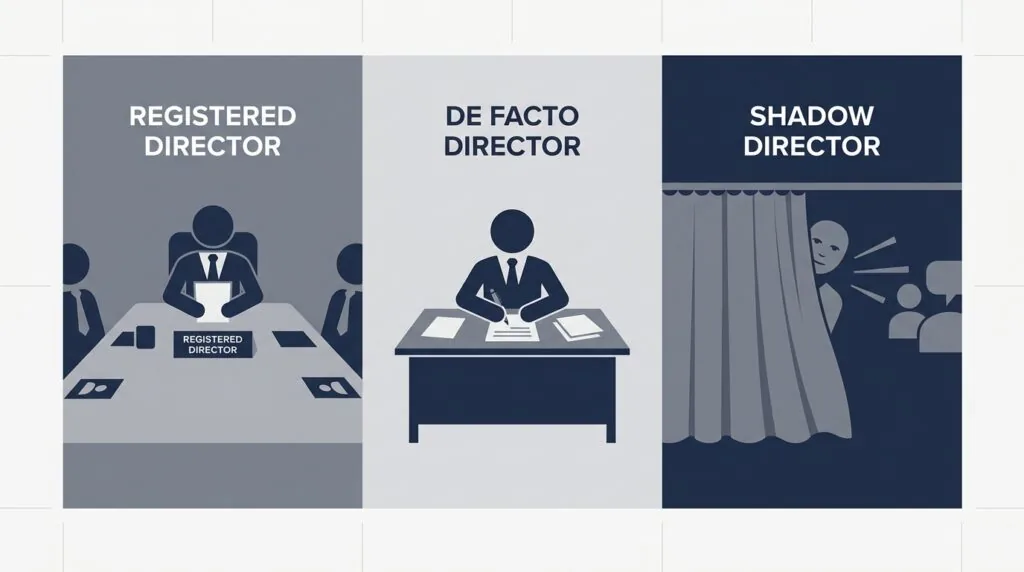
De Jure, De Facto, and Shadow Directors: Who Does the Law Apply To?
The law recognises three categories, and only the first is optional to avoid by staying off the register.
- De jure director — officially appointed and listed at Companies House. This is the standard, registered position.
- De facto director — someone who behaves as a director (signing contracts, hiring staff, opening bank accounts, making board-level calls) without ever being formally registered.
- Shadow director — someone whose instructions the board is accustomed to acting on, even though they hold no title at all. This often applies to a controlling investor or a parent company.
This is where many founders get caught out. A common assumption is that staying off the Companies House register avoids director liability. It doesn’t. UK courts have repeatedly held that de facto and shadow directors owe the same statutory duties, and face the same personal liability, as someone who was properly appointed. If your co-founder, spouse, or business partner is making director-level decisions without being registered, the law is very likely already treating them as one — with all the exposure that comes with it.
The 7 Statutory Duties of a UK Company Director (Companies Act 2006)
Under the Companies Act 2006, every UK company director owes seven general statutory duties. These govern how a director uses their powers, exercises judgement, and manages personal interests against the company’s interests.
1. Act within powers (Section 171)
A director must act in accordance with the company’s constitution — primarily its articles of association — and only use their powers for the purposes they were given. Using a power for an unintended purpose, even with good intentions, can breach this duty.
2. Promote the success of the company (Section 172)
A director must act in good faith to benefit the company’s members as a whole, weighing up the long-term consequences of decisions, the interests of employees, relationships with suppliers and customers, the impact on the community and environment, and the company’s reputation.
Most guides stop there. The practical question directors actually need answered is how to prove they considered these factors if a decision is ever challenged. The answer is documentation. For any significant decision — a redundancy round, a major supplier contract, taking on debt, a change in strategy — the board minutes should record which Section 172 factors were discussed and how they influenced the outcome. A short paragraph noting “the board considered the impact on employees and long-term customer relationships before approving X” creates a genuine paper trail. Without it, a director’s later claim that they weighed these factors is just an assertion.
3. Exercise independent judgment (Section 173)
A director can’t simply defer to a majority shareholder or parent company without applying their own judgement, unless the constitution or a shareholders’ agreement specifically permits it. Rubber-stamping instructions from above doesn’t discharge this duty.
4. Exercise reasonable care, skill, and diligence (Section 174)
This duty is tested two ways. The objective test asks what a reasonably diligent person with the general knowledge, skill, and experience expected of someone in that role would have done. The subjective test asks what a director with their own particular knowledge and skill should have done — so a director who is also a qualified accountant is held to a higher standard on financial matters than a director without that background.
5. Avoid conflicts of interest (Section 175)
A director must avoid situations where their personal interests conflict, or could possibly conflict, with the company’s interests — running a competing business, or exploiting a business opportunity that should belong to the company, for example. The board can authorise a specific conflict, but it must be done properly and recorded.
6. Do not accept benefits from third parties (Section 176)
Gifts, hospitality, or payments from suppliers or customers that could reasonably be seen to influence a director’s conduct are prohibited, unless the risk of a conflict is genuinely negligible.
7. Declare interest in proposed transactions or arrangements (Section 177)
Before the company enters into a transaction or arrangement in which a director has any interest — direct or indirect — that interest must be formally declared to the rest of the board, including its nature and extent.
Administrative & Operational Responsibilities
Alongside statutory duties, directors carry ongoing administrative obligations to Companies House and HMRC. These aren’t optional extras — missing them can block filings, trigger penalties, or feed into a disqualification case later.
Companies House Filings (Accounts, Confirmation Statements, PSCs)
Every UK limited company must file a confirmation statement at least once every 12 months, within 14 days of the review period ending, confirming details such as directors, registered office address, and shareholders are up to date. Annual accounts are due at Companies House within nine months of the company’s financial year end for private companies. Companies must also maintain an accurate register of People with Significant Control (PSC) — generally anyone holding more than 25% of shares or voting rights, or with the power to appoint or remove a majority of the board.
Two changes matter for 2026 that most existing guides on this topic haven’t caught up with:
- Mandatory identity verification. Since 18 November 2025, under the Economic Crime and Corporate Transparency Act 2023, all directors and PSCs must verify their identity with Companies House and hold a personal code, done free via GOV.UK One Login or through an Authorised Corporate Service Provider. New directors must verify before appointment. Existing directors must verify before their company’s next confirmation statement is filed, with a hard backstop of 18 November 2026. A company cannot file a confirmation statement without it, and acting as an unverified director is a criminal offence.
- Software-only accounts filing from 1 April 2027. Companies House is closing its free web and paper filing routes for accounts. From that date, all companies — including dormant ones — must file using compliant commercial software, and abridged or filleted accounts formats will be scrapped. It’s worth sourcing suitable software well before the deadline rather than scrambling in early 2027.
HM Revenue and Customs (HMRC) Tax Compliance
A company must register for Corporation Tax within three months of starting to trade, and file a Company Tax Return within 12 months of the end of its accounting period, with tax itself due nine months and one day after the period ends. If the company employs staff — including a director who takes a salary — it needs to run PAYE payroll. If turnover crosses the VAT registration threshold, VAT registration becomes compulsory. Directors who take income from the business also need to understand how salary and dividends interact for personal tax.
Record Keeping and Board Minutes
Directors are responsible for keeping accurate accounting records and statutory registers, generally for at least six years in line with HMRC’s compliance window. Board minutes matter more than most directors realise — not just as a formality, but as the evidence trail for Section 172 decisions and conflict-of-interest declarations discussed above. Many smaller companies are also adjusting to digital record-keeping requirements under Making Tax Digital as HMRC continues rolling this out.
What Happens if a Director Breaches Their Duties?
Breaching a statutory duty can expose a director personally, separately from the protection that limited liability normally provides to the company itself.
Personal Liability and Lifting the Corporate Veil
Limited liability generally protects a director’s personal assets from the company’s debts. Courts can set that protection aside — “lifting the corporate veil” — in cases involving fraud, wrongful or fraudulent trading, unlawful dividend payments, or a breach of duty that caused the company measurable loss. Shareholders can also bring a derivative claim, suing on the company’s behalf against a director whose breach damaged it.
Director Disqualification and Criminal Sanctions
Under the Company Directors Disqualification Act 1986, the Insolvency Service can apply to disqualify a director for unfit conduct for between 2 and 15 years, barring them from managing any UK company during that time. Certain conduct — fraudulent trading, false accounting, persistent filing failures — also carries criminal sanctions, including fines and imprisonment, separate from any disqualification.
The Insolvency Shift: When Duties Change to Creditors
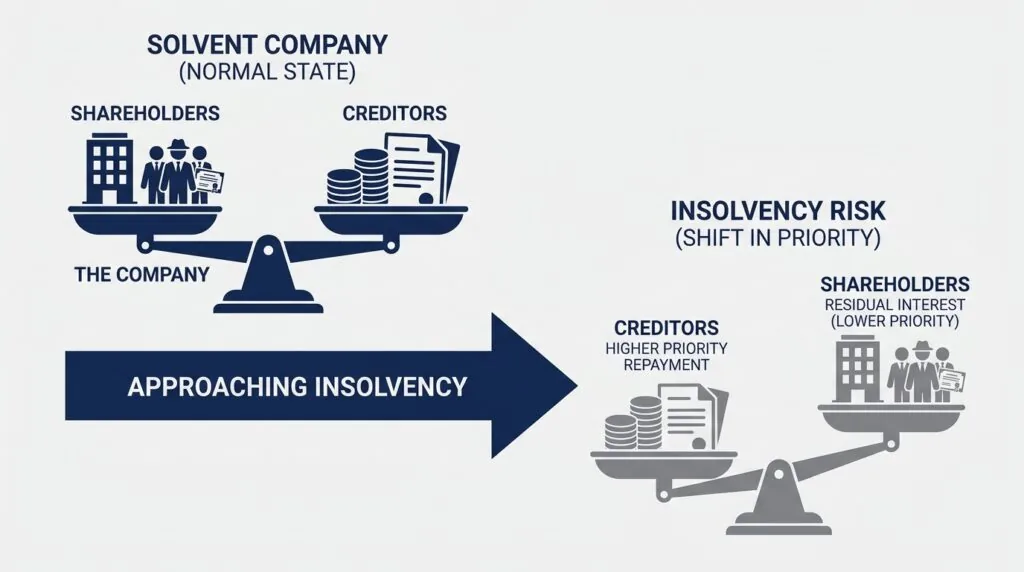
This is one of the most consequential rules in UK company law, and it’s frequently glossed over. When a company becomes insolvent, or a director knows or ought to know insolvency is likely, the Section 172 duty to promote the success of the company for shareholders shifts. The director’s primary consideration becomes the interests of the company’s creditors, not its shareholders.
Two offences under the Insolvency Act 1986 sit behind this shift:
- Wrongful trading — continuing to trade after a director knew, or ought to have concluded, that there was no reasonable prospect of avoiding insolvent liquidation, without taking every step to minimise loss to creditors. A director found liable can be ordered to personally contribute to the company’s assets.
- Fraudulent trading — carrying on business with intent to defraud creditors. This is both a civil and criminal offence, and considerably more serious.
In practice, this means a director who senses the company is heading toward insolvency needs to act early: take advice from a licensed insolvency practitioner, stop taking on new credit the company likely can’t repay, and keep board minutes recording the financial position and decisions made in response. Waiting until formal insolvency to start documenting this is usually too late.
Quick Reference: Directors vs. Shareholders vs. Employees
| Director | Shareholder | Employee | |
|---|---|---|---|
| Legal role | Manages the company day to day | Owns shares in the company | Works under an employment contract |
| Decision power | Makes operational and strategic decisions | Votes on major constitutional matters | Follows instructions within their role |
| Duties owed | Owes statutory duties to the company | Owes no statutory duties to the company | Owes duties under their employment contract |
| Liability | Can face personal liability for breach of duty | Liability generally limited to the value of their shares | Generally no personal liability for company debts |
| Pay | Salary, dividends, or both, if also a shareholder | Dividends, if the company pays them | Salary or wages |
For companies with multiple shareholders, it’s worth reading how these roles interact with the terms set out in a shareholder agreement, which often defines director appointment rights and decision thresholds.
Summary Compliance Checklist for UK Directors
Ongoing
- Act within the company’s articles of association before making major decisions.
- Declare any personal or financial conflict of interest before the board acts on it.
- Minute significant decisions, including which Section 172 factors were considered.
Monthly / Quarterly
- Review management accounts and cash flow position.
- Run payroll and PAYE if the company employs staff.
- Check VAT returns are filed on time, if registered.
Annually
- File the confirmation statement within 14 days of the review period ending.
- File annual accounts within nine months of the financial year end.
- File the Company Tax Return within 12 months, and pay Corporation Tax within nine months and one day of the accounting period end.
- Confirm identity verification is complete for all directors and PSCs, and renew as required.
- Review the PSC register for accuracy.
Frequently Asked Questions
What are the 7 duties of a company director?
Under the Companies Act 2006, they are: act within powers, promote the success of the company, exercise independent judgment, exercise reasonable care, skill and diligence, avoid conflicts of interest, not accept benefits from third parties, and declare interest in proposed transactions.
Can a director be personally liable for company debt?
Generally no, because of limited liability. But a director can become personally liable through wrongful or fraudulent trading, personal guarantees, unlawful dividends, or a breach of statutory duty that causes the company loss.
Who regulates company directors in the UK?
Companies House administers the statutory register and filing obligations, HMRC oversees tax compliance, and the Insolvency Service (part of the Department for Business and Trade) investigates and pursues director disqualification.
What are the filing requirements for a UK limited company?
An annual confirmation statement, annual accounts, a Company Tax Return, and — since November 2025 — identity verification for all directors and PSCs, alongside PAYE and VAT filings where applicable.