

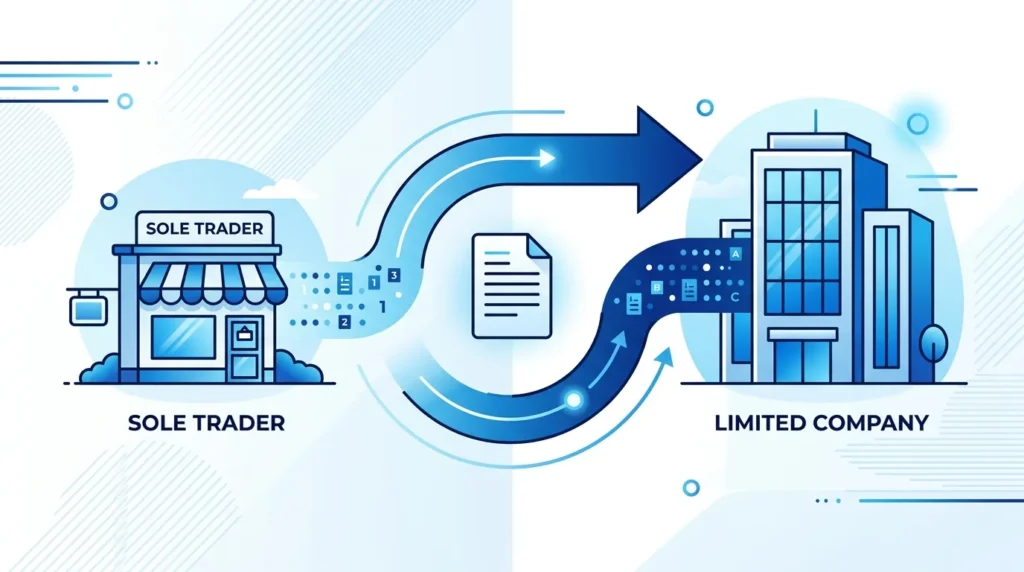
Growing past sole trader status is a good problem to have. But becoming a limited company involves more than filling in one form. You need to register a new legal entity, close your old tax affairs correctly, and move your money, contracts, and assets across without leaving gaps that HMRC or a supplier can catch you out on later.
To change from a sole trader to a limited company in the UK, you must:
- Choose and register a unique company name
- Incorporate with Companies House (Form IN01)
- Tell HMRC you’ve stopped trading as a sole trader
- Open a business bank account in the company’s name
- Transfer your VAT registration, ideally using Form VAT 68
- Reassign contracts, leases, IP, and other business assets
The rest of this guide covers each step in order, plus the tax questions that trip people up most: what happens to goodwill, whether you owe Capital Gains Tax, and how Section 162 relief can defer that bill.
Sole Trader vs Limited Company: Why Make the Switch?
The core difference is legal separation. As a sole trader, you and your business are the same legal person — you’re personally liable for every debt and claim. A limited company is a separate legal entity. It owns its own assets and is liable for its own debts, so your personal exposure is generally limited to what you’ve invested in shares.
| Sole Trader | Limited Company | |
|---|---|---|
| Liability | Unlimited — personal assets at risk | Limited to share capital (in most cases) |
| Tax | Income Tax + Class 2/4 NICs on all profit | Corporation Tax on profit, then tax on what you draw out |
| Admin | Self Assessment return only | Annual accounts, confirmation statement, CT600, payroll if applicable |
| Public disclosure | None | Accounts and director details public at Companies House |
| Credibility | Lower with larger clients/lenders | Often seen as more established |
When Is the Right Time to Transition?
There’s no legal profit threshold that forces incorporation — it’s a tax and risk decision. Most advisers point to somewhere around £30,000–£50,000 in annual profit as the point where incorporating starts saving meaningful tax, since a company lets you split income between a modest salary and dividends rather than paying Income Tax and Class 2 and Class 4 National Insurance on the full amount, as sole trader tax rules require.
Below that level, the extra admin often isn’t worth it. Above it, Corporation Tax at 19% on profits up to £50,000, plus dividend tax on withdrawals, typically beats sole trader rates once profits climb past the higher-rate threshold. If liability protection matters more than tax — say you’re taking on bigger contracts — that can justify incorporating even at lower profit levels.

The Step-by-Step Incorporation Checklist
Step 1: Choose and Secure Your Company Name
Your company name must be unique on the Companies House register — not identical or “too similar” to an existing one. It can’t use certain sensitive words without permission, and it can’t infringe someone else’s trade mark even if Companies House allows the registration. Run a quick trade mark search before you commit, especially if you plan to trademark the name yourself later. You can usually keep trading under your existing sole trader business name even after incorporating, as long as the registered company name is available.
Step 2: Register with Companies House (Incorporation)
This is done through Form IN01, either directly on the Companies House website, through accounting software, or via a formation agent. You’ll need a registered office address — this becomes public, so many owners use a registered office address service rather than their home — plus details of directors and shareholders, a Memorandum of Association, and Articles of Association setting out how the company is run.
As of 2026, the standard digital incorporation fee is £100 (same-day filing costs more). Companies House will also ask you to confirm the company’s Person(s) with Significant Control — anyone owning more than 25% of shares or voting rights. For the full mechanics of forming a company from scratch, see our guide to setting up a limited company.
Step 3: Tell HMRC You’re Ceasing Trading as a Sole Trader
Incorporating doesn’t automatically close your sole trader tax record — you must tell HMRC separately that you’ve stopped trading. File a final Self Assessment return covering the period up to your cessation date, and you can stop paying Class 2 NICs from that date. Get the date right: it determines which profits fall under the old rules and which belong to the new company. Our guide to completing a Self Assessment tax return explains the process, and it’s worth checking current penalties for late filing before your deadline.
Step 4: Open a Dedicated Business Bank Account (Non-Negotiable)
This is the step most guides gloss over, and it’s the one that causes the most damage when skipped. Once incorporated, your company is a separate legal person from you. Every payment needs to run through the company’s own account — not your personal or old sole trader account.
If you keep running company money through a personal account, you blur the line between yourself and the business. In a dispute or insolvency, a court can decide you’ve treated company money as your own — part of what’s known as “piercing the corporate veil” — which can strip away the limited liability protection you incorporated to get. It also makes your bookkeeping messier and makes HMRC more likely to query your accounts. Compare business bank accounts built for limited companies, and see our walkthrough on opening a business bank account before your first invoice goes out under the new name.
Step 5: Transfer Your VAT Registration (Form VAT 68 and TOGC)
If you’re VAT-registered as a sole trader, don’t just close the registration and start a new one — that’s the mistake most guides quietly recommend by only saying “re-register for VAT.” Doing that means updating your VAT number with every supplier and customer you have.
Instead, apply to transfer your existing VAT number to the new company using Form VAT 68, submitted alongside a VAT1 application. Both you and a director of the new company need to sign it, and HMRC has to approve the transfer — it isn’t automatic. Where the whole business is transferred as a live, ongoing operation, this usually qualifies as a Transfer of a Going Concern (TOGC), meaning VAT generally doesn’t need to be charged on the assets transferred. Line up your VAT registration paperwork early, since processing can take several weeks, and check the current VAT registration threshold of £90,000 if you weren’t previously registered.
Step 6: Transfer Contracts, IP, Domains, and Leases
This is where most guides stop short, and it’s usually where the real disruption happens if you skip it. Everything that was legally “yours” as a sole trader needs formal reassignment — it doesn’t move automatically just because you’ve incorporated:
- Contracts and supplier agreements — many need the other party’s consent to assign
- Intellectual property — trade marks, patents, and copyright need formal reassignment
- Website domain and hosting — update registrant and billing details
- Software licences and subscriptions — some aren’t transferable and need re-purchasing
- Insurance policies — public liability, professional indemnity, and equipment cover all need updating
- Commercial leases — your landlord may need to consent to the tenant change
- Vehicles or equipment on finance — check whether agreements can be novated
- Business credit cards and existing direct debits
Demystifying Tax: Goodwill, Capital Gains, and Section 162 Relief
When you incorporate, you’re effectively selling your existing sole trader business — including its “goodwill” — to your new company. That sale can trigger Capital Gains Tax, which most guides mention only as a vague warning.
Goodwill is the value of your business beyond its physical assets — customer relationships, reputation, and trading history. If your business has meaningful goodwill, it usually needs a professional valuation, since HMRC can challenge an unrealistic figure.
Section 162 Incorporation Relief (under the Taxation of Chargeable Gains Act 1992) stops this from becoming a shock tax bill. If you transfer your entire business — all its assets, not just some — wholly in exchange for shares rather than cash, the gain on goodwill and other assets is automatically deferred instead of taxed immediately. Rather than paying Capital Gains Tax now, the gain reduces the value attributed to your new shares, so tax only falls due when you eventually sell those shares.
Take some cash as part of the deal, or leave assets out, and the relief is restricted proportionally — you may face CGT on that portion at 18% within your basic-rate band, or 24% above it, for 2026/27, after your £3,000 annual exempt amount. Business Asset Disposal Relief, taxed at 18% for 2026/27 up to a £1 million lifetime limit, can sometimes apply instead if you meet its ownership conditions. Because the right structure depends on your goodwill value and how you’re paid, get an accountant to check the numbers before filing. See our guide to Capital Gains Tax on business assets for how gains are calculated more broadly.
Your New Ongoing Compliance Responsibilities
Incorporation changes your annual admin permanently. You’ll now file a confirmation statement at least once a year (£50 for digital filing), confirming your registered details, shareholders, and PSC information. You’ll also file annual accounts with Companies House and a Corporation Tax return (CT600) with HMRC.
Corporation Tax for 2026/27 runs at 19% on profits up to £50,000, 25% above £250,000, and a tapered rate — up to an effective 26.5% — in between. Once you draw dividends rather than sole trader profit, the first £500 is tax-free for 2026/27, then taxed at 10.75%, 35.75%, or 39.35% depending on your total income. Many directors combine a small salary with dividends to manage the overall bill — see our guide on paying yourself as a limited company director, and check the current dividend allowance and dividend tax rates before deciding how much to draw.
Taking a salary means registering for PAYE — our guide to running payroll covers the setup. Incorporating with a co-founder or investor? Put a shareholder agreement in place early, before a disagreement makes it harder to negotiate. Further ahead, Making Tax Digital rules are steadily extending digital record-keeping requirements — our overview of Making Tax Digital for Income Tax explains what’s changing.
FAQs: Common Transition Hurdles Answered
Can I keep my sole trader business name? Usually, yes, as a trading name — but the name registered at Companies House must be unique and can’t clash with an existing company name or protected trade mark.
Do I need to notify my customers and suppliers? Yes. Your existing contracts are legally with you as an individual, not the new company, so you need to formally reassign them or get written consent for the company to take over.
Can I keep using my sole trader bank account? No. The company is a separate legal entity and needs its own account. Mixing funds risks your limited liability protection and creates a bookkeeping headache.
What happens to my business credit score? Your new company starts with no credit history of its own, even if your personal or sole trader credit was strong. Expect to build it up gradually, and don’t be surprised if lenders ask for a personal guarantee early on.
What happens to my sole trader debts? Debts from your sole trader period remain your personal responsibility — they don’t transfer to the company automatically unless you formally arrange for the company to take them on, with the lender’s agreement.
How long does the transition take? Digital incorporation with Companies House can complete within 24 hours. The full transition — VAT transfer, new bank account, contract reassignment, asset transfer — typically takes four to eight weeks to complete properly.
Final Thoughts
Incorporating is a milestone, not just paperwork. Get the sequencing right — company first, then HMRC, then the bank account, then VAT and assets — and you’ll avoid the gaps that cause most disruption. If the tax side feels uncertain, particularly around goodwill and Section 162 relief, a short consultation with an accountant before you file is far cheaper than fixing a mistake afterwards.