

If you run a small business in the UK, you’ve probably heard that AI can save you time and help you grow faster. What’s less clear is where to actually start, which tools are worth paying for, and how to stay on the right side of UK data protection law while you do it.
What does “using AI” actually mean for a small business?
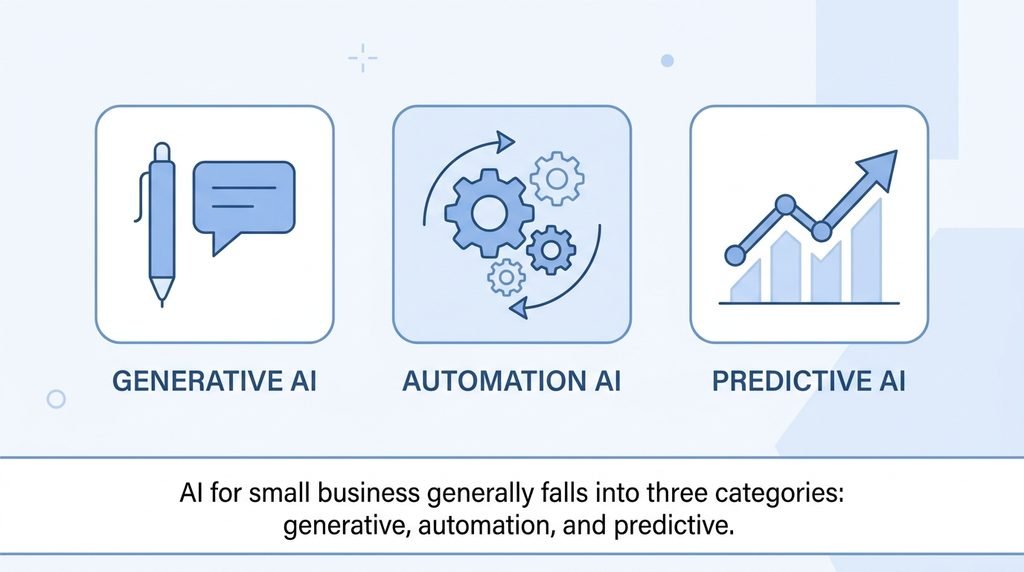
Using AI in a small business means applying software that can write, analyse, predict, or respond on your behalf, so you spend less time on repetitive tasks and more time on decisions that need a human. In practice, this covers three overlapping categories: generative AI (tools like ChatGPT or Microsoft Copilot that create text, images, or code), automation AI (tools that trigger actions based on rules and data, like invoice reminders or lead scoring), and predictive AI (tools that forecast sales, demand, or customer behaviour from historical data).
You don’t need to understand the technology behind any of this to benefit from it. Most tools built for small businesses hide the complexity and give you a simple interface — type a prompt, click a button, or connect an account.
Why UK small businesses are adopting AI now
Interest in AI adoption has grown sharply since ChatGPT’s public launch in November 2022, followed by more capable models through 2023 and beyond. But adoption among small businesses has been uneven. Surveys have found that a notable share of small business owners are hesitant to implement AI despite recognising its potential, while a similar proportion say they want to use it but don’t know where to begin.
That hesitation usually comes down to three things: not knowing which tool solves which problem, worrying about the cost, and being unsure whether using AI with customer data breaks UK GDPR rules. This guide addresses all three.
9 practical ways to use AI to grow your small business
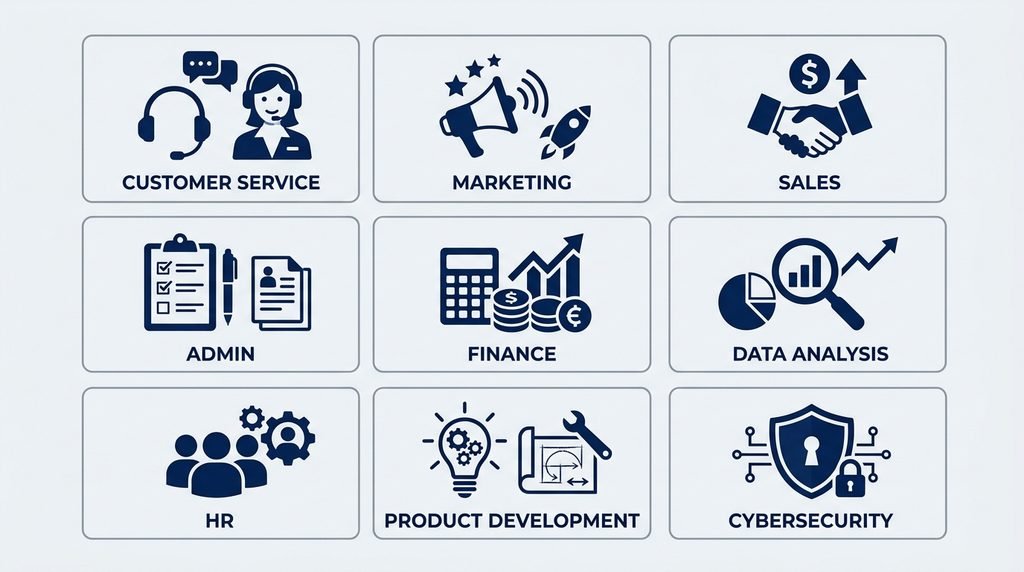
Growth for a small business usually comes down to serving customers faster, spending less on repetitive work, and making better decisions with the data you already have. Here’s where AI delivers on each of those, function by function.
1. Customer service and chatbots
AI chatbots can answer common customer questions around the clock without adding to your headcount. They handle order tracking, opening hours, product details, and FAQs, then hand off anything complicated to a person. If you’re ready to add one to your own site, this guide on adding an AI chatbot to a website walks through the setup.
This matters more than it sounds. A customer who gets an instant, accurate answer at 9pm on a Sunday is far more likely to convert than one who waits until Monday morning.
2. Marketing, content, and SEO
AI can draft blog posts, product descriptions, social captions, and ad copy, cutting the time it takes to produce marketing content. It’s not a replacement for a content strategy or human editing, but it removes the blank-page problem. Tools like ChatGPT and Jasper are widely used for this — see this Jasper AI review for UK small businesses if you’re comparing options, or this broader ChatGPT for business UK guide for practical prompts.
AI also speeds up SEO research — identifying keyword gaps, drafting meta descriptions, and analysing competitor content structure, all of which feed into your organic growth.
3. Sales and lead generation
AI tools can score and prioritise leads based on buying signals, so your sales effort goes toward the prospects most likely to convert. Some platforms also draft personalised outreach messages at scale. For a deeper look at tools built specifically for this, see the best AI tools for sales in UK small business and AI lead generation for UK businesses.
4. Admin, scheduling, and email management
Diary management, meeting transcription, and inbox sorting are all tasks AI now handles well. Tools like Otter.ai transcribe calls and meetings automatically, which is useful if you can’t always have someone taking notes — read more in this guide to using Otter.ai for business meetings in the UK. Scheduling tools use AI to find optimal meeting times across calendars; see the best scheduling software for UK small businesses for a comparison.
5. Finance, invoicing, and bookkeeping
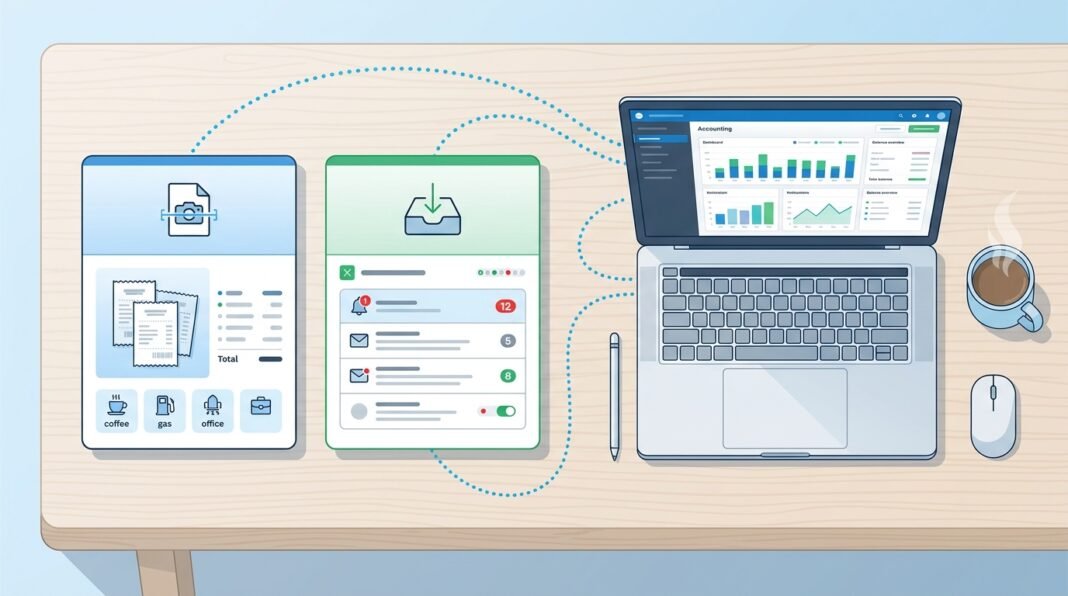
AI-powered accounting tools can generate invoices, chase late payments, and flag anomalies in your spending. If you’re tired of manually raising invoices, this guide on how to automate invoicing for a UK small business covers the options, and this Dext vs Hubdoc comparison is useful if you’re deciding between the two most common receipt-capture tools.
6. Data analysis and forecasting
AI turns raw sales and customer data into dashboards and forecasts you can actually act on. Instead of guessing at next quarter’s demand, predictive models use your historical data to estimate it. This is one of the areas where AI adds the most value with the least effort — most modern accounting and CRM platforms already include some forecasting features built in.
7. HR and recruitment
AI can write job adverts, screen CVs against a role’s requirements, and automate parts of onboarding. It saves hours during hiring season, though UK employers still need to apply human judgement to avoid bias in AI-assisted screening.
8. Product development and customer feedback
AI can process large volumes of reviews, survey responses, and social mentions to surface recurring themes — what customers love, what they’re frustrated by, and what they’re asking for next. That turns scattered feedback into a clear list of priorities for your next product update.
9. Cybersecurity and fraud detection
AI-driven security tools spot unusual account activity, flag suspicious transactions, and monitor for phishing attempts in real time. This matters more as small businesses become more common targets — see this Cyber Essentials certification guide for UK small businesses for a related compliance step worth taking alongside any AI security tool. Basic protection also still matters at the device level; this list of best antivirus software for UK small business is a good starting point, alongside setting up two-factor authentication wherever you can.
Best AI tools for UK small businesses by category
There’s no single “best” AI tool — the right one depends on the task and your budget. This table compares commonly used options by category.
| Category | Tool examples | Free option? | Typical UK pricing (paid) |
|---|---|---|---|
| General assistant / content | ChatGPT, Microsoft Copilot | Yes (limited) | From around £15–£20/month |
| Marketing copy | Jasper, Wordtune | Limited free trial | From around £30–£40/month |
| Meeting transcription | Otter.ai | Yes (limited minutes) | From around £8–£15/month |
| Scheduling | Motion, Akiflow | No | From around £20–£30/month |
| Chatbots | Freshchat, Kustomer | Yes (basic tier) | From around £12–£40/month |
| Invoicing & bookkeeping | Dext, Hubdoc | Limited free trial | From around £15–£25/month |
| Recruitment | Workable, Paradox | No | From around £100+/month |
| Productivity / notes | Notion AI | Add-on to Notion | From around £8–£10/month |
| Grammar & editing | Grammarly | Yes (basic) | From around £10/month |
Pricing changes often and varies by plan tier and user count, so treat these as a starting guide rather than fixed figures. For a fuller breakdown, see the best AI tools for UK small business and this Microsoft 365 Copilot UK pricing guide. If you’re weighing Notion’s AI features specifically, this Notion AI guide for UK small business is worth a read, and this Google Workspace vs Microsoft 365 comparison helps if you haven’t settled on a core productivity platform yet.
How to start using AI in your business
The fastest way to start using AI in a small business is to pick one repetitive task, trial a free tool for two weeks, measure the time saved, then expand from there. Trying to overhaul every part of the business at once is the most common reason AI adoption stalls.
- Pick one task that eats your time. Look for something repetitive and low-risk — drafting social posts, transcribing calls, or sorting your inbox are good starting points.
- Trial a free or low-cost tool for two weeks. Most tools listed above offer a free tier or trial. Use the real thing, not a demo.
- Measure the actual time or cost saved. Be specific. If a chatbot cuts customer response time from four hours to four minutes, write that down.
- Check the data protection basics before scaling up. If the tool touches customer data, confirm it, complying with UK GDPR (see the section below) before rolling it out further.
- Expand to a second use case once the first is working. Add one new function every few weeks rather than adopting five tools simultaneously. This keeps training time low and avoids tool fatigue for you and your team.
This sequencing also fits naturally with a wider growth plan — if you’re using AI as part of a broader push to scale, this guide on how to scale a small business in the UK covers the operational side alongside it.
Benefits of AI for small business growth
The main benefits of AI for small business growth are time savings, lower operating costs, faster customer response times, and better-informed decisions from data you already collect. In more detail:
- Increased efficiency — repetitive tasks like data entry, scheduling, and basic customer queries get handled automatically, freeing up hours each week.
- Lower costs — labour-intensive tasks such as first-line customer support or manual data analysis cost less to run through AI than through additional hires.
- Better customer experience — round-the-clock chatbot support and faster response times tend to improve satisfaction scores.
- Faster, clearer decisions — dashboards and reports that once took hours to build can be generated in minutes, making it easier to spot trends early.
Risks and challenges to consider
AI isn’t risk-free, and a UK small business faces some specific considerations that general “AI benefits” articles tend to skip over.
UK GDPR and data protection compliance
If you use AI tools that process customer or employee personal data, you’re still fully responsible for UK GDPR compliance — the AI provider doesn’t take on that responsibility for you. Before feeding any customer data into an AI tool, check where that data is stored, whether the provider processes it outside the UK or EU, and whether you have a lawful basis for using it that way.
Practical steps include reviewing your ICO registration status and the ICO data protection fee, and working through a proper UK GDPR compliance checklist for small business before rolling any customer-facing AI tool out at scale. It’s also worth understanding how the UK AI Act and related rules apply to your sector, since regulation in this area is evolving quickly.
Cost, complexity, and staff training
Some AI tools need upfront investment — either to buy the software or to train staff on how to use it properly. Complex platforms may need someone with specific knowledge to set up and manage, which can be a real barrier for a business with no dedicated IT resource.
Accuracy and over-reliance
Generative AI tools can produce confident-sounding but incorrect information, a problem often called hallucination. Never publish AI-generated content, financial figures, or legal wording without a human check. This is especially important for anything customer-facing or anything touching contracts, such as website terms and conditions or employment contracts — AI can draft a starting point, but it shouldn’t be the final check.
Job impact and ethical concerns
Automating tasks that used to require a person raises legitimate questions about staffing. Businesses that take on contractors instead of employees to manage this transition should be clear on the rules — see this guide on taking on a contractor under IR35 in the UK for the compliance side of that decision.
Real examples: how UK small businesses are using AI
A small ecommerce retailer might use an AI chatbot to handle order-tracking queries, freeing up the owner to focus on product sourcing rather than answering the same three questions all day. If you’re running or considering an online store, this decision often starts with the platform itself — see this Shopify vs WooCommerce comparison for UK small business for that groundwork.
A local tradesperson or service business might use AI-powered scheduling to fill gaps in a diary automatically, while transcription tools capture notes from client calls without needing to write anything down during the conversation.
A small professional services firm — an accountant, consultant, or agency — might use AI for drafting first-pass reports, summarising meeting notes, and running basic financial forecasting, cutting hours out of admin-heavy weeks. Firms in this position often benefit from getting the broader Google Business Profile set up alongside any AI-driven marketing push, since local visibility and AI tools tend to compound each other’s results.
Frequently Asked Questions
Is AI worth it for a small business?
For most small businesses, yes — even basic free-tier AI tools for tasks like transcription, scheduling, or first-draft content writing save enough time to justify the small learning curve involved.
What’s the cheapest way to start using AI?
Start with free tiers of established tools like ChatGPT, Grammarly, or Otter.ai. These let you test real use cases with zero financial risk before committing to a paid plan.
Is it legal to use AI tools with customer data in the UK?
Yes, but you remain responsible for UK GDPR compliance regardless of which AI tool you use. Check where the provider stores and processes data, and confirm you have a lawful basis before using customer data with any AI system.
Do I need technical skills to use AI in my business?
No. Most AI tools built for small businesses use plain-language prompts or simple dashboards, and don’t require coding or technical training to get started.
Will AI replace my staff?
AI typically automates specific repetitive tasks rather than entire roles. Most small businesses use it to free up staff time for higher-value work, not to eliminate positions outright.